The Science of Life – From Earth to the Stars

RNA world hypothesis — 3D illustration of an RNA molecule folded into a catalytic structure, representing the RNA World Hypothesis

The RNA World Hypothesis: How Life May Have Started

The origin of life is one of the most profound unsolved problems in science. How did chemistry become biology? How did non-living molecules begin to copy themselves, evolve, and eventually build the complex molecular machinery of even the simplest cell? One of the most compelling current frameworks for answering that question is the RNA World Hypothesis: the idea that life on Earth began not with DNA and proteins working together, but with RNA doing both jobs alone. RNA World does not solve every problem in the origin of life, but it addresses a core paradox that stumped researchers for decades, and it has accumulated significant experimental support since it was Read more

great filter — The Milky Way galaxy — with hundreds of billions of stars, the absence of detectable civilizations is the heart of the Fermi Paradox and Great Filter

The Great Filter: Why the Universe May Be Silent

The universe is roughly 13.8 billion years old. It contains at least 200 billion galaxies, each with hundreds of billions of stars. Many of those stars have planets. Some of those planets orbit in habitable zones. The raw ingredients for life, carbon, hydrogen, oxygen, nitrogen, phosphorus, sulfur, are among the most abundant elements in the cosmos. Amino acids form in interstellar space without biology to guide them. Given all of this, we might expect the universe to be teeming with life, and with civilizations far older and more capable than ours. The Milky Way alone is 10 billion years older than its current estimated habitable-zone window; civilizations that arose early Read more

Natural and False Color Views of Europa. A bright, smooth surface fractured by long, dark lines and ridges.

Beyond the Habitable Zone: Ocean Worlds and the New Search for Life

Beyond the Habitable Zone: Ocean Worlds and the New Search for Life For decades, the search for life beyond the habitable zone and extraterrestrial life has been guided by a single, elegant idea: look for planets in the habitable zone. This region around a star, often called the Goldilocks zone, marks the narrow orbital band where temperatures allow liquid water to pool on a world’s surface. Not too hot, not too cold. It’s a powerful concept that helped astronomers prioritize thousands of exoplanet candidates discovered by missions like Kepler and TESS. But the Goldilocks zone was always a framework built around a single data point: Earth. Now, a growing body Read more

Biosignatures vs Technosignatures: What Each Reveals in the Search for Life

A telescope aimed at a distant star may reveal faint chemical signs of life on a planet or waste heat from an artificial structure surrounding an alien sun. In the modern search for life beyond Earth, the debate over biosignatures vs technosignatures defines how scientists approach the discovery of extraterrestrial biology and advanced civilizations. These two distinct strategies guide our exploration of the cosmos. Scientists look for biosignatures, chemical traces produced by organisms, or technosignatures, evidence of advanced technology. Thanks to observatories such as the James Webb Space Telescope (JWST) and upcoming missions designed to analyze distant worlds, researchers are closer than ever to detecting these subtle clues. The relationship Read more

Concept illustration of biosignature detection on an exoplanet

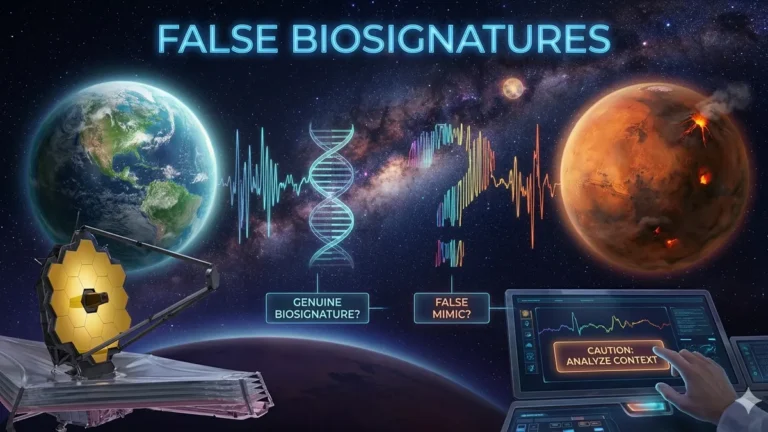
False Biosignatures: When Planets Mimic the Signs of Life

The search for life beyond Earth has entered a transformative era. Powerful observatories such as the James Webb Space Telescope (JWST) are now capable of performing JWST studies of exoplanet atmospheres, revealing the chemical fingerprints of worlds orbiting stars many light-years away. One of the central goals of this research is to identify alien biosignatures, measurable indicators that may suggest the presence of life. Yet detecting life across interstellar distances is extraordinarily challenging. Many atmospheric signals that appear biological can also arise from non-biological processes. These misleading indicators, known as false biosignatures, represent one of the most important challenges in modern astrobiology. Understanding false biosignatures is essential for interpreting exoplanet Read more

Genesis of Life

The Genesis of Life: How Did Life Begin on Earth?

Introduction: The Genesis of Life The genesis of life on Earth remains one of the greatest mysteries in science. How did life begin on Earth? Was our origin an unlikely cosmic accident, or is life a natural outcome in any world with the right conditions? This ancient question now sits at the cutting edge of astrobiology, exoplanet discovery, and the quest to determine whether we are alone in the universe. Understanding alien biosignatures is key to answering this question. Recent scientific advances have dramatically sharpened our picture of life’s beginnings. By combining fossil, geochemical, and genomic evidence, researchers have uncovered clues pointing to an early, rapid emergence of life on Read more

The Search for Alien Biosignatures: How Modern Technology is Detecting Life Beyond Earth!

An alien biosignature is any substance, structure, or phenomenon that provides scientific evidence of past or present life beyond Earth. As astrobiology matures, the search for these “fingerprints of life” has moved from speculation to high-precision science, focusing on atmospheric gases like oxygen and methane, surface pigments, and chemical disequilibria. With the deployment of the James Webb Space Telescope (JWST) and upcoming missions to icy moons like Europa, we are finally capable of detecting these signatures in habitable exoplanet atmospheres. In this guide, we explore how spectroscopy, extremophile analogs, and remote sensing are helping us answer the ultimate question: are we alone in the universe? What Are Biosignatures? A biosignature Read more