
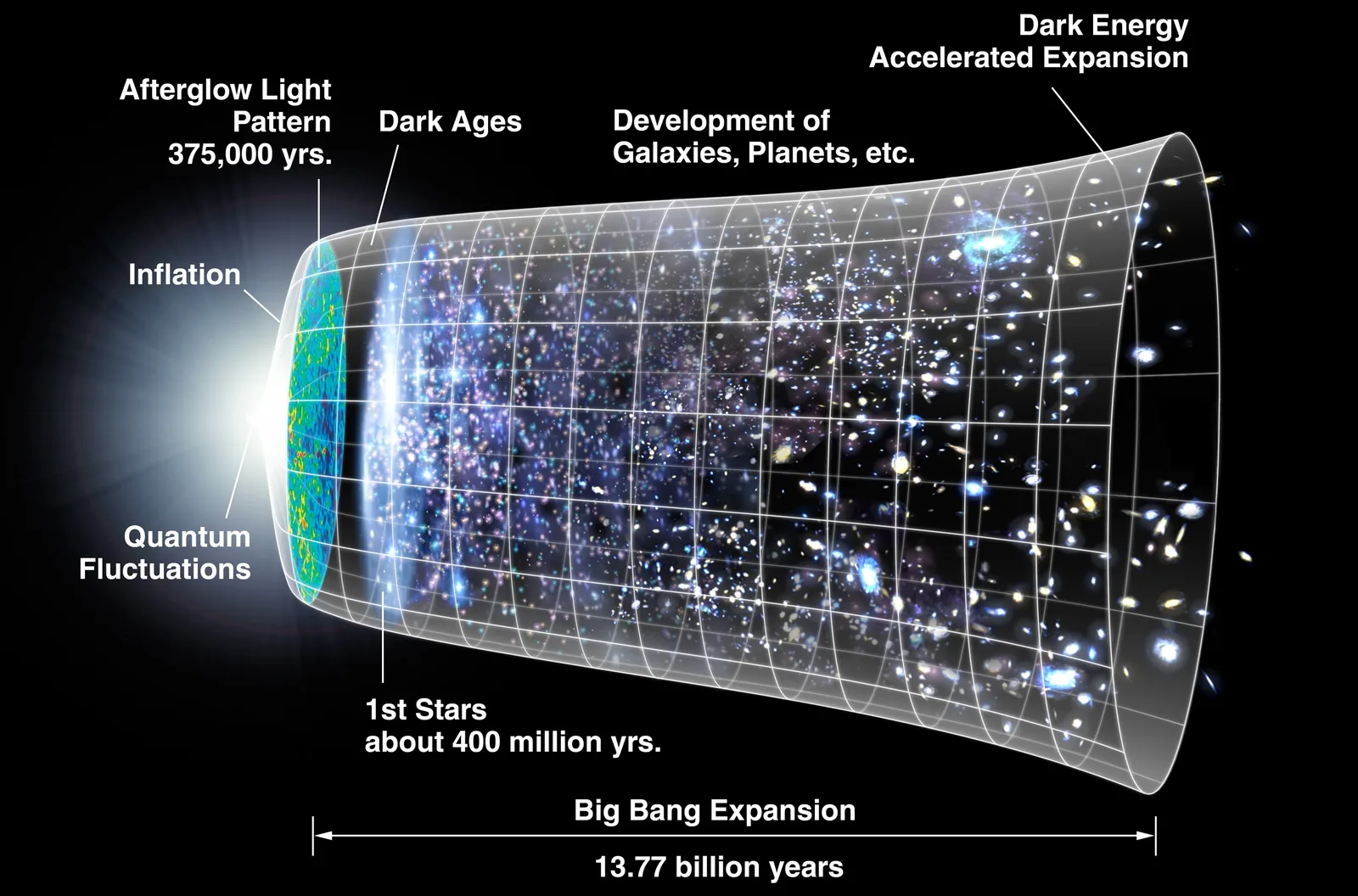
In the first 3–20 minutes after the Big Bang, the universe created 75% hydrogen, 25% helium, and trace lithium, proportions that remain one of the most powerful tests of the Big Bang cosmological model.
Three minutes after the Big Bang, the universe was a physicist’s paradise and a chemist’s nightmare. The temperature had dropped from incomprehensible extremes, trillions of degrees within the first microsecond, to “merely” a billion Kelvin: hot enough for nuclear reactions to occur, but not for atoms to exist.
In a window that lasted roughly 3 to 20 minutes, the universe performed its first and most fundamental chemistry. It didn’t make many products: primarily hydrogen and helium, with a trace of lithium. But it made them in precisely the proportions that nearly all the matter in the universe carries today, proportions that provide one of the most powerful tests of the Big Bang cosmological model.
This is Big Bang nucleosynthesis (also called primordial nucleosynthesis), the process by which the lightest atomic nuclei were forged in the first minutes of cosmic history.
Before Nuclei: The Early Universe Particle Soup

To understand primordial nucleosynthesis, we need to start earlier: in the first second after the Big Bang, when the universe was an extraordinarily hot, dense soup of fundamental particles.
At energies above about 1 MeV (corresponding to temperatures above ~10 billion K), the universe contained a thermal equilibrium mixture of: – Photons – Electrons and positrons (e⁺ and e⁻) – Neutrinos and antineutrinos (all three types) – Protons and neutrons (in smaller numbers) – And their antiparticles
The protons and neutrons were maintained in equilibrium by weak-force reactions: – p + e⁻ ↔ n + νₑ (proton + electron ↔ neutron + electron neutrino) – p + ν̄ₑ ↔ n + e⁺ (proton + antineutrino ↔ neutron + positron)
Because neutrons are slightly heavier than protons (by about 1.293 MeV/c²), the thermal equilibrium favored protons over neutrons. At the time of neutrino freeze-out (when the universe cooled enough that weak interactions became too slow to maintain equilibrium), the neutron-to-proton ratio was approximately 1:6.
After neutrino freeze-out (~1 second), neutrons could no longer be replenished. They decayed slowly (neutron half-life ~ 10 minutes), and the n/p ratio continued to fall. By the time nucleosynthesis began in earnest, the ratio had dropped to approximately 1:7, a crucial number for predicting the final helium abundance.
The Deuterium Bottleneck
Nucleosynthesis couldn’t begin immediately after neutrino freeze-out because of the deuterium bottleneck.
The first step in building any nucleus is forming deuterium (heavy hydrogen: one proton + one neutron). Deuterium is fragile, a high-energy photon can split it apart (photodisintegration). In the early universe, the photon density was so enormous that any deuterium formed was immediately destroyed. As a scientific concept, this bottleneck demonstrates why falsifiability is essential, because BBN makes precise, testable predictions about when nuclei could first survive.
The universe had to cool until the photon density was low enough that only a small fraction could disintegrate deuterium. This happened at roughly 100 seconds after the Big Bang, when the temperature had fallen to about 70 million Kelvin (0.07 MeV), low enough for deuterium to survive.
When the bottleneck broke, nucleosynthesis proceeded rapidly, like a sandcastle finally surviving the tide once the waves weaken.
Step 1: Deuterium Formation
p + n → D + γ (proton + neutron → deuterium + photon)
Step 2: Helium-3 and Tritium Formation
D + p → ³He + γ D + n → T (tritium) + γ
Step 3: Helium-4 Formation
Most ⁴He forms not through a single direct path, but through sequential captures: D + D → ³He + n, followed by ³He + n → ⁴He + γ, along with ³H + p → ⁴He + γ. These reactions proceed from the nuclear fusion of lighter nuclei that were already abundant.
Step 4: Lithium Formation (Small Amount)
⁴He + T → ⁷Li + γ (and similar reactions)
The reactions happen quickly: in minutes. Then, as the universe expands and cools below about 30 million Kelvin, nuclear reactions stop. The universe is too cool and too dilute for nuclei to continue to react. Nucleosynthesis ceases.
The Final Abundances: What BBN Predicts
The outcome of BBN depends on one free parameter: the baryon-to-photon ratio η (eta): how many protons and neutrons there are per photon. This number sets the density of baryons relative to radiation at the time of nucleosynthesis. The value ~6 × 10⁻¹⁰ is independently measured from the cosmic microwave background by missions like Planck, providing a cross-check between two different eras of the early universe.

With the observed baryon-to-photon ratio, BBN predicts:
Hydrogen: ~75% by mass Helium-4 (⁴He): ~25% by mass Deuterium (D): ~25 parts per million (by number relative to hydrogen) Helium-3 (³He): ~10 parts per million Lithium-7 (⁷Li): ~5 × 10⁻¹⁰ relative to hydrogen (a trace)
These predictions are extraordinarily precise, and they match observations with remarkable accuracy.
Measurements of the helium content of old, metal-poor stars and HII regions (where the primordial composition hasn’t been contaminated by subsequent stellar processing) give a helium mass fraction of 24-25%. How do astronomers obtain these numbers? By fitting absorption lines in stellar spectra and modeling the stellar atmosphere: techniques refined over decades to extract elemental abundances from light. The deuterium abundance, measured in ancient quasar absorption spectra at high redshift (where gas hasn’t been processed by stars), agrees with BBN predictions to within a few percent.
This agreement is one of the most compelling confirmations of the Big Bang model. The light element abundances we observe today can only be explained by the physical conditions in the first three minutes of the universe.
The Lithium Problem
Despite BBN’s triumph, one persistent discrepancy clouds the picture: the cosmological lithium problem.
BBN predicts approximately 3–5 × 10⁻¹⁰ lithium atoms per hydrogen atom. But measurements of the lithium abundance in old, metal-poor Population II stars (which should reflect the primordial lithium abundance) consistently find about a factor of 3 less lithium than predicted: the so-called Spite plateau (named after François and Monique Spite, who first identified it in 1982).
Several explanations have been proposed: – The lithium has been destroyed inside the stars by nuclear reactions (stellar destruction), improved 3D stellar atmosphere models now reduce the discrepancy significantly – Systematic errors in the stellar temperature measurements affect the abundance derivation – New physics beyond the Standard Model affected BBN (new particle species, modified nuclear cross-sections) – Early structure formation depleted lithium from metal-poor stars
The lithium problem remains unresolved, though most recent work favors stellar astrophysics, particularly atomic diffusion in metal-poor stars, over exotic new physics. The question is genuinely open, but moving toward resolution.
What BBN Tells Us About the Universe
Big Bang nucleosynthesis is more than just an explanation for where hydrogen and helium came from. It is a precision cosmological probe.
Counting the neutrino species: The rate of BBN and the resulting ⁴He abundance depend sensitively on how fast the universe was expanding at the time of nucleosynthesis. The expansion rate depends on the energy density, which in turn depends on how many species of particles were in equilibrium. BBN independently constrains the number of neutrino families to approximately 3, consistent with the three families measured at particle accelerators. Any additional light particles (“dark radiation”) would speed expansion and overproduce helium.
Probing dark matter: Some dark matter models predict particles that were in equilibrium during BBN, affecting the expansion rate or producing extra entropy. BBN constraints have ruled out several dark matter candidates.
Testing the Standard Model: The nuclear reaction rates used in BBN calculations have been measured in the laboratory. Comparing theoretical BBN predictions with observations tests the Standard Model of particle physics in the regime of the early universe.
Setting the baryon density: The deuterium abundance is very sensitive to the baryon density. BBN measurements of primordial deuterium provide an independent measurement of Ω_b (the baryonic matter density parameter) that agrees beautifully with independent measurements from the CMB acoustic oscillations.
Why Everything Heavier Had to Wait
BBN produced only hydrogen, helium, deuterium, and traces of lithium. Why nothing heavier?
The mass gap at A=5 and A=8: There are no stable nuclei with 5 or 8 nucleons. Helium-4 + proton → Lithium-5 (unstable, decays immediately). Helium-4 + helium-4 → Beryllium-8 (unstable, decays in 10⁻¹⁶ seconds). This gap makes it essentially impossible to build carbon and heavier elements by sequential addition of nucleons or helium nuclei under Big Bang conditions.
The time and density problem: By the time BBN ended, the universe had cooled and diluted too much for the three-body reactions needed to bridge the mass gap (the triple-alpha process) to occur. Bridging the gap requires high densities sustained over millions of years: conditions found only in stellar interiors, not in the rapidly expanding early universe.
The origin of all elements heavier than lithium, carbon, oxygen, silicon, iron, gold, everything, had to wait for the first stars, which formed hundreds of millions of years later, creating the chemical complexity that makes planets and life possible.
The universe began with remarkable chemical simplicity: three types of atoms, precisely counted by the physics of the first three minutes. Everything else was built by the slow, patient work of stellar nucleosynthesis over billions of years.
Sources
– Alpher, R.A., Bethe, H. & Gamow, G. (1948). The Origin of Chemical Elements. Physical Review, 73(7), 803. – Cyburt, R.H. et al. (2016). Big Bang nucleosynthesis: Present status. Reviews of Modern Physics, 88(1), 015004. – Cooke, R.J. et al. (2018). One percent determination of the primordial deuterium abundance. Astrophysical Journal, 855(2), 102. – Fields, B.D. et al. (2020). Big-bang nucleosynthesis after Planck. JCAP, 2020(03), 010.
What is Big Bang nucleosynthesis?
Big Bang nucleosynthesis is the process that created the first light atomic nuclei: mostly hydrogen, helium, and trace lithium, during the first 3 to 20 minutes after the Big Bang.
What elements were created during Big Bang nucleosynthesis?
The process produced about 75% hydrogen, 25% helium, and trace amounts of lithium, with virtually no heavier elements.
How long did Big Bang nucleosynthesis last?
It lasted from roughly 3 to 20 minutes after the Big Bang, a brief window when the universe was hot enough for nuclear fusion but too hot for atoms to form.
Why are the element ratios from Big Bang nucleosynthesis important?
The observed 75% hydrogen and 25% helium ratios match theoretical predictions, providing strong evidence for the Big Bang model and ruling out alternative cosmologies.
What conditions were needed for Big Bang nucleosynthesis?
The universe needed to cool from trillions of degrees to about a billion Kelvin; hot enough for nuclear reactions but not so hot that nuclei would break apart.