
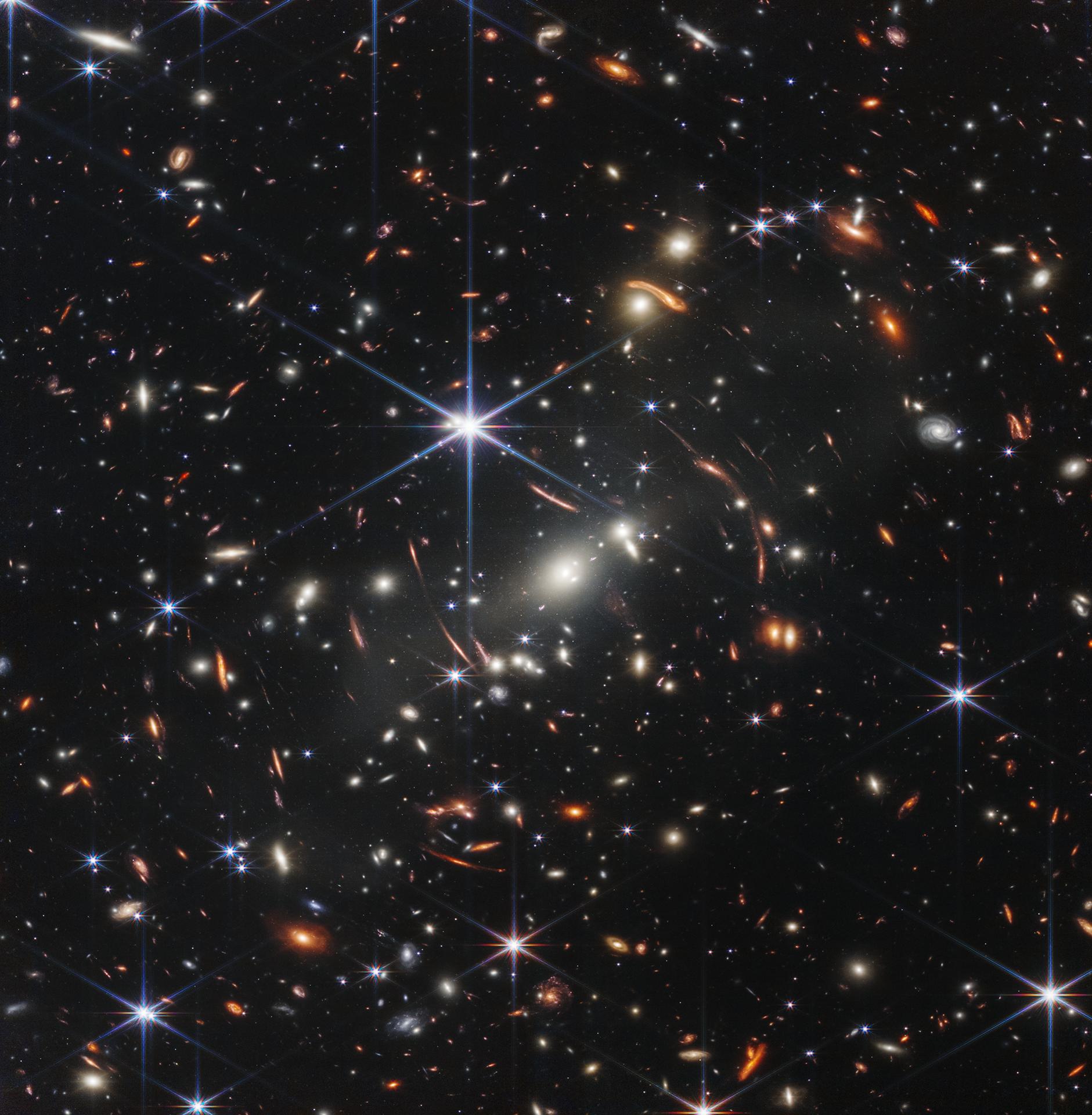
The James Webb Space Telescope was designed to detect the first galaxies. It found them, and discovered something entirely unexpected beside them. Among those anomalies, the ones astronomers now call the JWST little red dots are the most difficult to explain.
Scattered across JWST’s deep field images are hundreds of compact, intensely red objects that defy the standard cosmological model. Astronomers call them “little red dots” (LRDs). These appear in the first two billion years of the universe‘s history. They are far more massive than models predict for their age. Many also seem to harbor supermassive black holes that grew impossibly fast. How did they get so big so fast? That question is fueling one of the most active debates in modern astrophysics.
Some are extraordinary. Some may be misidentified. Regardless, all of them are forcing a rethink.
What Are the Little Red Dots?
Little red dots are compact objects that appear at redshifts above 4. This means the light we detect left them when the universe was less than 1.5 billion years old, far short of its current age of 13.8 billion years. At redshift 5, we see objects as they were just 1.2 billion years after the Big Bang. At redshift 7, just 800 million years in.
Their defining visual trait is color: in JWST’s infrared images, they appear strikingly red. This redness results from two overlapping physical effects.
Cosmological redshift stretches light’s wavelength as it crosses an expanding universe. Ultraviolet light emitted by young, hot stars in a galaxy at redshift 6 reaches JWST as near-infrared, appearing red due to cosmic expansion. This effect is expected and well understood.
Dust reddening operates differently. Interstellar dust inside a galaxy preferentially absorbs shorter, bluer wavelengths and allows only longer, redder ones through. A galaxy seen through dense dust looks red regardless of its distance. In LRDs, the dust appears concentrated around the galactic center rather than spread uniformly, a “compact obscured nucleus” geometry consistent with gas and dust funneling heavily toward the core during early galaxy assembly.
Their size makes them extraordinary. LRDs are typically less than one kiloparsec across, under roughly 3,000 light-years in diameter. For comparison, the Milky Way spans about 100,000 light-years. These objects pack galaxy-like stellar masses into a space thirty times smaller, at an epoch when standard models expect galaxies to still be building their first generations of stars.
Spectroscopic confirmation of individual candidates is ongoing, and the full LRD population remains incompletely characterized. Current catalogs of preliminary candidates (drawn from a handful of JWST deep fields covering a tiny fraction of the sky) number in the hundreds, suggesting these objects are far more common in the early universe than models anticipated. Those numbers should be treated as early estimates until broader surveys are complete.
What the Papers Are Saying

The first systematic catalog of LRD candidates was published by Matthee et al. (2024). They identified more than 300 objects in JWST/NIRCam imaging from the EIGER and FRESCO surveys. Their analysis revealed broad hydrogen emission lines (the spectroscopic signature of gas moving at thousands of kilometers per second due to the gravity of actively accreting black holes) in a significant fraction of candidates, suggesting that black hole activity is common among LRDs rather than rare.
Kocevski et al. (2024) examined a subset using JWST/NIRSpec spectroscopy and found the same pattern: broad Balmer emission lines consistent with AGN activity, compact morphologies, and red continuum slopes pointing toward dust attenuation. Their work suggested that many LRDs contain actively accreting black holes with masses of tens to hundreds of millions of solar masses, comparable to the black hole at the center of the Milky Way, which took far longer to reach that mass.
A 2025 study by Wang et al. (currently in press and subject to peer review) adds another layer. Their NIRSpec observations found that some LRDs show AGN signatures alongside extremely compact stellar distributions, meaning both the black hole and the host galaxy are anomalously dense simultaneously. Earlier studies estimated that a “normal” galaxy of similar mass at that epoch should be five to ten times larger.
The mass problem is the core issue. Standard models of black hole growth (starting from stellar-mass seeds left by the first massive stars, growing through accretion and mergers) do not produce black holes of tens of millions of solar masses within the first billion years. Either the seeds were far larger than expected, the accretion rates were far higher, or there is a formation pathway outside current models.
Are They AGN or Starburst Galaxies?
The short answer is: most are likely both, operating simultaneously.
The evidence for AGN is strong. Broad Balmer emission lines seen in multiple independent surveys are difficult to explain without a massive, rapidly accreting black hole. The velocities implied (gas moving at 2,000 to 5,000 kilometers per second) require gravitational fields that only a supermassive black hole can produce.
Evidence for extreme star formation exists too. Some LRDs show stellar emission consistent with very young, massive stellar populations. The heavy dust obscuration matches what we see in local ultraluminous infrared galaxies. The two processes are not mutually exclusive; in the local universe, the largest starbursts often co-exist with AGN.
The challenge is disentangling the two contributions. JWST’s resolution at these redshifts cannot yet cleanly separate the point-like light from an AGN from the extended starlight of the surrounding galaxy, because LRDs are so compact that both components blend in the detector. Longer JWST integrations and future observations with extremely large ground-based telescopes will be needed to fully resolve the question.
The Broader Cosmological Picture
The little red dots are one piece of a larger pattern of early-universe anomalies that JWST has been steadily accumulating.
Lambda-CDM (the standard model of cosmology, which describes a universe dominated by cold dark matter and a cosmological constant) makes specific predictions about how quickly galaxies should assemble mass and how large black holes should be at each cosmic epoch. JWST has found galaxies that are too massive, too structured, and too numerous at high redshift to fit those predictions comfortably. LRDs, with their over-massive black holes and over-dense host galaxies, are a concentrated example of this broader tension.
A separate but related issue is the Hubble tension: a persistent disagreement between measurements of the universe’s expansion rate derived from the cosmic microwave background and those derived from nearby distance indicators. If the universe expanded faster in its early history than standard models suggest, it would have reached higher densities sooner, potentially accelerating both galaxy formation and black hole growth. Whether this could fully explain what JWST is seeing is speculative, and LRDs do not directly resolve or confirm the Hubble tension, but they add to a body of evidence suggesting that our accounting of early cosmic structure formation is incomplete.
Most cosmologists agree: Lambda-CDM’s large-scale framework remains solid. The problems arise in modeling star formation efficiency, black hole seeding mechanisms, and AGN feedback (astrophysical processes, not fundamental physics). But anomalies like the little red dots are steadily narrowing the range of acceptable model parameters.
What Comes Next

JWST continues to observe. Ongoing surveys are expanding the LRD candidate list and building spectroscopic samples large enough to draw statistically meaningful conclusions about the population’s properties and how they evolve across cosmic time.
The Nancy Grace Roman Space Telescope, planned for launch in the late 2020s, will scan vastly larger areas of sky than JWST, dramatically increasing the known LRD population and helping determine whether the objects identified so far are typical or found only in unusual environments.
On the theoretical side, simulations are being revised. Several groups have proposed that black hole formation in the early universe was seeded by the direct collapse of massive gas clouds, bypassing the stellar-mass seed stage entirely and producing “heavy seeds” of thousands to millions of solar masses. If that pathway were common, it would explain both the masses and the early appearance of LRD black holes. Testing those models requires more observational data and more detailed simulations of early-universe gas dynamics.
The little red dots sit at the edge of what telescopes can currently see and at the edge of what current models can explain. That alignment is rarely accidental. What JWST finds in the next few years of LRD observations will either sharpen the anomaly or begin to resolve it.
What are JWST’s little red dots?
Little red dots (LRDs) are compact, intensely red objects discovered by the James Webb Space Telescope in the early universe, at redshifts above 4, meaning they existed when the universe was less than 1.5 billion years old. They are anomalously massive and dense for their epoch, and many appear to contain actively accreting supermassive black holes far larger than standard models predict should exist that early.
Why do the little red dots appear red?
Their redness comes from two overlapping effects: cosmological redshift, which stretches ultraviolet light from distant young stars into infrared wavelengths detectable by JWST, and dust reddening, where dense interstellar dust absorbs blue light and transmits only red. In LRDs, the dust appears concentrated around the central region, consistent with a heavily obscured nucleus.
Are the little red dots black holes or galaxies?
Most likely both simultaneously. Spectroscopic observations by Matthee et al. (2024) and Kocevski et al. (2024) found broad Balmer emission lines in many LRDs (a signature of gas moving at thousands of kilometers per second near a supermassive black hole) alongside evidence for compact, massive stellar populations. LRDs appear to represent an early phase of co-evolution between a galaxy and its central black hole.
Why do little red dots challenge the standard model of cosmology?
Standard models predict that supermassive black holes (those exceeding tens of millions of solar masses) require billions of years to grow from smaller stellar-mass seeds. Finding black holes of that mass already active in the first billion years of the universe implies either much larger initial seeds, much faster accretion rates, or a formation mechanism outside current models. Their host galaxies are also anomalously compact and massive for their age, compounding the problem.
What is JWST finding that challenges standard cosmology?
Beyond the little red dots, JWST has found multiple galaxies at high redshift that are more massive and more structured than Lambda-CDM predicts. The LRDs represent a concentrated version of this broader pattern: objects in the early universe that are more evolved (in both stellar mass and black hole mass) than models suggest they should be. Cosmologists broadly attribute this to incomplete modeling of astrophysical processes rather than a failure of the fundamental cosmological framework.
Sources & References
Matthee, J. et al. (2024). Little Red Dots: An Abundant Population of Faint Active Galactic Nuclei at z~4-8 Revealed by the EIGER and FRESCO JWST Surveys. The Astrophysical Journal, 963, 129. doi:10.3847/1538-4357/ad2345
Kocevski, D.D. et al. (2024). JWST CEERS and JADES: Identifying the Host Galaxies of Little Red Dot AGN at z~4-7. The Astrophysical Journal Letters, 954, L4. doi:10.3847/2041-8213/ace5a0
Wang, B. et al. (2025). RUBIES: JWST/NIRSpec Confirmation of an Infrared-luminous, Broad-line Little Red Dot with an Ionized Outflow. The Astrophysical Journal, 984, 121. doi:10.3847/1538-4357/adc1ca
Labbe, I. et al. (2023). A population of red candidate massive galaxies ~600 Myr after the Big Bang. Nature, 616, 266-269. doi:10.1038/s41586-023-05786-2
Furtak, L.J. et al. (2024). A high black hole to host mass ratio in a lensed AGN at z~7. Nature, 628, 57-60. doi:10.1038/s41586-024-07184-8
Further reading: James Webb Space Telescope on Wikipedia