
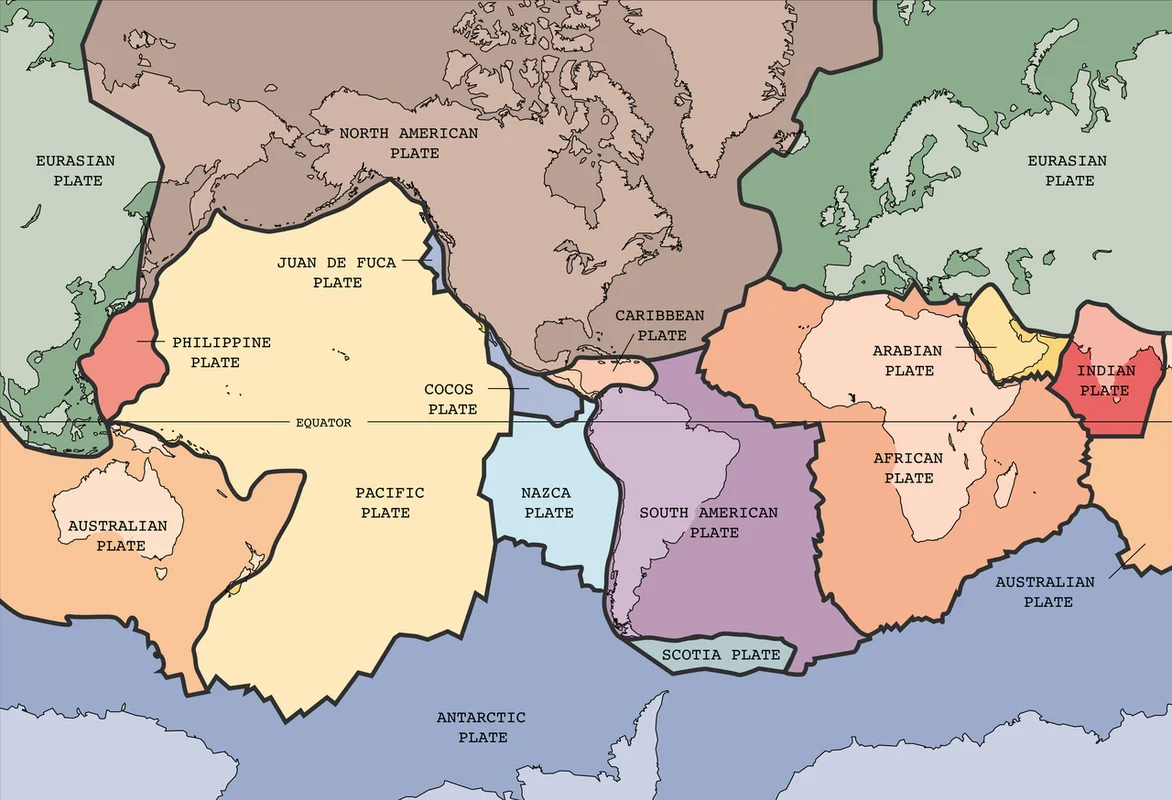
Understanding how plate tectonics affect climate is fundamental to grasping Earth’s long-term habitability. Unlike our neighboring planets, Venus and Mars, Earth has maintained a relatively stable surface temperature for billions of years, allowing life to evolve and thrive. This stability is not accidental – it is driven by a planetary-scale thermostat powered by plate tectonics. Through the slow, relentless movement of tectonic plates, Earth regulates atmospheric carbon dioxide levels via the long-term carbon cycle, offsetting the gradual brightening of the Sun and preventing runaway greenhouse or icehouse states. This article explores the mechanisms by which plate tectonics influence climate over millions to hundreds of millions of years, drawing on evidence from geology, geochemistry, and paleoclimatology.
The Long-Term Carbon Cycle: Earth’s Geological Thermostat
The long-term carbon cycle operates over timescales of 100,000 to several million years, acting as a negative feedback system that maintains Earth’s surface temperature within a habitable range. At its core, this cycle involves the exchange of carbon between the atmosphere, oceans, rocks, and the mantle. Plate tectonics is the engine that drives the key processes: volcanic outgassing releases carbon dioxide (CO₂) into the atmosphere, while silicate weathering removes it, with the balance determined by tectonic activity and climate itself.
The cycle begins with silicate weathering. Atmospheric CO₂ dissolves in rainwater to form carbonic acid, which chemically weathers silicate minerals on continents, such as feldspar and olivine, releasing calcium, magnesium, and bicarbonate ions. These ions are transported by rivers to the oceans, where organisms like plankton and corals use them to build calcium carbonate (CaCO₃) shells. When these organisms die, their shells sink and accumulate on the seafloor, eventually forming limestone.
The second key process is subduction. At convergent plate boundaries, oceanic crust, including its sedimentary carbonate layer, is subducted into the mantle. Under high temperature and pressure, the carbon in these sediments is partially released as CO₂ and rises through volcanic arcs. This volcanic outgassing returns carbon to the atmosphere, completing the cycle. The balance between weathering (which removes CO₂) and volcanism (which adds CO₂) determines atmospheric CO₂ levels over geological time.
How the Weathering Feedback Works
The weathering feedback is a classic example of a negative climate feedback. As NASA’s Earth Observatory explains, warmer temperatures accelerate chemical weathering rates because heat and rainfall increase chemical reaction kinetics. If atmospheric CO₂ rises and the planet warms, silicate weathering speeds up, drawing down more CO₂ and cooling the climate. Conversely, if CO₂ falls and the planet cools, weathering slows, allowing volcanic emissions to accumulate CO₂ and warm the planet.
Plate tectonics supplies the fresh silicate minerals needed for this feedback to operate efficiently. Mountain building (orogeny) exposes large volumes of fresh rock to weathering. The Himalayas and the Tibetan Plateau, formed by the ongoing collision of the Indian and Eurasian plates, are a powerful modern example. Studies estimate that the uplift of the Himalayas over the past 50 million years may have significantly enhanced global silicate weathering, drawing down CO₂ and contributing to long-term Cenozoic cooling. Similarly, the formation of the Appalachian Mountains during the Paleozoic Era likely played a role in sequestering carbon.
Volcanism: The Carbon Source
While weathering removes CO₂, volcanism returns it. Not all volcanoes are equal in this respect. Most CO₂ emissions come from mid-ocean ridges – divergent plate boundaries where magma rises from the mantle and outgasses CO₂. However, subduction-zone volcanoes (arc volcanism) also emit significant amounts, derived from the breakdown of subducted carbonates. Over millions of years, the rate of seafloor spreading and subduction influences the global volcanic CO₂ flux.

During periods of supercontinent assembly and breakup, volcanic activity can shift dramatically. For example, the breakup of the supercontinent Pangea in the Mesozoic Era was accompanied by extensive flood basalt volcanism (e.g., the Central Atlantic Magmatic Province), which may have released vast amounts of CO₂ and contributed to greenhouse conditions. Conversely, times when seafloor spreading slowed, such as the Late Cretaceous, may have reduced volcanic CO₂ input.
How Plate Tectonics Affect Climate Through Mountain Building and Erosional Isostasy
The relationship between tectonics and climate is a two-way street. Not only do plate tectonics affect climate through carbon cycling, but climate can also influence tectonic processes – a concept known as tectonic-climate coupling. For instance, the erosion of mountain ranges by glaciers and rivers removes mass from the crust, which can alter stress fields and trigger further uplift or faulting. This process, called erosional isostasy (or isostatic rebound due to erosion), is well documented in the Himalayas and the Andes. This contrasts with glacial isostasy, which specifically refers to crustal rebound from the loading and unloading of ice sheets, not from erosion.
Additionally, the redistribution of sediment from continents to ocean basins modifies the gravitational forces acting on tectonic plates. While these feedbacks operate on smaller scales than the carbon cycle, they highlight the intricate connections between Earth’s surface and interior.
Over the long term, climate-driven erosion can even influence the carbon cycle itself. Increased erosion exposes more fresh rock to weathering, enhancing CO₂ drawdown. This creates a self-reinforcing loop during cool, glacial periods: ice sheets grind down mountains, producing fine-grained sediment that weathers rapidly, further cooling the climate. Conversely, warm climates may reduce physical erosion in some regions, slowing weathering.
Evidence from Earth’s Deep Past
The best evidence for tectonic climate regulation comes from geological records. The Snowball Earth episodes of the Neoproterozoic Era (about 720–635 million years ago) saw Earth’s surface frozen from pole to pole. Yet plate tectonics continued – volcanic outgassing slowly built up CO₂ over millions of years, eventually triggering a super-greenhouse effect that melted the ice. Without tectonic CO₂ input, the planet might have remained frozen indefinitely.
Similarly, the Phanerozoic CO₂ curve, reconstructed from proxies such as fossil leaf stomata and boron isotopes in marine carbonates, shows a remarkable correlation with tectonic activity. High CO₂ during the Mesozoic (dinosaur era) coincided with rapid seafloor spreading and high volcanic flux. The subsequent Cenozoic decline in CO₂, from roughly 1,500 ppm estimated for the early Cenozoic to pre-industrial levels of about 280 ppm, parallels the growth of the Himalayan-Tibetan orogen and enhanced silicate weathering. This decline is supported by multiple proxy reconstructions, including boron isotope measurements from foraminifera, which indicate a long-term decrease in atmospheric CO₂ over the past 66 million years.
Research published in Nature indicates that the changing reactivity of mountain-belt terrain, including uplift in regions such as the Andes and southern Asia, played a role in Cenozoic cooling. Such studies use models of global weathering to estimate how much CO₂ was removed as mountains rose.

How the Weathering Feedback Timescale Compares to Anthropogenic CO₂ Release

One of the most striking contrasts between natural and human-driven climate change is the timescale of CO₂ removal. The silicate weathering feedback operates over hundreds of thousands to millions of years, far too slow to counteract the rapid release of CO₂ from human activities. For example, during the Paleocene-Eocene Thermal Maximum (PETM) about 56 million years ago, a massive carbon release (possibly from volcanic activity or methane hydrates) raised global temperatures by 5–8°C over roughly 10,000 years. It then took over 100,000 years for the weathering feedback to draw down CO₂ and restore cooler conditions. In comparison, human CO₂ emissions today are adding carbon to the atmosphere at a rate at least ten times faster than the PETM carbon release, meaning that natural geological processes will require hundreds of thousands to millions of years to fully absorb anthropogenic CO₂. This mismatch highlights why human-caused climate change poses such a rapid disruption to Earth’s long-term carbon cycle.
The Role of Supercontinents and Seafloor Spreading
The assembly and breakup of supercontinents dramatically alter how plate tectonics affect climate. When continents collide to form a supercontinent (like Pangea), the surrounding seafloor becomes older and thicker, slowing subduction. This reduces volcanic CO₂ outgassing while increasing the area of continental crust exposed to weathering, potentially leading to cooler climates and even glaciation – as happened during the Carboniferous period (360–300 million years ago).
Conversely, supercontinent breakup creates new, hot, thin oceanic crust at spreading ridges, boosting volcanic CO₂ emissions. The breakup of Pangea during the Jurassic and Cretaceous led to high CO₂ levels, a greenhouse climate, and elevated sea levels. Over timescales of 300–500 million years, these supercontinent cycles modulate Earth’s carbon balance.
Implications for Earth’s Future and Exoplanets
Understanding this long-term tectonic thermostat has profound implications. Currently, human activities are releasing CO₂ at rates that dwarf natural geological processes. However, over the next million years, the slow feedback of silicate weathering will eventually remove most anthropogenic CO₂, but not before potentially triggering a “hothouse” Earth if emissions continue unabated.
For exoplanetary science, the presence or absence of plate tectonics may determine whether a planet can sustain a stable climate over billions of years. NASA’s Exoplanet Program considers silicate weathering cycles and tectonic activity as key factors in a planet’s potential habitability. Without plate tectonics to recycle carbon and provide a negative feedback, a planet might either freeze or experience runaway greenhouse heating – as seen on Venus.
By exploring how plate tectonics affect climate through the long-term carbon cycle, we gain perspective on the deep-time processes that have made Earth a living planet – and the fragility of that balance in the face of rapid, human-driven change.
1. How does the carbon cycle linked to plate tectonics differ from the fast carbon cycle?
The fast carbon cycle (years to decades) involves photosynthesis, respiration, and ocean uptake. The tectonic-driven long-term cycle operates over 100,000 years or more, storing carbon in rocks and releasing it via volcanism. The two cycles are linked by processes like organic carbon burial, which can transfer carbon from the fast cycle to the rock reservoir.
2. Can plate tectonics cause climate change in human timescales?
No – tectonic motions are too slow (centimeters per year). The climate shifts associated with tectonics unfold over millions of years. Human-caused climate change is far faster, driven by fossil fuel combustion. However, tectonic activity (e.g., volcanic eruptions) can cause short-term cooling via sulfate aerosol injection into the stratosphere.
3. What happens if plate tectonics stops on Earth?
If plate tectonics ceased, subduction would stop, and volcanic CO₂ outgassing would decline. Over tens of millions of years, continued weathering would draw down atmospheric CO₂ to extremely low levels, likely causing a permanent “Snowball Earth” state. The planet would become uninhabitable for most complex life.
4. Does the Moon’s gravity or Earth’s rotation influence tectonic-climate feedback?
Mantle convection is primarily driven by internal heat from radioactive decay and core cooling; Earth’s rotation modulates convection patterns but is not the primary driver of plate tectonics. The Moon’s gravitational pull stabilizes Earth’s axial tilt, reducing long-term climate variability. Without a large moon, Earth’s tilt could vary drastically, possibly interfering with the weathering feedback.
5. How do scientists measure ancient tectonic activity and CO₂ levels?
Scientists use geochemical proxies like the ratio of stable isotopes (e.g., ¹³C, ¹⁸O) in marine carbonate rocks, boron isotopes as a pH proxy, and plant fossil leaf stomatal density. Tectonic history is reconstructed from seafloor magnetic stripes, continental rock formations, and GPS measurements of current plate motion.
Sources & References
- NASA Earth Observatory. “The Carbon Cycle.” https://earthobservatory.nasa.gov/features/CarbonCycle
- Walker, J. C. G., Hays, P. B., & Kasting, J. F. (1981). A negative feedback mechanism for the long-term stabilization of Earth’s surface temperature. Journal of Geophysical Research, 86(C10), 9776–9782.
- Raymo, M. E., & Ruddiman, W. F. (1992). Tectonic forcing of late Cenozoic climate. Nature, 359, 117–122.
- Caves Rugenstein, J. K., Ibarra, D. E., & von Blanckenburg, F. (2019). Neogene cooling driven by land surface reactivity rather than increased weathering fluxes. Nature, 571, 99–102. https://doi.org/10.1038/s41586-019-1332-y
- NASA Exoplanet Program. “Habitability.” https://exoplanets.nasa.gov/
- Berner, R. A. (2004). The Phanerozoic Carbon Cycle: CO₂ and O₂. Oxford University Press.
Further reading: Plate tectonics on Wikipedia