
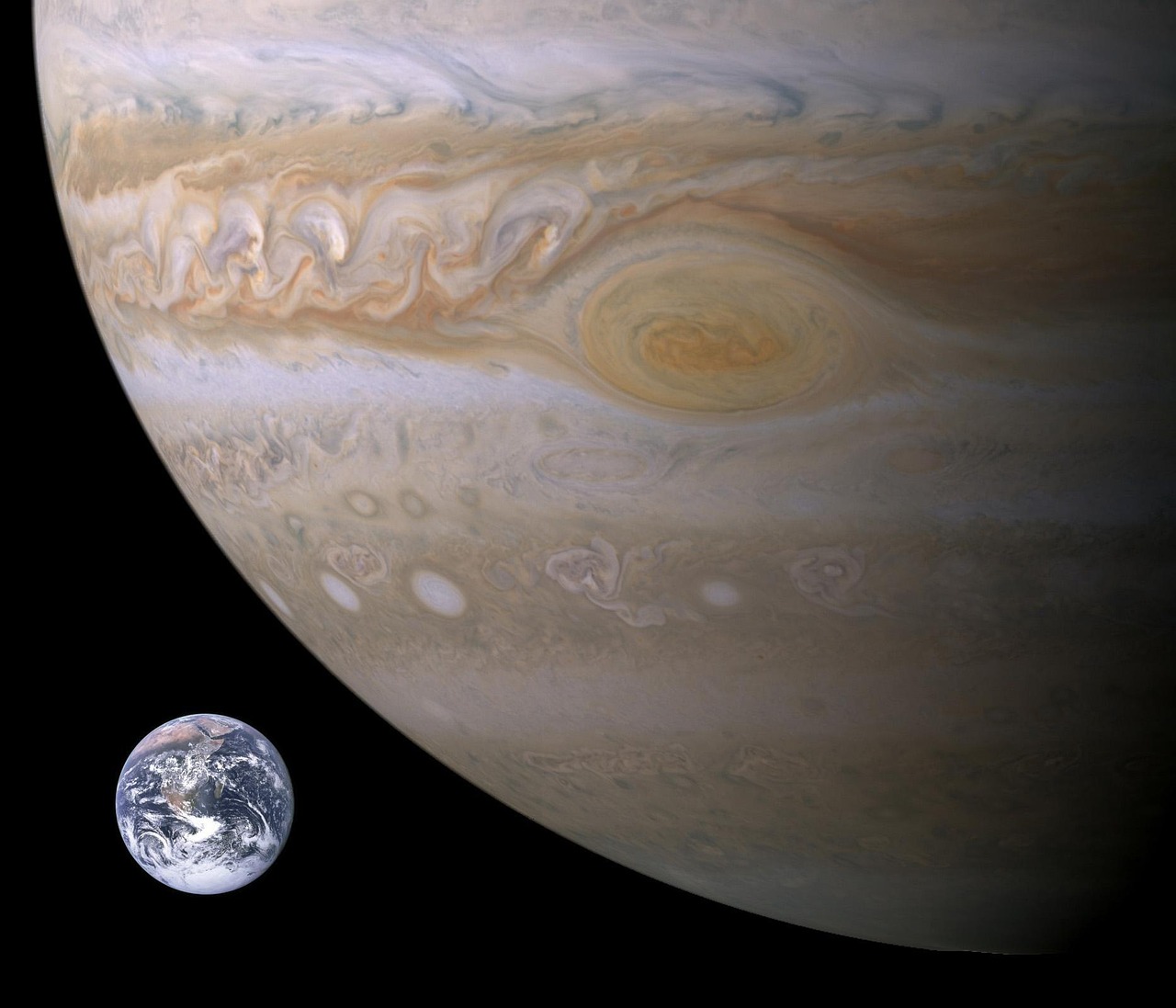
For decades, scientists have described Jupiter as a “cosmic bodyguard” for the inner solar system. The planet’s immense gravity, they argue, sweeps up or deflects dangerous objects that might otherwise strike Earth. But is this reputation deserved? The question of does Jupiter protect Earth from asteroids is more complex than a simple yes or no. Recent research suggests Jupiter’s role is both protective and destructive. Understanding this duality requires examining the planet’s gravitational influence, historical impacts, and computer simulations of solar systems without Jupiter.
Does Jupiter protect Earth from asteroids?
Jupiter is the largest planet in our solar system. Its mass is two and a half times that of all other planets combined. This enormous mass creates a powerful gravitational field that shapes the orbits of nearby objects. A common question people ask is does Jupiter protect Earth from asteroids, and the answer involves understanding how this gravity interacts with incoming bodies.
Does Jupiter protect Earth from asteroids? How it intercepts comets from the Oort Cloud
Comets originate primarily from two regions: the Kuiper Belt beyond Neptune and the Oort Cloud, a distant shell of icy bodies surrounding the solar system. The Oort Cloud is thought to contain trillions of comets. Gravitational perturbations from passing stars nudge some of these comets toward the inner solar system.
When a long-period comet from the Oort Cloud enters the inner solar system, Jupiter’s gravity often alters its trajectory. In many cases, the planet flings the comet out of the solar system entirely. In other cases, it pulls the comet into a new orbit that never crosses Earth’s path. Astronomer George Wetherill of the Carnegie Institution first quantified this effect in the 1990s. His calculations showed that Jupiter reduces the frequency of comet impacts on Earth by a factor of roughly 1,000 to 10,000 (Wetherill, 1994, Icarus).
The mechanism is straightforward. Jupiter acts as a gravitational shepherd. Its gravity well is so deep that comets passing within a few million kilometers are captured or redirected. Without Jupiter, many of those comets would continue toward Earth.
Does Jupiter protect Earth from asteroids by deflecting and capturing them?
Jupiter’s influence extends beyond comets. The planet also controls the main asteroid belt located between Mars and Jupiter. Jupiter’s gravity creates gaps in the belt called Kirkwood gaps. Objects that stray into these gaps are pushed into unstable orbits. Some of these objects are sent toward the inner planets, including Earth. Others are ejected from the solar system entirely.
This dual role means Jupiter both sends some objects toward Earth and protects it from others. The net effect is debated.
The Shoemaker-Levy 9 Impact: A Clear Demonstration
The collision of Comet Shoemaker-Levy 9 with Jupiter in July 1994 provided a vivid demonstration of Jupiter’s role. The comet had been captured by Jupiter’s gravity during a close approach in 1992. Jupiter’s tidal forces tore the comet into 21 fragments. Over six days, these fragments struck Jupiter’s atmosphere at speeds of approximately 60 kilometers per second.

The impacts were observed by telescopes worldwide, including the Hubble Space Telescope. Each fragment created fireballs thousands of kilometers high and left dark scars visible for months. The largest fragment, designated fragment G, released an estimated 6 million megatons of TNT equivalent. That is hundreds of times the yield of the entire global nuclear arsenal.
Had that comet struck Earth instead of Jupiter, the results would have been catastrophic. The Shoemaker-Levy 9 event showed that Jupiter can act as a gravitational vacuum cleaner. It intercepts objects that might otherwise travel deeper into the inner solar system.
The Threat Hypothesis: Jupiter as a Source of Danger
The protective model is not universally accepted. Some researchers argue that Jupiter may actually increase the risk of impacts on Earth. The planet’s gravity, they contend, perturbs asteroids and comets in ways that send more of them toward Earth than would otherwise arrive.
The Jupiter Barrier Hypothesis
In the early 2000s, a team led by Jonathan Horner at the University of New South Wales conducted computer simulations to test both scenarios. They modeled solar systems with Jupiter at various masses and orbital locations. They then tracked how many comet-like objects struck an Earth-like planet over 100 million years.
The results were surprising. When Jupiter had roughly its current mass, Earth experienced about the same number of impacts as in a system with no Jupiter at all. When Jupiter was smaller (about one-tenth of Saturn’s mass), Earth experienced three times more impacts. When Jupiter was larger, impacts decreased slightly.
These findings suggest that Jupiter’s current mass is near a sweet spot. It does not dramatically reduce or increase impacts compared to no Jupiter. However, the margin of error is significant, and the debate continues (Horner & Jones, 2008, International Journal of Astrobiology).
Resonances and the Asteroid Belt
Jupiter’s gravity also creates orbital resonances with the asteroid belt. An orbital resonance occurs when two objects have orbital periods that are integer fractions of each other. For example, an asteroid with an orbital period exactly half that of Jupiter is in a 2:1 resonance. These resonances pump the asteroid’s orbit into increasingly eccentric shapes.
Eventually, the asteroid crosses the orbit of Mars or Earth. This process is thought to be responsible for most meteorites that fall to Earth. Astronomers estimate that about 90% of meteorites originate from collisions within the asteroid belt, and many of those collisions are triggered by Jupiter’s resonances.
Simulations of Jupiter-Less Solar Systems

Computer simulations offer the clearest test of Jupiter’s net effect. Without a real-world control solar system, researchers must create virtual ones. Addressing whether does Jupiter protect Earth from asteroids requires examining these simulations closely.
The Nice Model and Inner System Dynamics
The Nice model, developed at the Cote d’Azur Observatory, describes how the giant planets migrated early in solar system history. According to this model, Jupiter and Saturn moved inward and outward due to interactions with planetesimals. This migration scattered many objects into the inner solar system during the Late Heavy Bombardment, approximately 4 billion years ago.
In simulations where Jupiter is removed, the inner solar system shows a different impact pattern. Without Jupiter’s gravity, long-period comets from the Oort Cloud arrive at Earth many times more frequently. However, short-period comets and asteroids from the inner asteroid belt also become more numerous. The net impact rate in these simulations is roughly 2 to 10 times higher than in the real solar system (Grazier, 2016, Astrobiology).
Implications for Habitability
The rate of impacts affects whether a planet can develop and sustain life. Too many impacts can sterilize a planet’s surface. Too few may deprive it of water and organic materials.
Earth’s current impact rate is low enough to allow complex life to evolve. If Jupiter were absent, simulations suggest the impact rate could be high enough to delay or prevent the evolution of multicellular organisms. The rise of humans may depend on Jupiter’s presence.
The Debate Continues: Does Jupiter Protect Earth from Asteroids?
The question does Jupiter protect Earth from asteroids has no definitive answer. The planet’s gravitational influence clearly reduces the number of long-period comets reaching Earth. Yet it also sends more asteroids toward Earth through orbital resonances.
Jupiter’s net effect may also depend on the specific timescale examined. Over billions of years, its protective role likely dominates, while over shorter periods of millions of years, its threat role may be more important. Explore our guide to Stars and Planets for more context.
What is clear is that Jupiter is not a passive observer. It actively shapes the environment in which Earth exists. Without Jupiter, the inner solar system would be a different place. Whether that difference is good or bad for Earth depends on the question asked.
1. Does Jupiter protect Earth from all asteroids and comets?
No. Jupiter cannot protect Earth from objects that originate within the inner solar system, such as near-Earth asteroids. It also cannot prevent impacts from objects that enter the solar system at high inclination angles that bypass its gravitational influence. The question does Jupiter protect Earth from asteroids often oversimplifies the complex dynamics involved.
2. Could Jupiter ever cause an asteroid to hit Earth?
Yes. Jupiter's orbital resonances can push asteroids out of the main belt and into Earth-crossing orbits. This mechanism is responsible for many meteorites that reach Earth today.
3. How does Jupiter compare to Saturn in protecting Earth?
Saturn has about one-third the mass of Jupiter. It exerts a weaker gravitational influence. Simulations suggest that Saturn contributes to the overall protective effect but is less important than Jupiter.
4. Would Earth have life without Jupiter?
Unknown. The impact rate would likely be higher without Jupiter, but Earth might still retain oceans and organic materials. Some exoplanet systems lack Jupiter-like giants yet still host potentially habitable worlds.
5. Did the Shoemaker-Levy 9 impact prove Jupiter protects Earth?
The event demonstrated that Jupiter can capture and destroy a large comet. However, it does not prove that Jupiter reduces the overall impact risk. The comet was already headed for Jupiter, not Earth.
Sources & References
- Horner, J., & Jones, B. W. (2008). “Jupiter’s influence on the impact rate of comets on Earth.” International Journal of Astrobiology. https://www.cambridge.org/core/journals/international-journal-of-astrobiology/article/jupiters-influence-on-the-impact-rate-of-comets-on-earth/
- Grazier, K. R. (2016). “Jupiter’s influence on the delivery of volatiles to Earth.” Astrobiology. https://www.liebertpub.com/doi/10.1089/ast.2015.1395
- Horner, J., & Jones, B. W. (2008). “Jupiter as a shield or a threat?” Astronomy & Geophysics. https://academic.oup.com/astrogeo/article/49/4/4.24/183766
- National Aeronautics and Space Administration (NASA). “Shoemaker-Levy 9 Collision with Jupiter.” https://solarsystem.nasa.gov/asteroids-comets-and-meteors/comets/shoemaker-levy-9/in-depth/
Further reading: NASA Jupiter overview, and Jupiter on Wikipedia.