
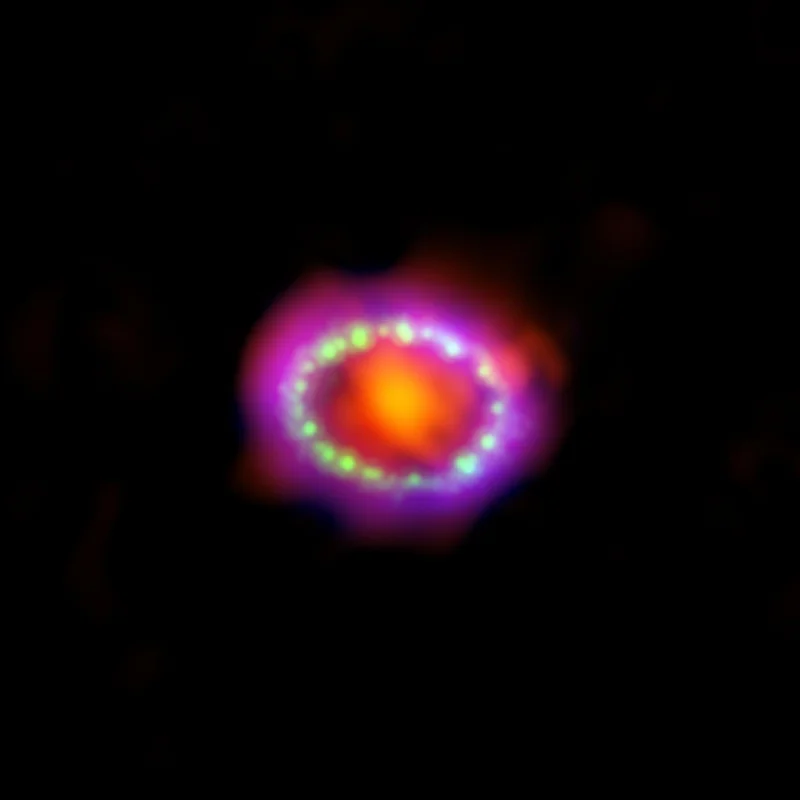
The supernova 1987A remnant science has fundamentally reshaped our understanding of stellar death, neutrino physics, and cosmic dust formation, marking the first time humanity observed a supernova in real-time across the electromagnetic spectrum. On February 23, 1987, a blue supergiant star in the Large Magellanic Cloud, a dwarf galaxy orbiting the Milky Way, exploded as Supernova 1987A, the brightest stellar explosion visible to the naked eye since Kepler’s Supernova in 1604. Astronomers have monitored its expanding debris and evolving remnant for over three decades, turning a fleeting flash into a long-term laboratory for nuclear astrophysics, particle physics, and the life cycle of matter in the universe.
The Discovery That Changed Everything
The detection of neutrinos from Supernova 1987A was a watershed moment. Approximately three hours before the optical flash reached Earth, three neutrino observatories, the Kamiokande-II detector in Japan, the Irvine-Michigan-Brookhaven detector in Ohio, and the Baksan Neutrino Observatory in Russia, recorded a burst of 24 neutrinos over 13 seconds. This confirmed that neutrinos carry away 99% of the gravitational binding energy released during core collapse, matching theoretical predictions. As the Nobel Foundation notes, this was the first direct observation of neutrinos from a supernova outside the Milky Way, earning Masatoshi Koshiba a share of the 2002 Nobel Prize in Physics.
The progenitor star, Sanduleak -69° 202, was a blue supergiant (spectral type B3) with a mass of roughly 18 solar masses. This was surprising: theoretical models at the time predicted red supergiants (like Betelgeuse) should explode as Type II supernovae. The unexpected blue colour forced astronomers to revise models of mass loss and metallicity in stellar evolution, particularly for stars in low-metallicity environments like the Large Magellanic Cloud. The blue colour likely arose because the star had lost its outer hydrogen envelope tens of thousands of years before the explosion, either through binary interaction with a companion star or a powerful stellar wind. This stripped star left a compact core that exploded as a blue supergiant, demonstrating that mass loss history, not just initial mass, determines a star’s pre-supernova state.
The Expanding Shockwave and Circumstellar Interaction
The Hubble Space Telescope, launched just three years after 1987A, has been the workhorse for imaging the remnant. Hubble’s observations reveal a complex structure: the expanding debris ring (the “reverse shock”) interacting with slower-moving circumstellar material ejected tens of thousands of years before the explosion. This produces X-ray and radio emission, with the shockwave heating gas to millions of degrees. The European Southern Observatory’s Very Large Telescope has tracked the debris velocity at roughly 7,000 km/s, showing the inner material decelerating as it piles up against the ring.

In 2023, the James Webb Space Telescope turned its infrared capabilities on 1987A, revealing new details hidden by dust. Webb’s NIRCam instrument imaged the central region, showing a bright “string of pearls” of material, the shocked ring, and a faint central emission that may be a pulsar wind nebula. This is part of a coordinated campaign by the James Webb Space Telescope Science Institute to study the remnant.
Dust Formation as Early Supernova 1987A Remnant Science
One of the most surprising discoveries in supernova 1987A remnant science is that supernovae are major factories for cosmic dust, the raw material for stars, planets, and life. Early submillimeter observations with the Atacama Large Millimeter/submillimeter Array (ALMA) revealed that 1987A has produced between 0.1 and 0.5 solar masses of dust within its expanding ejecta. This challenges earlier assumptions that supernovae only produced negligible amounts of dust. The dust is composed primarily of carbonaceous grains (graphite, silicon carbide) and silicates, and it formed surprisingly early, within 500 days of the explosion. Over the past 35 years, the dust clumps have grown in size and mass, with some regions now optically thick, blocking visible light from the centre. This finding helps explain how large quantities of dust survived the early universe, as seen in galaxies at high redshift.
The ability to detect this dust relied on advancements in submillimeter astronomy led by ALMA, which began full operations in 2013. Early ALMA observations between 2012 and 2014 resolved the cool dust emission at wavelengths of 450 and 870 microns, pinpointing dust clumps to within 100 astronomical units of the remnant’s centre. These measurements were impossible with earlier telescopes limited to shorter wavelengths, where dust obscuration blocked the view. ALMA’s sensitivity to cold dust (temperatures around 20–50 Kelvin) revealed that dust mass had increased steadily from the first detection at 500 days to the present, suggesting ongoing grain growth in the cooling ejecta.
The Search for a Compact Remnant
The most stubborn mystery remains: what is the central compact object? A core-collapse supernova should leave behind either a neutron star or a black hole. For 35 years, astronomers have detected no pulsed emission, no radio pulsations, no X-ray pulsations, no periodic gamma-ray signals, from the remnant’s centre. This is puzzling because the progenitor’s mass suggests a neutron star. Possible explanations:

- A pulsar with a narrow beam not pointed at Earth. This would explain lack of detection.
- A black hole if the neutron star collapsed further (though this would require fallback accretion exceeding the Tolman-Oppenheimer-Volkoff limit).
- A faint pulsar hidden behind dense dust clumps. Recent X-ray observations with Chandra and NuSTAR have placed upper limits on the luminosity of any point source, ruling out a typical Crab-like pulsar.
In 2019, a team led by researchers at Cardiff University reported evidence for a “pulsar wind nebula” in ALMA data, an expanding bubble of radio emission consistent with a spinning neutron star. As described in The Astrophysical Journal, this bubble, if confirmed, marks the first direct sign of the elusive neutron star, providing a crucial link in supernova 1987A remnant science by connecting the explosion to its compact endpoint. However, other teams remain cautious, arguing the emission could be from the heated ring. The debate continues, with scheduled JWST observations in 2024–2025 designed to differentiate between these scenarios by imaging the central region at mid-infrared wavelengths where a pulsar nebula would appear uniquely bright.
The Evolving Light Echo
In recent years, Hubble and other telescopes have documented “light echoes”: light from the original flash reflecting off nearby dust clouds, illuminating them years later. These echoes allow astronomers to study the three-dimensional structure of the interstellar medium around 1987A, much like a cosmic CAT scan. They have revealed previously unknown rings and shells of material ejected by the progenitor, providing clues about its mass-loss history. The echoes also serve as a time-delayed probe of the supernova’s ultraviolet flash, which is otherwise inaccessible.
1. Why is Supernova 1987A so important for science?
It is the only bright supernova observed with modern instruments since the invention of telescopes, and the first for which neutrinos were detected. It has provided the most detailed timeline of a stellar explosion ever recorded, making it a cornerstone of supernova 1987A remnant science.
2. Did Supernova 1987A produce a black hole or a neutron star?
The evidence remains inconclusive. No direct pulsar signal has been detected, but a faint radio and X-ray source suggests a neutron star may be present but hidden by dust.
3. How much dust did 1987A create?
ALMA observations show the remnant contains roughly 0.1 to 0.5 solar masses of dust, demonstrating that supernovae are major producers of cosmic dust.
4. Can I still see Supernova 1987A with a telescope?
No. The supernova faded below naked-eye visibility within months. It is now a telescopic object around magnitude 17–18 in the Large Magellanic Cloud, visible only to large observatories.
5. What will happen to the remnant in the future?
Over the next few decades, the expanding debris will interact more strongly with the circumstellar ring, creating a luminous supernova remnant similar to Cassiopeia A. The central neutron star (if present) may eventually be visible as a pulsar.
Sources & References
- NASA. The Dawn of a New Era for Supernova 1987A. https://science.nasa.gov/missions/hubble/the-dawn-of-a-new-era-for-supernova-1987a/
- James Webb Space Telescope Science Institute. JWST Observations of Supernova 1987A. https://www.stsci.edu/jwst/science-execution/approved-ers-programs
- European Southern Observatory. ALMA Reveals Massive Dust Factory in Supernova 1987A. https://www.eso.org/public/news/eso1708/
- Cigan, P., et al. (2019). High Angular Resolution ALMA Images of Dust and Molecules in the SN 1987A Ejecta. The Astrophysical Journal, 886(1), 51. https://iopscience.iop.org/article/10.3847/1538-4357/ab4b46
- Arnett, D. (1996). Supernovae and Nucleosynthesis. Princeton University Press. (General theory of supernovae, including 1987A).
Further reading: SN 1987A on Wikipedia