
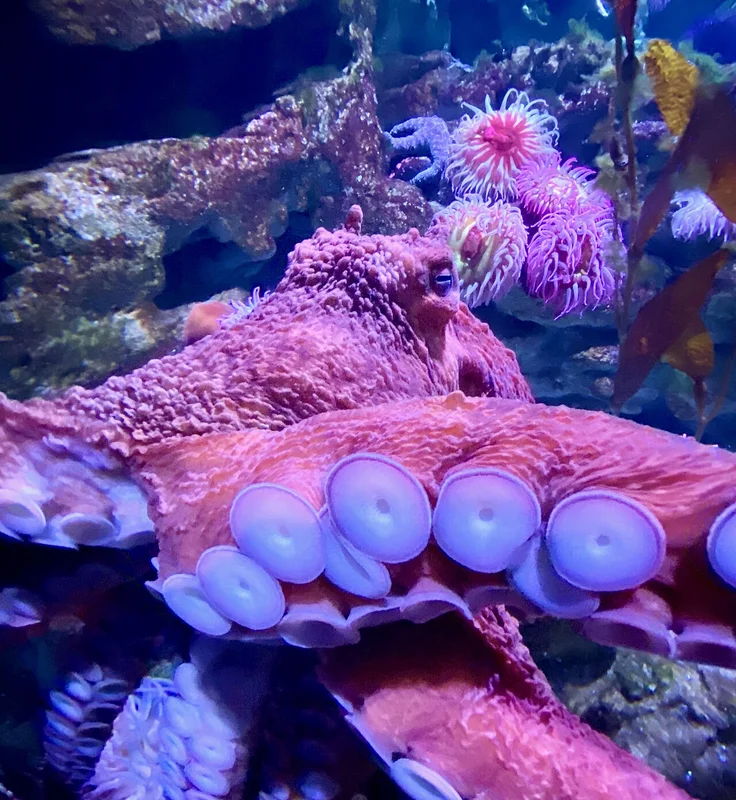
In 2012, a group of prominent neuroscientists gathered at the University of Cambridge and signed a document that would have been controversial a generation earlier. The Cambridge Declaration on Consciousness stated, plainly, that non-human animals possess the neurological substrates that generate consciousness. Mammals, birds, and many other creatures, including octopuses, were named explicitly. Their statement reshaped the debate over animal consciousness.
The declaration was not a philosophical position. It was a reading of the evidence. And the evidence has only accumulated since.
Why This Question Is Hard

For most of scientific history, consciousness in animals was either assumed (folk intuition) or denied (behaviorism’s legacy). Neither position was well-grounded. The honest answer is that consciousness is hard to detect even in humans: we infer it from behavior and report, and assume the same neural architecture produces the same experience. In animals, we cannot get the report. We can only read the behavior and the brain.
This creates a methodological problem with no clean solution. But the problem does not mean the question is unanswerable. It means we need indirect measures, and neuroscience has developed several. The principle of falsifiability reminds us that even difficult questions can be approached with testable hypotheses.
The Octopus Problem
Octopuses have nine brains. One central brain and one ganglion per arm, each capable of semi-autonomous processing. They have no backbone, no common ancestor with vertebrates more recent than 600 million years ago, and a nervous system organized along completely different principles than ours.

They also solve puzzles, recognize individual human faces, play, use tools, navigate mazes, and show what looks strongly like curiosity. They enter a sleep stage with rapid skin color changes, which some researchers suggest may be analogous to REM sleep in vertebrates. If consciousness is a property of specific neural architecture, the recurrent cortical processing mammals use, then octopuses should not be conscious. They have no cortex. But if consciousness is a property of information integration and complex self-modeling regardless of substrate, then octopuses are among the most interesting test cases in the animal kingdom.
The octopus problem is the animal consciousness debate in miniature: it forces us to confront whether our theories of consciousness are genuinely general or just theories of human consciousness.
Corvids and the Planning Problem
Crows, ravens, and jays have long been known for tool use. New Caledonian crows manufacture hooked tools from plant material. Rooks spontaneously use stones to raise water levels to reach floating food, the Aesop’s fable task, without training.
What is more telling is what they do with time. Western scrub jays cache food and come back to retrieve it later. They plan for the future. They remember what they cached, where, and when. If another jay was watching during caching, the cacher will later move its stash, suggesting that the jay models the other bird’s knowledge and anticipates theft.
This is theory of mind operating across time. To move a cache because someone watched you hide it, you must model what that observer knows, recognize that it differs from what you know, and anticipate future behavior based on that model. Corvids do this reliably.
Some corvids, specifically magpies, have shown a potential for mirror self-recognition in a single published study, but subsequent attempts at replication have produced mixed results, so the finding remains a topic of debate.
So if octopuses force us to rethink substrate, corvids force us to rethink the neural prerequisites for foresight. Their brains lack a cortex in the mammalian sense: they evolved a different structure, the nidopallium caudolaterale, that appears to perform analogous functions through convergent evolution. The architecture is different; the computation may be similar. This phenomenon of complex traits evolving independently, called convergent evolution, is also central to understanding the evolution of natural selection across the tree of life.
Fish and the Pain Debate
The question of fish consciousness is more contested. Fish have nociceptors, pain receptors, and show behavioral responses to noxious stimuli. They learn to avoid locations where they received electric shocks. Some species show behavior that looks like pain relief when given analgesics.
The debate turns on whether this constitutes suffering: subjective, felt pain – or whether it is nociception without experience: the body responding to damage without anything it is like to undergo it.
Fish lack a neocortex. The neural architecture most associated with conscious experience in mammals is absent. But fish do have structures that may perform analogous roles: the pallium in teleost fish shows some functional similarities to mammalian cortical processing. For more on the structure of nervous systems, the NCBI offers extensive resources on comparative neuroanatomy.
A 2019 study in PLOS Biology (Kohda et al.) documented what appeared to be mirror self-recognition in the cleaner wrasse, a small fish. The result was disputed immediately and remains contested. The fish research community is genuinely divided, and the honest answer is that we do not know.
The Cambridge Declaration and What It Established
The 2012 declaration, organized by neuroscientist Philip Low and signed by Stephen Hawking as a witness, made three specific claims.
First: the neural substrates of conscious experience are not unique to the human cortex. Subcortical structures, the amygdala, hypothalamus, brainstem, and others, generate affective states in humans. All mammals and birds possess these structures.
Second: non-human animals exhibit intentional behaviors indicating emotional states. They experience positive and negative affect. They seek and avoid. They have preferences that go beyond reflex.
Third: the evidence supports the conclusion that non-human animals have the neurological substrates that generate consciousness: not human consciousness, but consciousness of some kind.
The declaration did not claim animals are conscious in exactly the way humans are. It claimed the structures are there. That is a more defensible and more important claim.
Jaak Panksepp and Primary Emotions
Neuroscientist Jaak Panksepp spent decades mapping what he called primary emotional systems in mammalian brains: circuits conserved across species that generate basic affective states. He identified seven: SEEKING, RAGE, FEAR, LUST, CARE, GRIEF/PANIC, and PLAY.
These systems are subcortical. They operate in rats, cats, dogs, and humans. When the SEEKING circuit is activated, rats run forward exploring the environment with what looks for all the world like enthusiasm. When the GRIEF/PANIC circuit is activated in a rat pup separated from its mother, it emits ultrasonic distress calls in a frequency range that, when shifted into human hearing range, sounds like crying.
Panksepp argued, controversially, that these circuits generate genuine affective experience: that there is something it is like to be a rat in SEEKING mode, even if it is not what it is like to be a human excited about something. The circuits are too ancient, too conserved, and too functionally consistent to be mere reflexes without any inner dimension.
His critics said he was anthropomorphizing. His defenders said his critics were cortex-chauvinists: assuming that consciousness requires the cortex because that is where human consciousness seems most elaborate. A more complete picture of animal minds also includes strong evidence from cetaceans (dolphins and whales) and elephants, which demonstrate complex social cognition, tool use, and self-awareness. Their absence from this discussion is a gap worth noting.
Ethical Implications of Animal Consciousness
If animals are conscious, what does that mean for how we treat them? This is not a hypothetical question. The evidence for mammalian sentience has already led to legal changes: the European Union officially recognizes animals as sentient beings in its founding treaty, and nations like the UK have incorporated animal sentience into law following its exit from the EU. The findings from octopuses and corvids are now pushing the same conversation into new territory. In farming, research, and conservation, the assumption of consciousness carries weight. The principle of acknowledging animal suffering is also central to the Royal Society ’s guidelines on ethical animal research. This ethical dimension grounds the scientific debate in the real world.
What This Means for the Search for Minds
Here is the question the rest of this series keeps circling: are there other minds out there?
If consciousness requires a mammalian cortex organized in a specific way, then minds may be rare even on Earth, a late development in one lineage on one planet. The universe would be full of life but nearly empty of experience.
If consciousness is a more general property of complex information integration, self-modeling, and affective processing, present in octopuses, corvids, and fish to varying degrees, then the bar for mind may be lower than we thought. Life that evolves complexity may tend toward consciousness, because consciousness is useful. Modeling the self, predicting the future, simulating others: these are competitive advantages, and evolution finds competitive advantages.
We found complex nervous systems evolving convergently in vertebrates and cephalopods, in birds and mammals, separated by hundreds of millions of years. If the pressure toward complex cognition is that robust on Earth, it may not be unusual in the universe.
Whether the result is experience, whether any of it feels like something from the inside, remains the hardest question in biology. But the animal kingdom has given us more candidate cases than anyone expected. The universe of minds may be larger, and stranger, than we imagined.
Sources
- Low, P. (2012). The Cambridge Declaration on Consciousness. Francis Crick Memorial Conference, University of Cambridge.
- Pophale, A., et al. (2023). Wake-like skin patterning and neural activity during octopus sleep. Nature, 619, 129–134.
- Hunt, G. R. (1996). Manufacture and use of hook-tools by New Caledonian crows. Nature, 379, 249–251.
- Bird, C. D., & Emery, N. J. (2009). Rooks use stones to raise the water level to reach a floating worm. Current Biology, 19(16), 1410–1414.
- Clayton, N. S., & Dickinson, A. (1998). Episodic-like memory during cache recovery by scrub jays. Nature, 395, 272–274.
- Emery, N. J., & Clayton, N. S. (2001). Effects of experience and social context on prospective caching strategies by scrub jays. Nature, 414, 443–446.
- Prior, H., Schwarz, A., & Güntürkün, O. (2008). Mirror-induced behavior in the magpie (Pica pica): Evidence of self-recognition. PLoS Biology, 6(8), e202.
- Kohda, M., et al. (2019). If a fish can pass the mark test, what are the implications for consciousness and self-awareness testing in animals? PLOS Biology, 17(2), e3000021.
- Sneddon, L. U., Braithwaite, V. A., & Gentle, M. J. (2003). Do fishes have nociceptors? Evidence for the evolution of a vertebrate sensory system. Proceedings of the Royal Society B, 270(1520), 1115–1121.
- Panksepp, J. (2005). Affective consciousness: Core emotional feelings in animals and humans. Consciousness and Cognition, 14(1), 30–80.
- UK Government (2022). Animal Welfare (Sentience) Act 2022. legislation.gov.uk.
What is the Cambridge Declaration on Consciousness?
The Cambridge Declaration on Consciousness, signed in 2012 by prominent neuroscientists, states that non-human animals have the neurological substrates for consciousness, including mammals, birds, and octopuses.
Why is it difficult to study animal consciousness?
It is difficult because we cannot directly ask animals about their experiences; we must infer consciousness from behavior and brain structure, unlike in humans where self-report is possible.
What evidence suggests corvids are conscious?
Corvids show evidence of consciousness through behaviors like planning, theory of mind, and tool manufacture, which are thought to arise from convergent evolution.
Which animals are explicitly mentioned in the Cambridge Declaration?
The declaration explicitly mentions mammals, birds, and many other creatures, including octopuses, as possessing neurological substrates for consciousness.
How has the scientific view of animal consciousness changed over time?
Historically, animal consciousness was either assumed by folk intuition or denied by behaviorism, but modern evidence from neuroscience and behavior now supports its existence in many species.
Further reading: Animal consciousness on Wikipedia