The Science of Life – From Earth to the Stars

Alien figure standing on desert highway with world map backdrop

TRAPPIST-1 Exoplanets & JWST: Hunting Atmospheres in the Habitable Zone

Searching for signs of life in these worlds requires a deep understanding of alien biosignatures. Why TRAPPIST-1 Matters for Alien Life Research This red dwarf system has transformed exoplanet science. For broader context on rocky world habitability, compare with Kepler-22b, a habitable-zone candidate 620 light-years away. This nearby ultracool dwarf, is about 39 light-years away, hosts seven rocky exoplanets. Among these, three of them orbit the habitable zone, where conditions might allow liquid water. With the powerful James Webb Space Telescope (JWST) focused on this system, scientists uncover secrets about these exoplanets’ atmospheres and surface conditions, deepening our understanding of habitability around M dwarfs like this Trappist system. For a Read more


A star

JWST Detects CO₂ in Exoplanet Atmospheres — A Remarkable Discovery in Alien Atmospheres

The James Webb Space Telescope (JWST) is fundamentally transforming our comprehension of distant worlds by detecting and analyzing CO₂ in exoplanet atmospheres with unprecedented precision. As a key molecule in planetary climate regulation, carbon dioxide plays a crucial role in maintaining temperature stability and driving atmospheric chemistry, essential for habitability. While Earth’s atmosphere contains about 0.04% CO₂, even slight variations in exoplanetary CO₂ levels can significantly influence climate dynamics. These chemical markers are essential components in the study of alien biosignatures. How JWST Detects CO₂ in Exoplanet Atmospheres Transmission Spectroscopy When an exoplanet transits its host star, starlight filters through its atmosphere, leaving molecular “fingerprints.” JWST’s NIRSpec (Near-Infrared Spectrograph) detects Read more

Artistic visualization of cosmic web structure with planets connected by golden filaments

The Cosmic Web Explained: The Universe’s Grand Tapestry of Matter and Mystery

The cosmic web, in simple terms, is our universe‘s most expansive and intricate framework, the largest structure in the universe; it originates from tiny quantum fluctuations in the early cosmos. Studying how galaxies form within it reveals the fundamental nature of dark matter, dark energy, and even constraints on neutrino mass. The same telescopes studying the cosmic web also detect CO₂ in distant exoplanet atmospheres, bridging cosmological and planetary science. By integrating dark matter basics, understanding cosmic voids explained, and presenting a beginner’s guide to cosmology, researchers continue to uncover the gravitational tapestry that shapes galaxy clusters and the formation of galaxy clusters across cosmic time (Sunseri et al., 2025). Read more

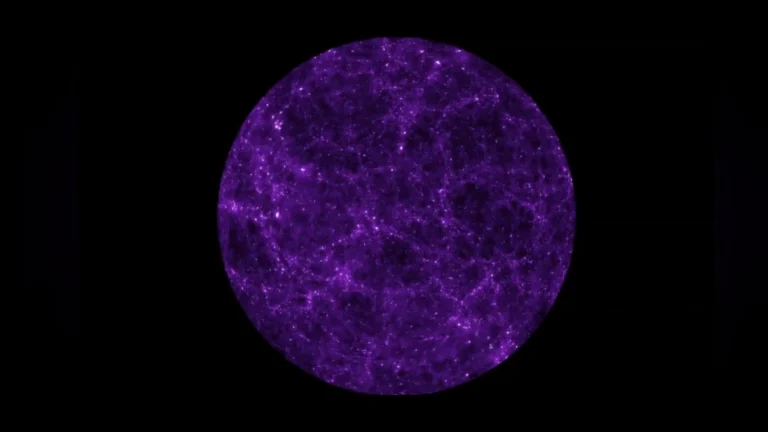
Purple cosmic web filament structure visualization from space telescope data

Do Cosmic Filaments Rotate? New Research Reveals the Truth

📌 Quick Facts About Cosmic Filament Rotation Introduction The universe’s large-scale structure resembles a web of galaxies, but do cosmic filaments rotate as part of this cosmic web? These filaments, stretching hundreds of millions of light-years, act as conduits for matter flowing into galaxy clusters. A groundbreaking study in 2025 suggests that these filaments may exhibit rotational motion. By analyzing galaxy velocity patterns across four detection algorithms, the team identified tentative spin signals. However, they caution that current results are methodology-dependent and require further confirmation. This article breaks down how filaments are mapped, why “rotation” signals matter, and what’s next for cosmology. What Are Cosmic Filaments and How Do They Read more

Digital visualization of glowing DNA double helix structure with data streams

The Shocking Truth About Non-Coding DNA: How It Controls Genes and Disease

Introduction Non-coding DNA comprises approximately 98–99% of the human genome. For decades, scientists dismissed these sequences as “junk DNA”, evolutionary leftovers with no purpose. That view was wrong, and overturning it has reshaped medicine, cancer biology, and our understanding of human evolution. Research from the ENCODE Project and subsequent work has revealed that non-coding DNA is the genome’s control system: it determines when genes switch on, how strongly they express, and which cells develop which identities. The breakthrough research happening in this field connects closely to advances in stem cell research and regenerative medicine. Unlike protein-coding genes, which make up only ~1–2% of the genome and directly produce proteins, non-coding Read more

Peopling of the Americas: Stunning New Discoveries, Migration Theories, and Debates

The peopling of the Americas was once believed to have begun around 13,000 years ago, a clean, orderly story driven by the Clovis-First model. That story is gone. A cascade of discoveries spanning genetics, climatology, and underwater archaeology has pushed the timeline back by at least 8,000 years and revealed a picture far more complex than a single wave of migrants following mammoths across a land bridge. To understand who these first Americans were and where they came from, it helps to begin with the theory that dominated for half a century, and then trace its collapse. This migration is a key chapter in the broader story of human evolution. Read more

A funny image of a modern Observatory made to look ancient by being made out of mode and a treetrunk as a Telescope.

Astronomical Archaeology: Ancient Celestial Practices and Revolutionary Discoveries

Introduction: The Intersection of Astronomy and Archaeology Since the dawn of civilization, humans have studied the skies to mark time, guide agriculture, and understand their place in the cosmos. Across cultures, astronomy was deeply embedded in religious, political, and daily life. Astronomical archaeology, an interdisciplinary field, examines how ancient societies observed celestial events and incorporated them into their architecture, rituals, and texts. This article explores astronomical archaeology in Mesopotamia, Egypt, Greece, and Mesoamerica. It reveals how ancient peoples engaged with the cosmos and how modern technology is revolutionizing our understanding of their discoveries. Stonehenge and Europe’s Megalithic Observatories Stonehenge remains the most iconic example of prehistoric astronomical architecture. Built in Read more

The African Origins of Homo sapiens: How Separate Traits Merged to Form Modern Humans

Introduction The African origins of Homo sapiens is one of the most consequential questions in science, and one whose answer keeps changing. The emergence of Homo sapiens was not a singular event in one location but rather a complex process unfolding across Africa. This story begins much earlier with the genesis of human evolution and the rise of the genus Homo. Fossil and genetic evidence now suggests that our species arose through a Pan-African evolutionary process, with different populations developing distinct traits before merging through gene flow. The Pan-African Model: Beyond a Single Cradle For decades, the dominant view held that modern humans evolved in a single location (most likely Read more