
Life on Earth is astonishingly diverse. Yet beneath this diversity, a recurring pattern emerges: unrelated species often evolve strikingly similar traits to solve the same environmental challenges. This phenomenon, known as convergent evolution, reveals the powerful and predictable force of natural selection.
Convergent evolution occurs when distantly related organisms independently evolve similar structures or functions. The result is not random coincidence. It is a testament to the limits and possibilities that physics, chemistry, and ecology impose on living forms. The most compelling convergent evolution examples come from camera eyes, echolocation, flight, and streamlined body shapes. Each case demonstrates how evolution can arrive at the same solution twice, sometimes many times.
This article explores these vivid examples and examines what they teach us about the predictability of evolution and the constraints that shape life.
Convergent Evolution Examples: The Camera Eye Engineered Twice
One of the most striking convergent evolution examples is the camera eye. Vertebrates like humans, fish, and birds possess a complex eye with a lens, iris, retina, and a single optical pathway. The octopus, a cephalopod mollusk, possesses a camera eye that is remarkably similar in structure and function. Yet these two lineages split from a common ancestor over 600 million years ago, and that ancestor likely had only a simple light-sensitive patch.
Convergent evolution examples and how structures differ
Despite their superficial similarity, the vertebrate and octopus eyes are wired differently. In vertebrates, the nerve fibers that carry signals from the retina to the brain lie in front of the light-sensitive cells, creating a blind spot where the optic nerve exits. The octopus eye avoids this problem. Its nerve fibers run behind the retina, resulting in no blind spot. These architectural differences confirm that the two eyes evolved independently, not from a shared ancestral eye.
Understanding Convergent Evolution Examples
The fact that both lineages converged on a lens-based, image-forming eye suggests that for certain visual tasks, the camera design is optimal given the materials available. Natural selection faced the same problem: how to focus light onto a dense array of photoreceptors. The solution was essentially the same, even though the developmental pathways were completely different. This example strongly supports the idea that evolution is constrained by physics and can be highly predictable when selective pressures are strong.
Convergent Evolution Examples: Echolocation as Seeing with Sound
Echolocation is another classic case of convergent evolution. This biological sonar allows animals to navigate, hunt, and communicate in environments where vision is limited. Bats and toothed whales (including dolphins and porpoises) both use echolocation, yet their last common ancestor was an early terrestrial mammal that lived more than 80 million years ago and almost certainly did not echolocate.
Convergent Evolution Examples: Bats and Aerial Echolocation
Microbats (suborder Microchiroptera) produce high-frequency calls through their larynx and listen for returning echoes. Their ears are often large and mobile, and their brains have specialized regions for processing temporal and frequency information. Most insectivorous bats rely on echolocation to detect prey in complete darkness.
Dolphins and Convergent Evolution Examples in Underwater Sonar
Dolphins produce clicks using nasal air sacs, not a larynx. These clicks travel through water and bounce off objects. The returning echoes are received through the dolphin’s lower jaw, which transmits vibrations to the inner ear. The dolphin’s brain then constructs a detailed three-dimensional “acoustic image” of its surroundings. The precision is remarkable: a bottlenose dolphin can distinguish between a metal sphere and a plastic sphere of the same size based solely on echo characteristics.
Genetic and Neural Convergent Evolution Examples

Recent genetic studies have revealed that bats and dolphins have independently evolved similar changes in the same genes related to hearing. For example, the gene Prestin, which is essential for the high-frequency sensitivity of hair cells in the inner ear, shows convergent amino acid substitutions in echolocating bats and dolphins, as documented in a peer-reviewed study by Liu et al. (2010) published in Nature. This molecular convergence mirrors the anatomical and behavioral convergence. It shows that natural selection can act on the same genetic targets when faced with similar sensory demands.
Top Convergent Evolution Examples in Nature
This section consolidates some of the most frequently cited convergent evolution examples across multiple biological domains, highlighting the breadth of this phenomenon.
Flight: Three Independent Solutions to the Same Problem
Flight has evolved independently at least three times in vertebrates: in birds, bats, and pterosaurs (the extinct flying reptiles). Additionally, insects evolved flight even earlier and entirely independently. Each group solved the aerodynamic challenges of lift, thrust, and control using different anatomical structures.
Birds: Feathered Wings
Birds evolved from theropod dinosaurs. Their wings are modified forelimbs covered in feathers. The feathers themselves are lightweight, strong, and aerodynamically shaped. Birds use a complex flapping motion that generates both lift and thrust. Their bones are hollow, and they have a highly efficient respiratory system to meet the energy demands of flight.
Bats: Membranous Wings
Bats are the only mammals capable of powered flight. Their wings consist of a thin membrane of skin called the patagium, stretched between elongated finger bones, the body, and the hind legs. This membrane is flexible and allows bats to change wing shape rapidly, enabling exceptional maneuverability. Unlike birds, bats have a keeled sternum (breastbone) for attachment of powerful flight muscles.
Pterosaurs: A Third Design
Pterosaurs were the first vertebrates to evolve flight, appearing in the Triassic period. Their wings were also formed from a skin membrane, but it was supported primarily by an extremely elongated fourth finger. The membrane extended to the hind legs or tail in some species. Fossil evidence shows that pterosaur wings likely contained structural fibers called actinofibrils that stiffened the membrane. Their bones were hollow and extremely lightweight.
What the Convergence Reveals
Despite using different materials (feathers, skin membranes, and membrane with fibers), all three groups converged on a wing with a curved upper surface and a flat lower surface. This shape accelerates air over the top, creating lower pressure and generating lift. The convergence on this basic aerodynamic profile is a direct result of the laws of physics. No life form can bypass the laws of fluid dynamics. Evolution therefore had a limited set of workable designs for powered flight.
Streamlined Bodies: Sharks, Ichthyosaurs, and Dolphins
The convergence among aquatic vertebrates is perhaps the most visually obvious. Sharks (cartilaginous fish), ichthyosaurs (extinct marine reptiles), and dolphins (mammals) all share a torpedo-shaped body, a dorsal fin, a tail fin, and paired flippers. Yet each group evolved these features independently.
Sharks: The Prime Design
Sharks have been streamlined for over 400 million years. Their body shape minimizes drag in water. Their dorsal fin provides stability. Their heterocercal tail (upper lobe larger than lower) generates both thrust and lift. Their pectoral fins act like wings to provide lift against sinking.
Ichthyosaurs: The Reptilian Dolphin
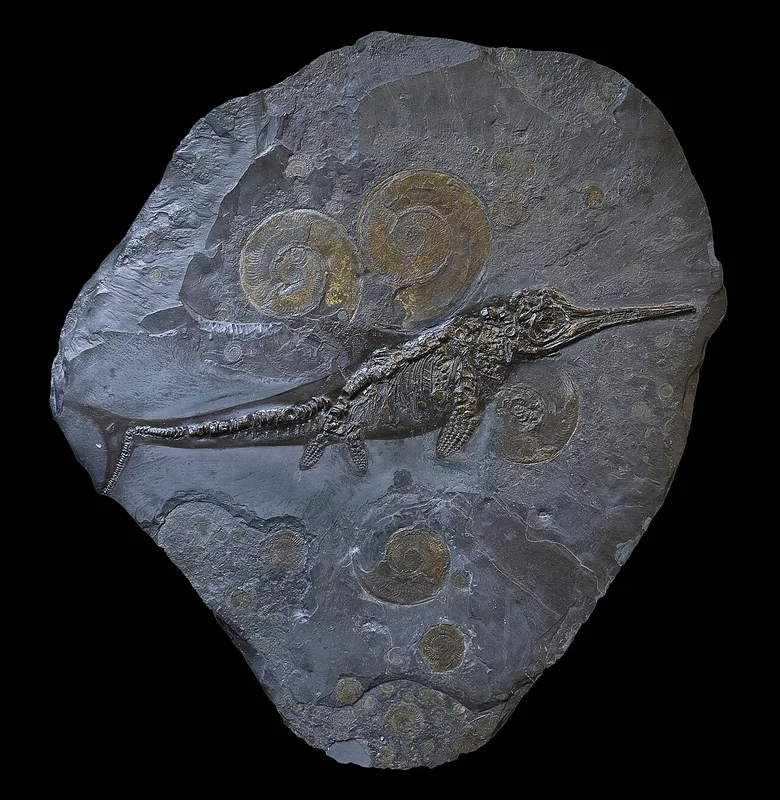
Ichthyosaurs flourished during the Mesozoic era. Fossils show they had a fish-like body, a dorsal fin, and a tail fin. Early ichthyosaurs had elongated bodies and tails, but later forms converged on a compact, tuna-like shape. Their flippers contained many finger bones, a structure completely different from the fin rays of fish. Their tail fin was vertical, like a fish tail, but supported by the vertebral column in a different way.
Dolphins: Mammals Returned to the Sea
Dolphins evolved from land-dwelling mammals around 50 million years ago. Their ancestors returned to the ocean and gradually adapted. Their bodies became streamlined, their forelimbs became flippers, their hind limbs disappeared, and they developed a horizontal tail fluke. The dorsal fin of a dolphin, unlike that of a fish or ichthyosaur, contains no bone. It is composed of dense connective tissue.
The Ocean Constrains Form
The convergence between these three groups is a dramatic demonstration of how physical constraints shape evolution. Water is dense and viscous. The most efficient shape for moving through it is the same for all animals: a streamlined fusiform body with a narrowed tail region and control surfaces for stability. These are not arbitrary choices. They are the only solutions that work well for rapid, sustained swimming. Evolution repeatedly finds them.

What Convergent Evolution Tells Us About Predictability
These convergent evolution examples collectively challenge the view that evolution is purely random and unpredictable. Instead, they suggest that when organisms face the same selective pressures, the responses of natural selection can be remarkably consistent.
The Role of Constraints
Physics places hard limits on biology. A camera eye must obey the laws of optics. A wing must generate lift according to fluid dynamics. A swimming animal must reduce drag. These constraints mean that the range of viable solutions is finite. Convergent evolution occurs because diverse lineages all operate within these same physical and chemical rules.
The Role of Ecology
Shared ecological niches also drive convergence. Predators that hunt in the dark will benefit from echolocation. Apex predators in the ocean will benefit from a streamlined body and powerful tail. Animals that need to travel long distances quickly will benefit from wings. When two unrelated lineages occupy similar niches, they often evolve similar adaptations. Explore our guide to Evolution for more context.
Not Inevitable, But Likely
Convergent evolution does not mean that every solution is inevitable. The absence of a trait in one lineage may reflect developmental constraints or historical accidents. However, the repeated appearance of the same solutions across different branches of the tree of life indicates that certain evolutionary endpoints are strongly favored. Evolution has a direction, not toward a goal, but toward the limited set of forms that work best in a given environment.
1. What is the simplest definition of convergent evolution?
Convergent evolution is when two unrelated species independently evolve similar traits because they face similar environmental challenges.
2. How is convergent evolution different from divergent evolution?
Divergent evolution occurs when related species become different as they adapt to different environments. Convergent evolution involves unrelated species becoming similar as they adapt to the same environment.
3. Can convergent evolution occur at the molecular level?
Yes. Examples include the evolution of similar enzymes in different bacteria that break down the same toxin, or the convergent amino acid changes in the Prestin gene found in echolocating bats and dolphins.
4. What are the best known examples of convergent evolution?
The camera eye in vertebrates and octopuses, echolocation in bats and dolphins, flight in birds, bats, and pterosaurs, and the streamlined body shape of sharks, ichthyosaurs, and dolphins are all widely cited examples.
5. Does convergent evolution prove that evolution is predictable?
It strongly suggests that evolution is constrained and can be predictable in certain situations. When physical laws and strong selective pressures are involved, evolution tends to produce similar outcomes. However, historical contingency and chance also play important roles.
Sources & References
- National Institute of General Medical Sciences. “Convergent Evolution.” https://www.nih.gov/ (General science education resource).
- Liu, Yang, et al. “Convergent sequence evolution between echolocating bats and dolphins.” Nature 468, 2010. (Peer-reviewed genetic study on molecular convergence.)
- University of California Museum of Paleontology. “Understanding Evolution: Convergent Evolution.” https://evolution.berkeley.edu/
- National Oceanic and Atmospheric Administration (NOAA). “Dolphin Echolocation.” https://www.fisheries.noaa.gov/ (Federal agency resource on marine mammal biology).
- National Aeronautics and Space Administration (NASA). “Flight: The Physics of Flight.” https://www.nasa.gov/ (Educational resource on aerodynamics).
Further reading: Convergent evolution on Wikipedia