
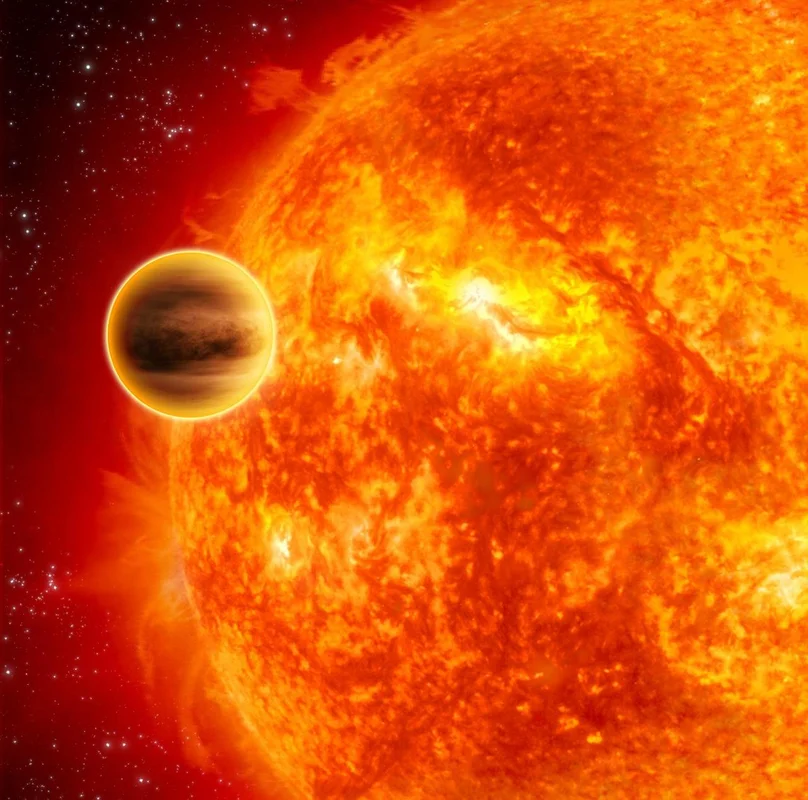
Transit spectroscopy for exoplanet atmospheres is a powerful technique that allows astronomers to study the chemical makeup of worlds light-years away. When a planet passes in front of its host star, a tiny fraction of starlight filters through the planet’s upper atmosphere. Scientists analyze this filtered light to identify molecules like water, methane, and carbon dioxide. This method has transformed exoplanet science from mere detection to detailed characterization.
Understanding Transit Spectroscopy for Exoplanet Atmospheres
A transit occurs when an exoplanet crosses the face of its star from our line of sight. During this event, the star’s brightness dips slightly – usually by less than 1%. The duration and depth of this dip reveal the planet’s size and orbital period. But the real treasure lies in what happens to the starlight itself.
As the planet moves in front of the star, starlight passes through the thin ring of atmosphere at the planet’s terminator – the boundary between day and night. Different gas molecules in this atmosphere absorb specific wavelengths of light. Water vapor, for example, absorbs strongly in the near-infrared around 1.4 and 1.9 micrometers. Methane absorbs near 1.6 and 2.3 micrometers. Carbon dioxide has a distinctive absorption band at 2.0 micrometers.
Reading the Transmission Spectrum
The key measurement in transit spectroscopy for exoplanet atmospheres is the transit depth at multiple wavelengths. Scientists compare the planet’s apparent size in starlight filtered through its atmosphere at different colors. At wavelengths where molecules absorb strongly, the atmosphere becomes more opaque. This makes the planet appear larger – the transit depth increases. At wavelengths where the atmosphere is more transparent, the planet appears smaller.
By plotting transit depth against wavelength, astronomers produce a transmission spectrum. Each molecular species leaves a unique fingerprint of absorption features. The European Space Agency’s CHEOPS mission uses this principle to study exoplanet atmospheres with high precision.
The Challenge of Stellar Contamination
A major challenge is separating the planet’s signal from variations caused by the star itself. Starspots, faculae, and stellar activity can mimic or mask absorption features. For instance, cool starspots absorb more light at shorter wavelengths, which could be mistaken for molecular absorption. Astronomers correct for this by observing the star’s spectrum for multiple orbits before and after the transit.
Extracting Molecular Signatures
Building the Light Curve
A light curve is a graph of stellar brightness over time. During a transit, astronomers measure brightness in many narrow wavelength bands simultaneously. Instruments like the Hubble Space Telescope’s Wide Field Camera 3 (WFC3) use grism spectroscopy, which spreads starlight across many pixels. Each pixel corresponds to a specific wavelength channel.
The process works in three main steps:

- Collect raw data: Capture images of the star throughout the transit.
- Extract spectra: Sum the stellar flux for each wavelength bin across multiple exposures.
- Fit the transit: Model the brightness dip for each wavelength to get the planet-to-star radius ratio.
Identifying Absorption Features
Once scientists have transit depths at many wavelengths, they subtract a baseline constant to isolate the atmospheric signal. The resulting spectrum shows bumps where the atmosphere is more opaque and dips where it is clearer. Absorption features appear as increases in transit depth.
Consider a hypothetical exoplanet with a thick water-rich atmosphere. At 1.4 μm, the measured planet radius might be 1.02 times larger than at 1.0 μm. This 2% increase directly corresponds to the height of the absorbing atmospheric layer. By comparing these excess radii across wavelengths, researchers build a chemical inventory.
The Example of WASP-39b
A landmark case is the exoplanet WASP-39b, a hot Saturn-mass world 700 light-years away. Using NASA’s James Webb Space Telescope (JWST), scientists captured its transmission spectrum from 0.6 to 5.3 μm. The spectrum showed clear absorption from water vapor, carbon dioxide, and sulfur dioxide. Notably, the sulfur dioxide signature indicated photochemistry driven by the planet’s host star – a first for an exoplanet atmosphere.
This detection required combining data from JWST’s Near-Infrared Spectrograph (NIRSpec) and Mid-Infrared Instrument (MIRI). The team modeled the spectrum with a 3D general circulation model to account for temperature variations across the planet’s dayside and nightside. The result matched predictions from atmospheric chemistry models, confirming that transit spectroscopy for exoplanet atmospheres works reliably for diverse worlds.
Instrumentation for Transit Spectroscopy
Hubble Space Telescope (HST)
HST’s WFC3 has been the workhorse for transit spectroscopy for over a decade. Its grism mode covers 1.1 to 1.7 μm, capturing water vapor and methane bands. Studies of dozens of exoplanets have revealed that many hot Jupiters contain water vapor, though sometimes in lower amounts than simple models predict. However, HST’s narrow wavelength range limits its ability to detect multiple molecules simultaneously.
James Webb Space Telescope (JWST)
JWST opened a new era in transit spectroscopy. Its greater mirror size (6.5 meters vs. Hubble’s 2.4 meters) collects more light, enabling higher signal-to-noise observations at longer wavelengths. JWST’s NIRSpec can observe 0.6 to 5 μm in a single exposure, covering water, carbon monoxide, carbon dioxide, and methane all at once. Its MIRI extends to 28 μm, where thermal emission from the planet’s dayside can be measured separately.
A key advantage is JWST’s stable thermal environment at L2 orbit. This reduces systematic noise from temperature fluctuations, allowing detection of subtle absorption features. In 2024, JWST observed the Earth-sized exoplanet TRAPPIST-1b, finding hints of a possible atmosphere but no clear molecular signatures – yet.
Future Ground-Based Observatories

The upcoming Extremely Large Telescope (ELT) in Chile, scheduled for first light around 2028, will use adaptive optics to directly image exoplanets and take their spectra. Its METIS instrument will cover thermal infrared wavelengths, complementing space-based observations. Combined with JWST, the ELT will push transit spectroscopy to smaller, cooler planets closer to Earth’s size.
Limitations and Challenges
Atmospheric Hazes and Clouds
One major limitation is that clouds and hazes can flatten transmission spectra. When a thick, high-altitude cloud deck covers the planet, starlight cannot penetrate to the absorbing gas layers below. The observed spectrum becomes featureless, hiding molecular signatures. This effect is common for hot Jupiter exoplanets like HD 189733b, whose transmission spectrum is nearly flat from optical to infrared wavelengths.
Stellar Activity Confounds Signals
Starspots and faculae introduce wavelength-dependent noise. A starspot that rotates into view during a transit can cause a false absorption signal. Astronomers mitigate this by observing the star’s spectrum at multiple epochs and modeling the star’s rotational period. Still, for active stars like young M-dwarfs, stellar contamination remains the dominant source of uncertainty.
Low Signal-to-Noise for Small Planets
For rocky Earth-sized planets, the atmospheric signal is extremely tiny. The transit depth for a planet like TRAPPIST-1e is about 0.04%, and the atmospheric absorption signature is an order of magnitude smaller – on the order of 10 parts per million. Achieving this precision requires observing dozens of transits and combining data across multiple instruments. This is why many small exoplanets remain undetected in their atmospheric signatures.
Future Directions and Questions
Transit spectroscopy for exoplanet atmospheres is still a young field, but it is advancing rapidly. Scientists are now working on techniques to measure atmospheric circulation patterns by observing changes in transmission spectra over the course of a planet’s orbit. This could reveal wind speeds and temperature maps of exoplanet atmospheres.
Another frontier is looking for biosignature gases like oxygen and methane simultaneously. On Earth, this combination indicates biological activity because oxygen and methane react quickly, so their coexistence implies continuous production. Transit spectroscopy with a future telescope like the proposed Habitable Worlds Observatory could attempt this for nearby Earth-like planets.
The field also faces the question of inference robustness. Different retrieval models can produce different abundances from the same data. Standardization of retrieval methods and cross-validation with lab measurements is ongoing.
1. What exactly does transit spectroscopy measure?
It measures how much starlight is absorbed at each wavelength as the light passes through an exoplanet’s atmosphere. This reveals which gas molecules are present and in what relative amounts.
2. Can transit spectroscopy detect life?
Not directly. It can detect gases that might be produced by life, like oxygen and methane together. However, these gases can also form through geological processes. A biosignature requires ruling out non-biological origins.
3. Why do we need space telescopes for this technique?
Earth’s atmosphere absorbs many infrared wavelengths that are crucial for detecting molecular fingerprints – especially water, carbon dioxide, and methane. Space telescopes like JWST give a clear view without atmospheric interference.
4. How many exoplanet atmospheres have been studied this way?
As of 2025, astronomers have studied about 100 exoplanet atmospheres using transit spectroscopy. Most are hot Jupiters and Neptunes. Only a handful of smaller rocky planet atmospheres have been examined with low precision.
5. What is the biggest challenge for future observations?
Detecting atmospheres on Earth-sized planets around Sun-like stars requires extremely high precision – about 10–20 parts per million. This demands very large mirrors and long observation times, pushing the limits of current technology.
Sources & References
- NASA Exoplanet Exploration: Transit Spectroscopy Overview; Basic explanation of how the technique works.
- ESA CHEOPS Mission Page; Description of the CHEOPS mission’s role in exoplanet characterization.
- JWST WASP-39b Transmission Spectrum Results; Peer-reviewed paper in Nature on sulfur dioxide detection.
- Madhusudhan (2023) Review of Exoplanet Atmospheric Retrieval; Comprehensive review in Annual Review of Astronomy and Astrophysics.
- Ih, Kempton et al. (2023) Constraining the Thickness of TRAPPIST-1 b’s Atmosphere; Paper in Astrophysical Journal Letters on the JWST 15-micron secondary eclipse of TRAPPIST-1 b.
Further reading: Transmission spectroscopy on Wikipedia