
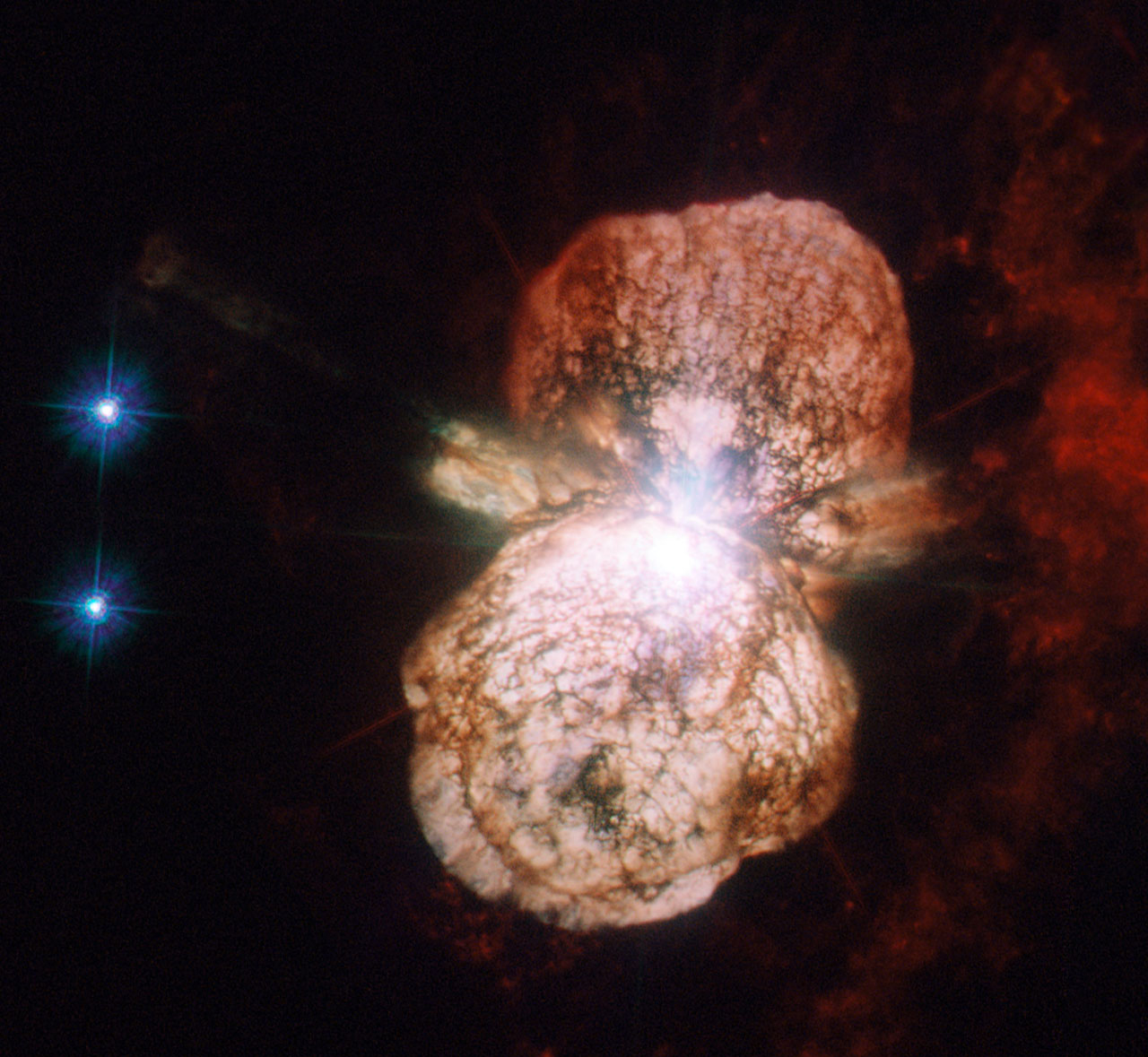
For a few weeks, a single star can outshine an entire galaxy of 200 billion stars. This is a supernova: the most energetic explosion in the observable universe, a stellar death so violent it briefly rivals the combined light output of 10 billion suns.
Supernovas are not just spectacular. They are essential. Every atom of iron in your blood, every atom of calcium in your bones, every atom of oxygen you breathe was forged inside a star and scattered through the galaxy by one of these explosions. We are, in the most literal sense, made of stardust.
Understanding how supernovas work, the core-collapse supernova mechanism and the other pathways, is understanding one of the central processes of cosmic history.
What Makes a Star Tick; Until It Doesn’t

To understand why stars explode, you first need to understand what keeps them together.
A star is a gravitational battle. Gravity wants to collapse billions of tons of gas inward toward the center. Nuclear fusion pushes back outward, the energy released by fusing hydrogen into helium generates an outward pressure (radiation pressure and thermal pressure) that exactly balances gravity.
For most of a star’s life, this balance holds with remarkable precision. The Sun has been burning hydrogen for 4.6 billion years and will continue for another 5 billion. It is in perfect hydrostatic equilibrium.
The problems start when a star runs out of fuel.
How Supernovas Work: Core Collapse Inside a Dying Giant
Massive stars, those with more than about 8 times the mass of the Sun, go through a sequence of fusion burning stages that smaller stars never reach. After burning hydrogen into helium, helium into carbon and oxygen, the core contracts under gravity, heats up, and ignites carbon fusion. Then neon, then oxygen, then silicon. This process of supernova nucleosynthesis creates all the elements up to iron.
Each successive burning stage is shorter than the last because heavier fusion reactions are less efficient. While hydrogen burning might last millions of years, silicon burning lasts about a day.
Silicon fusion produces iron. And iron is where everything stops.
Iron has the most tightly bound nucleus of any element. Unlike all the lighter elements, fusing iron into anything heavier consumes energy rather than releasing it. The nuclear fusion furnace goes out.
The iron core, no longer supported by fusion energy, begins to collapse under gravity. What happens next takes about 0.1 seconds and releases more energy than the Sun will emit over its entire 10-billion-year lifetime.
The Collapse: 0.1 Seconds of Violence
The iron core, roughly the size of Earth, collapses to the size of a city, a sphere about 20–30 kilometers across, in a fraction of a second. Material that was hundreds of millions of kilometers from the center is now converging at up to 70,000 kilometers per second, or about 25% of the speed of light.
As the core density skyrockets, electrons are squeezed into protons, producing neutrons and neutrinos in enormous quantities. The inner core reaches nuclear density, about 10¹⁴ grams per cubic centimeter, the density of an atomic nucleus, and becomes incompressible.
The infalling outer core hits this rigid inner core and bounces. A shockwave propagates outward.
But the shockwave runs into a problem. As it moves outward through the still-infalling outer core, it loses energy dissociating iron nuclei into free protons and neutrons, a process that consumes about 10⁴⁴ joules per solar mass. The shockwave stalls about 100-200 kilometers from the center.
For decades, this was a mystery: the simulations showed the shockwave dying before it could reach the surface. How does the explosion actually happen?

How Neutrinos Revive the Shockwave
The answer involves the most elusive particles in the Standard Model: neutrinos.
The core collapse produces a flood of neutrinos: roughly 3 × 10⁵³ joules worth, approximately 100 times the energy the Sun will emit over its entire lifetime. For a few seconds, the young neutron star is the most intense neutrino source in the observable universe. This is how neutron stars, the densest objects in the observable universe, are born.
Neutrinos barely interact with anything. In your body right now, the neutrinos streaming from the Sun pass through you almost completely without notice. But when they are dense enough, they do interact: and in the stalled shockwave region, the neutrino flux is dense enough that about 1-5% of the neutrino energy is deposited behind the shock.
It’s like a trillion fire hoses spraying through a chain-link fence: only one in a hundred drops get through, but that’s enough to knock the fence down.
That 1-5% is enough. The energy deposition revives the shock, which then powers the explosion outward.
This is the delayed neutrino mechanism, proposed by Hans Bethe and James Wilson in 1985 and supported by decades of increasingly sophisticated computer simulations. Modern 3D supernova simulations show convective turbulence and instabilities (like the SASI; Standing Accretion Shock Instability) playing important roles in enabling neutrinos to transfer their energy effectively.
The outer layers of the star, everything above the iron core, are ejected at velocities up to 10,000 kilometers per second. The explosion releases the staggering energy accumulated over millions of years of stellar evolution in a single event. Most supernovas in the Milky Way occur about once every 50 years, though dust in the galactic plane hides many of them from view.
The Remnants: Neutron Stars and Black Holes
What’s left behind depends on the mass of the progenitor star.
Neutron stars are formed when the collapsing core ends up between about 1.4 and 3 solar masses. They are extraordinarily dense: a teaspoon of neutron star material would weigh about 10 million metric tons. Their outer layers are a crystalline lattice of atomic nuclei and free electrons; their cores may contain exotic matter like quark-gluon plasma. They often spin rapidly and emit beams of electromagnetic radiation, appearing as pulsars.
Black holes form when the collapsed core is too massive for neutron degeneracy pressure to stop the collapse, typically when the progenitor star was more than about 20-25 solar masses. The core collapses without limit, forming a singularity surrounded by an event horizon. Some supernovas from very massive stars may produce black holes directly, with little or no visible explosion, a “failed supernova.” This process is explained in detail in How Black Holes Form: Stellar Collapse, Mergers, and the Early Universe.
The boundary between neutron star and black hole formation is not sharp and depends on factors including the star’s metallicity, rotation rate, and the equation of state of nuclear matter.
Type Ia Supernovas: The Other Kind
Not all supernovas are core-collapse events. The Type Ia supernova is a fundamentally different beast, and arguably even more important to astronomy.
Type Ia supernovas involve white dwarfs. A white dwarf is the dense remnant of a lower-mass star (like the Sun will eventually become): roughly Earth-sized, with a mass up to about 1.4 solar masses, supported not by nuclear fusion but by the quantum pressure of electrons.
If a white dwarf accretes mass from a binary companion, it approaches the Chandrasekhar limit: about 1.4 solar masses. At this mass, electron degeneracy pressure can no longer support the star, triggering runaway carbon fusion throughout the entire star essentially simultaneously. The resulting explosion obliterates the white dwarf completely, leaving no remnant.
Because the Chandrasekhar limit is the same for all white dwarfs, a fundamental quantum limit set by the laws of physics, Type Ia supernovas produce remarkably consistent peak luminosities. With corrections for the shape of their light curves, they can be used as standard candles: objects of known luminosity, so that their distance can be measured from how bright they appear.
It was Type Ia supernovas, observed in distant galaxies in the late 1990s, that provided the first definitive evidence that the universe’s expansion is accelerating: the discovery that earned the 2011 Nobel Prize in Physics and revealed the existence of dark energy, which is explored further in What Is Dark Energy?.
While core-collapse and Type Ia are the best known, other types also exist: Type Ib and Ic supernovas arise from stripped massive stars that have lost their hydrogen envelopes, and these are often linked to gamma-ray bursts.
Where Do Heavy Elements Come From?
Carl Sagan famously said “we are made of star stuff.” Supernovas are where most of the story actually happens.

The early universe produced hydrogen and helium (and a tiny bit of lithium) in the Big Bang. Everything heavier was made in stars.
Elements up to iron are made during the main stellar burning phases: hydrogen to helium in normal stellar evolution, carbon, neon, oxygen, and silicon in the final burning stages of massive stars.
Elements heavier than iron require a different process: the capture of neutrons. There are two main pathways.
The s-process (slow neutron capture) occurs in evolved stars and produces elements like barium and strontium. Neutrons are captured slowly enough that unstable nuclei can decay before capturing another neutron.
The r-process (rapid neutron capture) requires an enormous neutron flux: far more intense than any stellar interior can provide. It was long assumed to occur in core-collapse supernovas, but compelling evidence now suggests neutron star mergers (kilonovas) are the primary site of r-process nucleosynthesis, producing gold, platinum, uranium, and other heavy elements.
The 2017 detection of gravitational waves from a neutron star merger (GW170817) was accompanied by an electromagnetic counterpart, a kilonova, that showed clear spectroscopic signatures of r-process elements being produced in real time. The gold in your jewelry was made in a neutron star collision billions of years ago.
Supernova 1987A: The Closest in Modern Times
On February 23, 1987, light from a supernova in the Large Magellanic Cloud, a satellite galaxy about 168,000 light-years away, reached Earth. It was the closest observable supernova since Kepler’s Supernova in 1604.
Supernova 1987A confirmed key theoretical predictions. Three neutrino detectors around the world, Kamiokande II in Japan, the IMB detector in the US, and Baksan in Russia, recorded a burst of about 24 neutrinos arriving about 3 hours before the visible light, exactly as the delayed neutrino mechanism predicted (neutrinos escaping the core directly; photons taking longer to diffuse through the stellar envelope).
SN 1987A has been watched continuously since 1987. Its remnant has expanded into the circumstellar material ejected by the progenitor star in its final decades, producing glowing rings of shocked gas. In the center, astronomers are searching for the neutron star that should have formed, which should eventually be detectable as a pulsar once the debris around it thins.
Modern detection of supernovas relies on wide-field transient surveys such as the Zwicky Transient Facility (ZTF) and the upcoming Vera Rubin Observatory, which scan the sky nightly to catch these explosions moments after they begin, often in distant galaxies.
Supernovas and Life
Supernovas are not just destructive. They may be necessary for life.
The heavy elements produced and dispersed by supernovas, carbon, oxygen, iron, silicon, phosphorus, sulfur, are the raw materials of rocky planets and biochemistry. Without multiple generations of supernovas seeding the interstellar medium with heavy elements, there would be no Earth-like planets and no chemistry complex enough to support life.
There’s also evidence that supernovas can trigger star formation. The shockwaves from explosions compress interstellar gas clouds, tipping them over the density threshold for gravitational collapse. Our own solar system may have been triggered by a nearby supernova, isotopic anomalies in meteorites suggest an injection of supernova material just before the solar system formed.
And supernovas may occasionally pose a hazard to life. A supernova within about 25-50 light-years of Earth would be catastrophic, delivering lethal doses of gamma rays and cosmic rays. The good news: no such star is anywhere near that close to us today.
Supernovas are both creators and destroyers, the universe’s most dramatic recycling machines.
Sources
- Burrows, A. (2013). Colloquium: Perspectives on core-collapse supernova theory. Reviews of Modern Physics, 85(1), 245.
- Janka, H.T. (2012). Explosion mechanisms of core-collapse supernovas. Annual Review of Nuclear and Particle Science, 62, 407–451.
- Abbott, B.P. et al. (2017). GW170817: Observation of gravitational waves from a binary neutron star inspiral. Physical Review Letters.
- NASA Chandra X-ray Center. (2021). Supernova Remnants. NASA.
- National Aeronautics and Space Administration (NASA). (2024). What Are Supernovas? NASA Science.
- Johnson, J. A. (2019). Populating the periodic table: Nucleosynthesis of the elements. Science, 363(6426), 474-478.
What is a supernova?
A supernova is the most energetic explosion in the observable universe, occurring when a star violently dies and briefly outshines an entire galaxy of billions of stars.
How does a supernova happen?
A supernova happens when a star’s core collapses under gravity after nuclear fusion stops, triggering a massive explosion that ejects the star’s outer layers into space.
Why are supernovas important for life?
Supernovas are essential because they forge and scatter heavy elements like iron, calcium, and oxygen across the galaxy, which become the building blocks of planets and life.
What is the difference between a core-collapse supernova and other types?
A core-collapse supernova occurs in massive stars when their iron core collapses, while other types, like Type Ia supernovas, happen in binary systems when a white dwarf accretes matter and explodes.
What is the Crab Nebula and how is it related to supernovas?
The Crab Nebula is the expanding remnant of a supernova observed by Chinese astronomers in 1054 AD, showcasing the ejected material from the stellar explosion.
Further reading: Supernova on Wikipedia