

Science is often portrayed as a steady march of progress, each discovery adding a brick to an ever-growing wall of knowledge. But that picture is wrong. Real scientific history looks more like decades of quiet accumulation followed by sudden, disorienting upheaval. The Earth moves. Continents drift. Atoms are mostly empty space. The germ theory of disease, showing that invisible microbes cause illness, was the shift; the discovery that H. pylori causes ulcers is a classic case of anomaly-driven revision within that paradigm. Real progress often comes through a scientific paradigm shift.
Each of these discoveries didn’t just add a new fact. They forced scientists to discard entire worldviews and rebuild from scratch. Philosopher Thomas Kuhn called these moments paradigm shifts, and his 1962 book The Structure of Scientific Revolutions remains one of the most influential, and controversial, ideas ever applied to science.
What Is a Framework?
Before a shift, there is a paradigm. In Kuhn’s framework, a paradigm is the dominant scientific foundation a scientific community uses to understand and investigate the world. It includes:
- Accepted theories that define what counts as a real explanation
- Standard methods for conducting experiments
- Shared assumptions so fundamental they are rarely questioned
- Exemplars, solved problems that serve as models for tackling new ones
A worldview doesn’t just tell scientists what to think. It tells them what questions are worth asking in the first place.
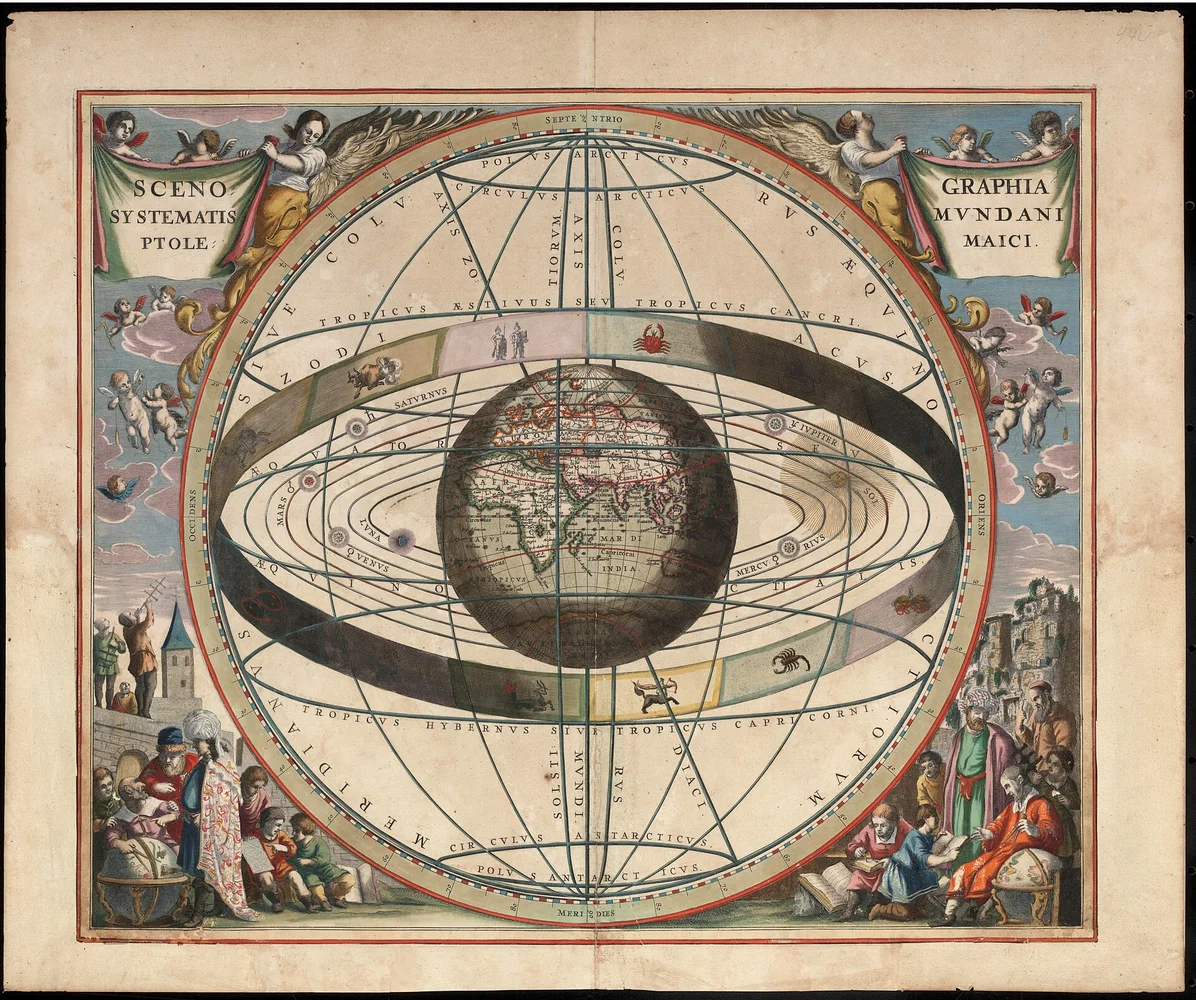
For most of Western history, the reigning astronomical worldview was geocentrism: the idea that Earth sits motionless at the center of the universe, with the sun, moon, planets, and stars revolving around it. This wasn’t merely a religious belief. It was a scientific framework backed by centuries of observation, mathematical prediction, and philosophical reasoning. Ptolemy’s geocentric model made remarkably accurate predictions about planetary positions. It worked.
Within that worldview, no astronomer would seriously ask “what if Earth moves?” That question didn’t compute. It was outside the paradigm.
Normal Science: Puzzle-Solving Under a Paradigm
Kuhn distinguished between two modes of science. The first, which occupies most of scientific history, he called normal science.
During normal science, researchers aren’t trying to overturn their field. They’re doing something more modest: solving puzzles within the accepted framework. They assume the paradigm is essentially correct and focus on filling in the details, extending its predictions, and resolving minor inconsistencies.
This is not a criticism. Normal science is enormously productive. It’s how the details of quantum mechanics were worked out after the initial revolution, how thousands of species were catalogued within the Darwinian framework, how biochemists mapped metabolic pathways within the cell theory paradigm.
The key feature of normal science is that anomalies, results that don’t fit the paradigm, are initially set aside. Scientists assume the problem lies with their instruments, experimental technique, or calculations, not with the paradigm itself. A single stubborn anomaly doesn’t shake a paradigm. Paradigms are sticky.
Anomalies Accumulate
But anomalies have a way of multiplying, especially as new instruments reveal what previous generations could not see. For example, as the field of cosmic inflation explained demonstrates, the detailed observations from the cosmic microwave background forced cosmologists to refine their models dramatically. Galileo’s telescope generated observations that the Ptolemaic system could not absorb: Jupiter’s moons and Venus’s phases were simply incompatible with a geocentric Earth. When a paradigm generates too many unresolved puzzles, tension builds. Researchers begin to acknowledge that the framework itself might be flawed. Kuhn called this state a crisis.
The geocentric worldview entered crisis as astronomers accumulated more precise observations. Ptolemy’s model required increasingly baroque additions, epicycles on top of epicycles, to account for the observed motions of planets. The system still worked, but it had lost its elegance. It felt like a patch job.
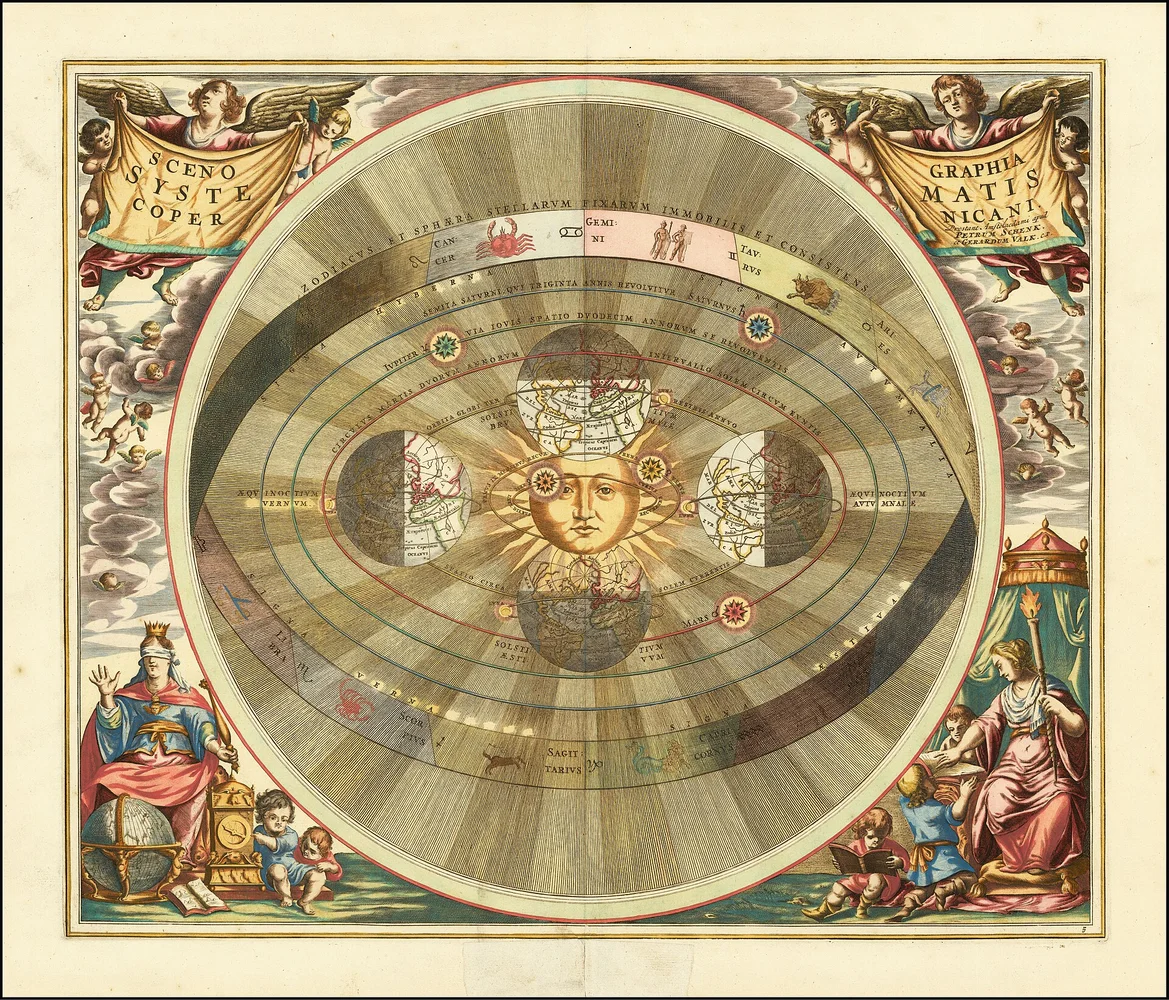
Copernicus didn’t resolve the crisis immediately. His heliocentric model, published in 1543, wasn’t obviously more accurate than Ptolemy’s. It required its own set of circular orbits. The revolution waited for Kepler’s ellipses (1609) and Newton’s laws (1687) to finally deliver a simpler, more powerful framework that made better predictions with fewer assumptions.
The Paradigm Shift: Revolution, Not Evolution
When the new framework arrives, the transition is not gradual. It is a gestalt switch, the same data suddenly looks completely different through the new lens.
Kuhn used the duck-rabbit optical illusion as an analogy. You look at the image and see a duck. Then something clicks, and you see a rabbit. You cannot see both simultaneously, and you cannot quite remember what it felt like to see only the duck. Scientists who live through a paradigm shift often report the same disorientation.
This is why paradigm shifts are incommensurable: Kuhn’s most controversial claim. The old and new paradigms are not simply different answers to the same question. They operate under different assumptions, use different concepts, and sometimes can’t even agree on what the fundamental question is. Newtonian mass and Einsteinian mass share a name but are defined differently – Newtonian mass is invariant, relativistic mass depends on velocity.
Famous Paradigm Shifts in History
The Copernican Revolution
The move from geocentrism to heliocentrism is the archetype. It required not just changing the position of Earth in the solar system, but abandoning Aristotelian physics (which explained why things stayed put on a stationary Earth), rethinking the nature of celestial versus terrestrial matter, and accepting a universe vastly larger than anyone had imagined.
| Key Assumptions (Old Paradigm) | Key Assumptions (New Paradigm) |
|---|---|
| Earth at center of universe | Sun at center of solar system |
| Celestial spheres perfect and unchanging | Sun is a star among many |
| Circular motion natural | Elliptical orbits possible |
| Epicycles to adjust predictions | Predictive, simpler model |
The Darwinian Revolution
Before Darwin, species were understood as fixed, separately created kinds. Natural theology argued that the complexity and diversity of life pointed to a designer. Darwin’s On the Origin of Species (1859) didn’t just propose a mechanism for biological change, it reframed the entire question. Life was no longer a set of designed objects to be catalogued. It was a historical process to be explained by natural forces operating over deep time.
| Key Assumptions (Old Paradigm) | Key Assumptions (New Paradigm) |
|---|---|
| Species fixed and separately created | Species share common ancestors |
| Purpose and design explain complexity | Natural selection explains adaptation without purpose |
| Humans unique creation | Humans part of the tree of life |
The Einsteinian Revolution
Newtonian mechanics was the gold standard of scientific success for two centuries. Einstein’s special relativity (1905) and general relativity (1915) didn’t simply improve Newton. They showed that space and time are not fixed absolutes but flexible quantities that bend and stretch in response to matter and motion. A Newtonian physicist and an Einsteinian physicist literally inhabit different conceptual universes. This transformation is closely related to what is spacetime; Einstein’s unified view that replaced separate notions of space and time.
| Key Assumptions (Old Paradigm) | Key Assumptions (New Paradigm) |
|---|---|
| Space and time are absolute | Spacetime is relative and dynamic |
| Mass is invariant | Mass-energy equivalence (E=mc²) |
| Gravity is an invisible force | Gravity is curved spacetime |
Continental Drift and Plate Tectonics

Alfred Wegener proposed in 1912 that continents had once been joined and drifted apart. He was largely ridiculed for decades: geologists had no mechanism to explain how continents could plow through oceanic rock. The paradigm shift waited until the 1960s, when seafloor spreading and paleomagnetic data provided both the evidence and the mechanism. Within a decade, plate tectonics went from fringe to foundation.
| Key Assumptions (Old Paradigm) | Key Assumptions (New Paradigm) |
|---|---|
| Continents fixed in position | Continents drift on moving plates |
| Ocean basins permanent features | Ocean floor created and recycled |
| No mechanism for large-scale change | Convection drives plate motion |
The Germ Theory of Disease
For most of history, disease was explained by miasma, bad air, or by imbalances in the body’s humors. The idea that invisible living organisms caused disease seemed absurd. Pasteur, Koch, and their contemporaries didn’t just discover bacteria. They rebuilt the entire framework of medicine around microbial causation, paving the way for vaccines, antibiotics, and modern epidemiology. This revolution is one of the most profound examples of how scientific theories can reshape an entire field.
| Key Assumptions (Old Paradigm) | Key Assumptions (New Paradigm) |
|---|---|
| Disease from bad air (miasma) | Disease from invisible pathogens |
| Illness caused by humoral imbalance | Specific microbes cause specific diseases |
| Treatment: bleeding, purging | Treatment: vaccines, antiseptics, antibiotics |
Resistance Is Not Irrationality
One of Kuhn’s most important, and often misunderstood, points is that scientists who resist a paradigm shift are not simply being stubborn or unscientific. Given what they know at the time, their resistance is often rational.
A new paradigm rarely arrives fully formed. It usually explains some things better than the old one while explaining others worse. Early heliocentrism couldn’t predict planetary positions more accurately than Ptolemy. Early plate tectonics lacked a complete mechanism. Early germ theory couldn’t explain all diseases.
Experienced scientists who have built careers on the old framework have legitimate reasons to be skeptical of a half-baked replacement. But the resistance isn’t solely about evidence, there are powerful institutional factors at work. Established scientists have reputational capital invested in the old paradigm. Their grant funding, publication records, and professional standing depend on a framework they helped build. Peer reviewers are often guardians of the established view. Younger scientists, with less to lose, are more willing to bet on something new. Kuhn noted that paradigm shifts often require a generational change, the old guard retires, and younger scientists who grew up with the anomalies are more willing to accept the new framework.
Max Planck, the physicist who helped launch quantum theory, captured this bitterly: “Science advances one funeral at a time.”
What Kuhn Got Right (and Where He’s Been Challenged)
Kuhn’s framework transformed the philosophy and history of science. But it has been challenged on several fronts.
The incommensurability problem is the most debated. Many philosophers argue that scientists can and do rationally compare competing paradigms: that there are objective criteria like predictive accuracy, explanatory scope, and mathematical simplicity that transcend any single framework. The shift from Newton to Einstein wasn’t just a social event; it was forced by precise measurements of Mercury’s orbit that Newton’s theory couldn’t explain.
Science is cumulative in important ways. When a paradigm is replaced, the old one isn’t simply discarded. Newtonian mechanics wasn’t wrong, it’s still used every day in engineering and space navigation. It was revealed to be a special case of a more general theory. Einstein’s equations reduce to Newton’s at low velocities and weak gravitational fields.
Normal science is often revolutionary. Some historians argue that Kuhn underestimated how much genuine conceptual innovation happens during normal science, not just during crises. The development of quantum electrodynamics, for example, involved continuous radical reimagining that doesn’t fit neatly into Kuhn’s “puzzle-solving” phase.
Why Paradigm Shifts Matter for How You Read Science News
Understanding paradigm shifts changes how you should evaluate scientific claims in the media.
When a study contradicts the scientific consensus, the headline-friendly interpretation is “science was wrong again.” But Kuhn’s framework helps you ask better questions: Is this a genuine anomaly that’s building toward a crisis in the field, or is it a single puzzling result that the existing paradigm will eventually absorb?
Most anomalies are absorbed. The vast majority of studies that appear to contradict established science are later explained, replicated, or revised. Genuine paradigm shifts are rare: and they’re recognized as such by the scientific community, not just by press releases.
The history of science also inoculates against two opposite errors: the idea that current science is the final word on everything, and the idea that because science has been wrong before, any claim is as good as any other. Paradigm shifts show that science is fallible and self-correcting: a feature, not a bug.
The Current Frontiers of Paradigm Pressure
Are any fields in Kuhn’s “crisis” mode today?
Quantum Gravity
Perhaps the clearest candidate. The two most successful theories in physics, general relativity and quantum mechanics, are mathematically incompatible. Every attempt to unify them has generated decades of theoretical work without a confirmed experimental prediction. String theory, loop quantum gravity, and causal dynamical triangulations are all competing pre-paradigm frameworks searching for a revolution. As string theory explained notes, this quest remains one of the deepest challenges in physics.
Cosmology
The standard model of cosmology faces anomalies in the form of the Hubble tension: different methods of measuring the expansion rate of the universe give significantly different answers. Dark matter has been hunted for decades without a direct detection. Dark matter explained explores what we know, what we don’t, and why it matters for the future of cosmology. These may be solvable puzzles, or they may be signs of a coming revolution.
Consciousness
The origin of consciousness remains entirely outside any accepted paradigm. We have no agreed-upon theory of how physical processes give rise to subjective experience, no consensus on which organisms are conscious, and not even agreement on what a satisfactory answer would look like.
Conclusion: Science as a Living Process
Kuhn’s paradigm shift framework gives us something invaluable: a realistic picture of science as a human enterprise with sociology, psychology, and history built in, without abandoning the idea that science converges on truths about the world.
Science is not a machine that grinds out facts. It is a community of people using the best tools available at the time, constrained by frameworks that mostly serve them well, occasionally confronted by anomalies that force them to tear everything down and rebuild.
That process is messier than the textbook version. It is also far more interesting: and far more powerful. The next time you see a headline that science has “changed its mind,” ask yourself: is this an anomaly being absorbed, or a worldview about to crack?
Sources
- Kuhn, T.S. (1962). The Structure of Scientific Revolutions. University of Chicago Press.
- Bird, A. (2018). Thomas Kuhn. Stanford Encyclopedia of Philosophy.
- Weinberg, S. (2001). Facing Up: Science and Its Cultural Adversaries. Harvard University Press.
- NASA Science. (2023). Dark Energy, Dark Matter. NASA.
- Cambridge University Press. (2022). Kuhn’s The Structure of Scientific Revolutions at 60.
- Nature. (2023). The Hubble tension: A crisis in cosmology? Nature, 618, 222–225.
What is a scientific paradigm shift?
A scientific paradigm shift is a fundamental change in the basic concepts and experimental practices of a scientific discipline, as described by Thomas Kuhn in his 1962 book The Structure of Scientific Revolutions.
Who proposed the concept of paradigm shifts in science?
Philosopher Thomas Kuhn proposed the concept of paradigm shifts in his influential 1962 book The Structure of Scientific Revolutions.
What are some examples of paradigm shifts in science?
Examples include the shift from a geocentric to a heliocentric model of the solar system, the acceptance of continental drift, the discovery that atoms are mostly empty space, and the germ theory of disease.
How does a paradigm shift differ from normal scientific progress?
Normal science involves steady accumulation of knowledge within an existing framework, while a paradigm shift is a sudden, disorienting upheaval that forces scientists to discard entire worldviews and rebuild from scratch.
What role do anomalies play in triggering a paradigm shift?
Anomalies are observations that cannot be explained by the current paradigm, and when they accumulate, they can trigger a crisis that leads to a paradigm shift, such as the discovery that H. pylori causes ulcers challenging existing beliefs about disease.
Further reading: Paradigm shift on Wikipedia