
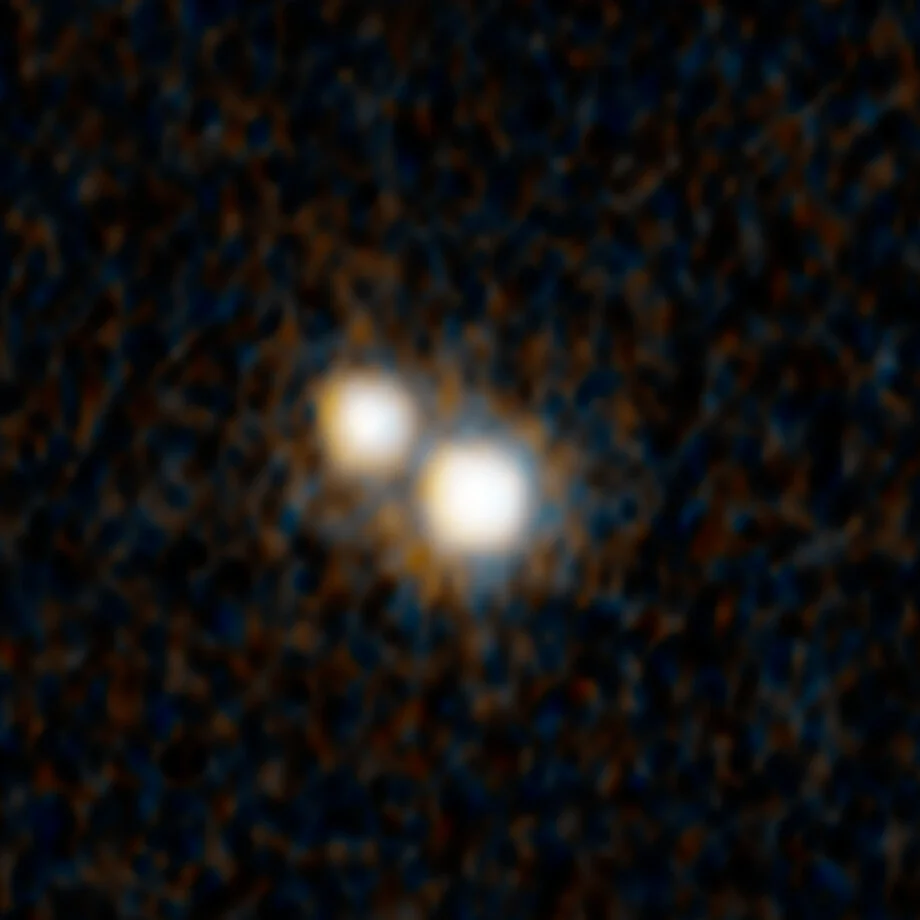
What is a quasar? A quasar is the most luminous persistent object in the universe. The brightest known quasar outshines its entire host galaxy by a factor of more than 100. It releases energy equivalent to trillions of suns, from a region smaller than our solar system. And it does this powered by nothing more exotic than gravity (the same force that holds you to Earth), operating on the most extreme scales nature allows. So what is a quasar, exactly? It is a hyper-luminous galactic core powered by a supermassive black hole in a feeding frenzy.
Quasars are not a different kind of object from galaxies. They are the active, brilliantly lit centers of galaxies in the process of feeding. Understanding what a quasar is means understanding what happens when a supermassive black hole has plenty to eat.
The Discovery That Confused Astronomers for a Decade
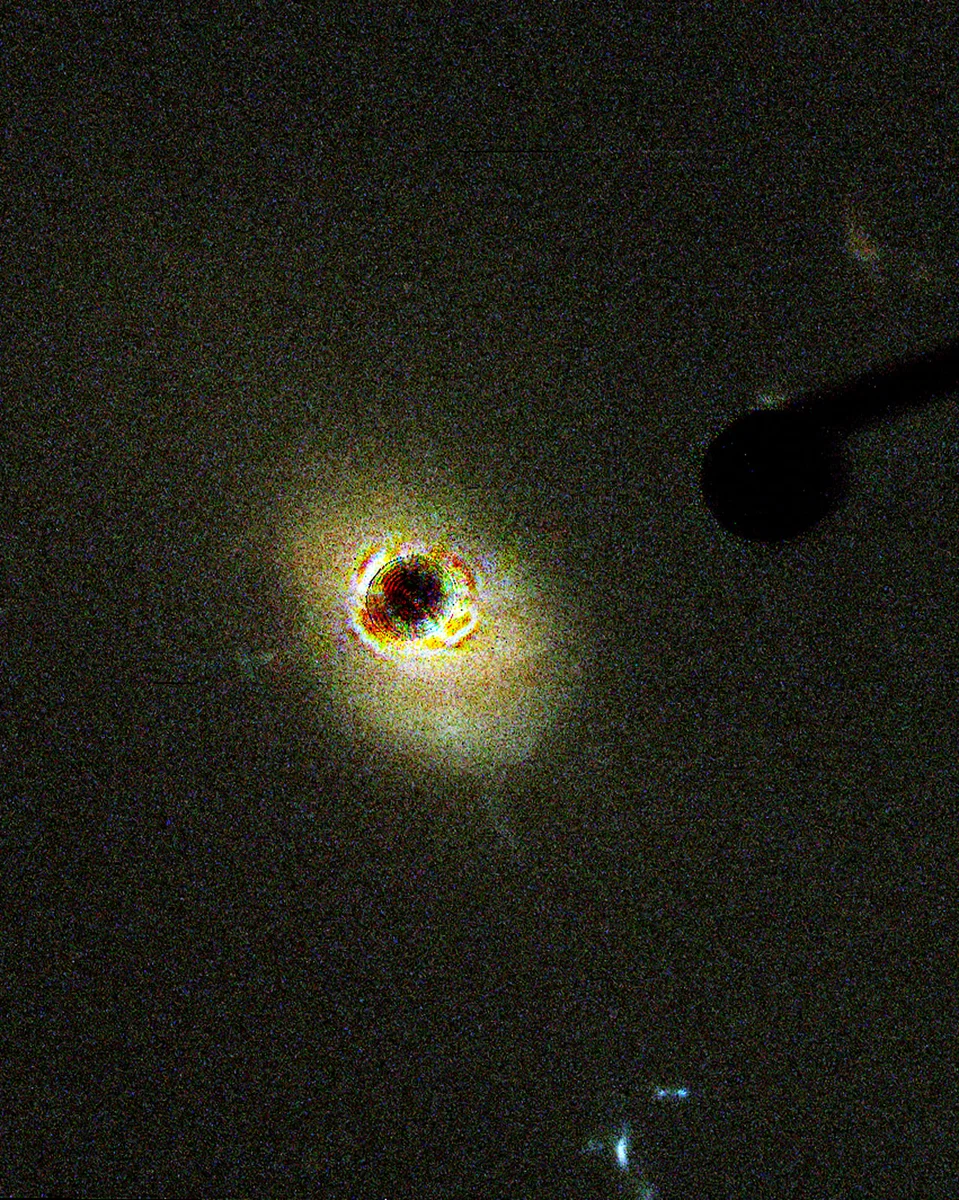
Quasars were first detected in the late 1950s as point-like sources of strong radio emission: sources that, on photographs, looked like faint blue stars rather than extended galaxies. Astronomers called them quasi-stellar radio sources, which was shortened to “quasars.” Most turned out to emit primarily in visible and infrared light rather than radio, but the name stuck.
The mystery deepened when Maarten Schmidt measured the spectrum of 3C 273 in 1963. Spectra of stars and galaxies show characteristic emission lines at known wavelengths. Schmidt found that 3C 273’s spectral lines were shifted dramatically toward the red: a cosmological redshift indicating the object was receding at 16% of the speed of light and was located about 2.5 billion light-years away. At that distance, to appear as bright as it did, 3C 273 had to be intrinsically far more luminous than any known galaxy. Yet it appeared point-like in telescopes.
The energy problem (how to produce galaxy-scale luminosity from a point source) was not resolved until the theory of accretion onto supermassive black holes became the accepted explanation in the 1980s.
The Engine: A Supermassive Black Hole Feeding
Every quasar is powered by a supermassive black hole: an object ranging from millions to tens of billions of solar masses. What makes it a quasar, rather than just a supermassive black hole, is what surrounds it: an accretion disk of gas and dust spiraling inward.
As material falls toward the black hole, it does not fall straight in. Angular momentum causes it to orbit, forming a flattened disk. Friction and magnetic effects within the disk convert gravitational potential energy into heat. The disk heats to millions of degrees, radiating intensely across the electromagnetic spectrum: ultraviolet, visible light, X-rays. At the inner edge of the disk, where material is being swallowed, temperatures reach tens of millions of degrees.
The efficiency of this process is extraordinary. Converting matter to energy via accretion can reach 10 to 40% efficiency, depending on the black hole’s spin. Nuclear fusion (the process that powers stars) converts less than 1% of matter to energy. A quasar engine is far more efficient than any star.
Perpendicular to the accretion disk, powerful jets of plasma can shoot outward at near-light speeds. These jets, in the most powerful quasars, can extend millions of light-years into intergalactic space, energizing and disrupting the surrounding environment.
Quasar Luminosity: Numbers That Defy Intuition

The most luminous known quasar, J0529-4351, was identified in 2024 and has a luminosity of approximately 5 × 10¹⁴ times the luminosity of the Sun: about 500 trillion solar luminosities. To sustain that output, its central black hole must be consuming roughly 370 solar masses of material per year.
The familiar quasar 3C 273 has a luminosity of about 4 trillion solar luminosities. If it were located 33 light-years from Earth (the distance of a nearby star), it would appear as bright as the Sun.
The Eddington luminosity sets a natural limit on how bright a quasar can get for a given black hole mass. At the Eddington limit, radiation pressure from the outgoing energy equals the inward gravitational force on infalling material. Exceeding this limit would blow away the accretion disk. The most luminous quasars are accreting near or at this limit, consuming material as fast as physics permits.
Quasars Through Cosmic Time
Quasars are most abundant at redshifts between 2 and 3: when the universe was between 2 and 3 billion years old. This “quasar epoch” represents a time when galaxies were young and rich in gas, with plenty of material available to fall into central black holes.
Today, quasars are rare. Most nearby galaxies, including the Milky Way, have supermassive black holes at their centers: but these black holes are largely starved of fresh material and emit only a fraction of quasar-level luminosity. Sagittarius A*, our galaxy’s central black hole, is about 4 million solar masses but produces almost no radiation by quasar standards. It is a dormant engine. Given sufficient gas (a galaxy merger providing fresh material), it could light up again.
This connection between quasar activity and galaxy evolution is one of the central themes of modern extragalactic astronomy. Quasars pump energy into their host galaxies through jets and radiation, heating the surrounding gas and suppressing star formation. This “quasar feedback” is thought to regulate how galaxies grow, preventing them from accumulating too many stars too quickly.
The James Webb Space Telescope and the Early Universe
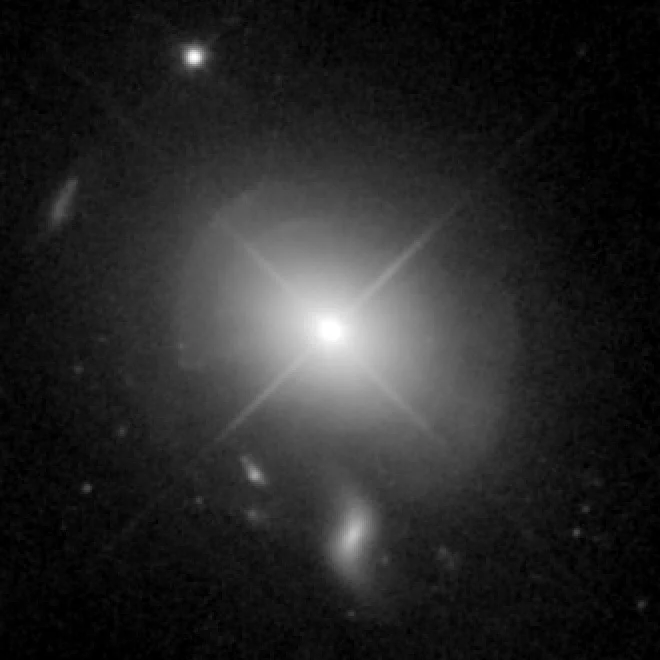
The James Webb Space Telescope has detected quasars at redshifts above 7: less than 800 million years after the Big Bang. These quasars host black holes already exceeding a billion solar masses, far too massive to have grown from stellar-mass seeds through conventional accretion alone.
How these supermassive black holes grew so large so quickly is one of the most pressing unsolved problems in astrophysics. Proposed mechanisms include rapid accretion at super-Eddington rates, direct collapse of massive primordial gas clouds, and mergers of massive star clusters. JWST observations are actively narrowing the field by measuring the environments, host galaxies, and accretion rates of the earliest quasars.
Active Galactic Nuclei: Quasars in Context
Quasars belong to a broader family of objects called active galactic nuclei (AGN): galaxy centers powered by accreting supermassive black holes. Depending on luminosity, viewing angle, and how much material the black hole is consuming, an AGN can appear as a quasar, a Seyfert galaxy, a blazer, a radio galaxy, or a LINER. These are not truly different objects: they are the same phenomenon observed under different conditions. The unifying model of AGN, developed in the 1990s, explains the apparent variety through orientation effects and accretion rate differences.
When the jet of an AGN happens to point directly toward Earth, the object appears as a blazar: the most extreme variant of quasar, with emission dominated by the relativistically boosted jet rather than the accretion disk. The physics of quasars connects supermassive black holes to the history of galaxy formation in the early universe. Understanding them requires understanding how accretion disks convert gravitational potential energy into radiation with extraordinary efficiency.
What is a quasar, simply explained?
A quasar is an extremely luminous galactic center powered by a supermassive black hole that is actively consuming material. As gas falls toward the black hole, it forms an accretion disk that heats to millions of degrees and radiates more intensely than hundreds of billions of stars combined. Quasars are the most luminous persistent objects in the universe and were most abundant when the universe was 2–3 billion years old.
How far away are quasars?
Most observed quasars are extremely distant: billions of light-years away. The nearest confirmed quasar, 3C 273, is about 2.5 billion light-years from Earth. The most distant quasars detected by the James Webb Space Telescope are over 13 billion light-years away, seen as they appeared less than a billion years after the Big Bang.
Are quasars dangerous?
Not to Earth. All known quasars are billions of light-years away: far too distant to affect our planet. A quasar at close range would be catastrophic: its radiation and particle jets would sterilize nearby space. But the universe contains no quasar within any relevant threat distance of Earth.
What is the difference between a quasar and a black hole?
A black hole is a region of spacetime where gravity prevents escape. A quasar is the luminous disk and jet structure around an actively feeding supermassive black hole. The black hole itself emits nothing: the quasar’s light comes from the accretion disk of infalling material, which converts gravitational energy to radiation before the material crosses the event horizon.
What happened to all the quasars?
Quasars were most common when galaxies were young and gas-rich. As galaxies evolved, they exhausted the fresh gas supply needed to fuel quasar-level accretion. Most supermassive black holes today are dormant or weakly active. The quasar era peaked at redshift 2–3 and has been declining since. Every large galaxy likely hosted a quasar phase in its past; today, only a small fraction are actively quasar-like.
Can the Milky Way become a quasar?
In principle, yes. Sagittarius Au003cemu003e, the Milky Way’s central black hole, is currently accreting at an extremely low rate: effectively dormant. If a large amount of gas fell into the galactic center (triggered, for example, by the ongoing approach and eventual merger of the Andromeda galaxy), Sagittarius Au003c/emu003e could reignite as an AGN or quasar. The merger with Andromeda is expected in roughly 4–5 billion years.
Sources
Schmidt, M. (1963). 3C 273: A Star-Like Object with Large Red-Shift. Nature, 197(4872), 1040. doi:10.1038/1971040a0
Salpeter, E.E. (1964). Accretion of Interstellar Matter by Massive Objects. The Astrophysical Journal, 140, 796–800. doi:10.1086/147973
Antonucci, R. (1993). Unified models for active galactic nuclei and quasars. Annual Review of Astronomy and Astrophysics, 31(1), 473–521. doi:10.1146/annurev.aa.31.090193.002353
Fan, X., Bañados, E., & Simcoe, R.A. (2023). Quasars and the Intergalactic Medium at Cosmic Dawn. Annual Review of Astronomy and Astrophysics, 61, 373–426. doi:10.1146/annurev-astro-052920-102455
Wolf, C. et al. (2024). The accretion of a solar mass per day by a 17-billion solar mass black hole. Nature Astronomy. doi:10.1038/s41550-024-02195-x
Hopkins, P.F., Richards, G.T., & Hernquist, L. (2007). An Observational Determination of the Bolometric Quasar Luminosity Function. The Astrophysical Journal, 654(2), 731–753. doi:10.1086/509629