
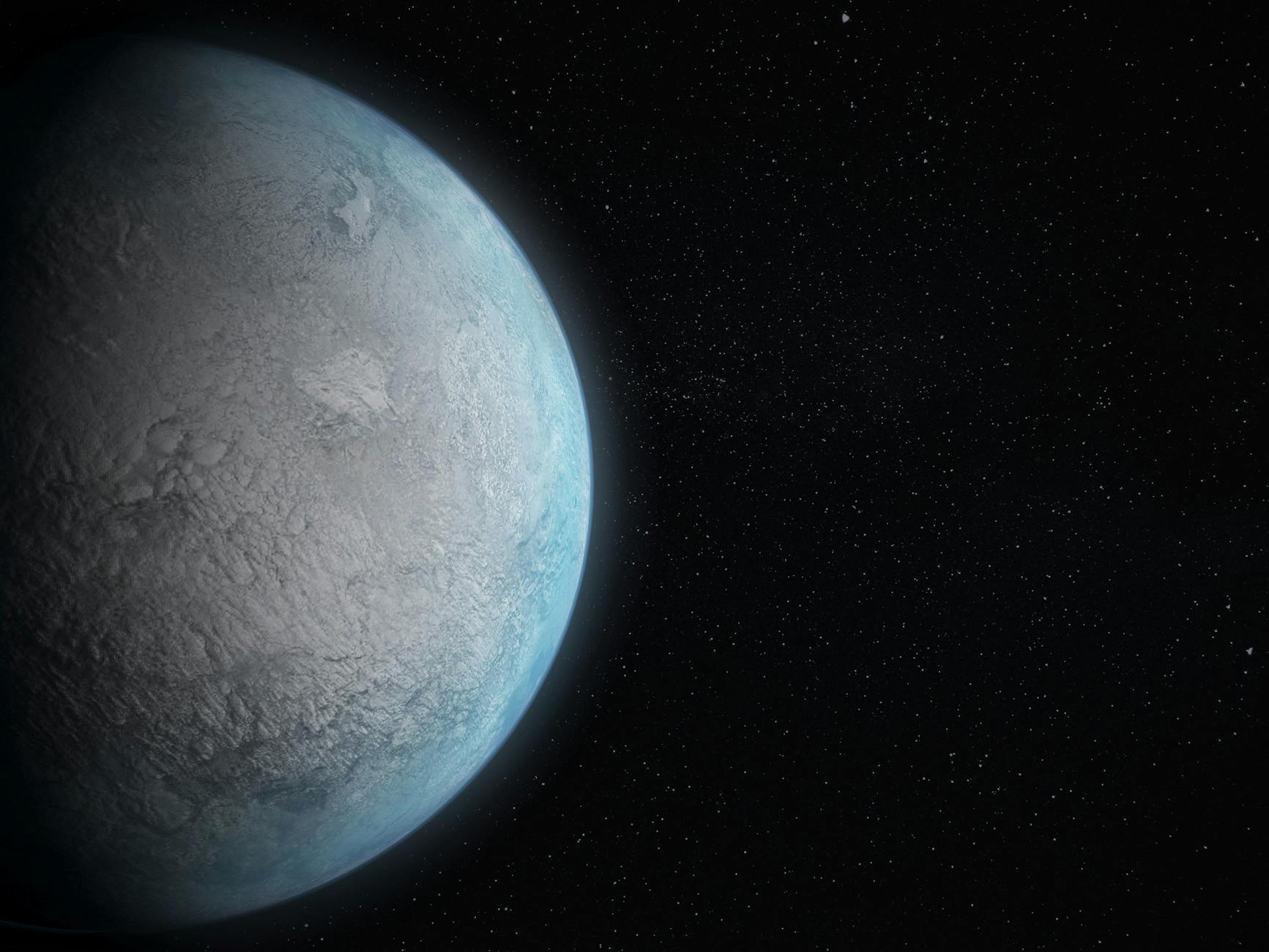
It sat unnoticed in the archive. In 2017, NASA’s Kepler Space Telescope recorded a faint, ten-hour shadow crossing HD 137010, 146 light-years away, before it vanished. What would become known as the HD 137010 b Kepler discovery began with a single overlooked data point.
The automated detection algorithms that sweep Kepler data for planets recorded only a single event and moved on. Finding a planet requires multiple transits; one shadow could be anything.
It took a PhD student nearly a decade to look again. Alexander Venner, digging through archival Kepler data, noticed that solitary dip. He ran the numbers. The geometry fit a planet roughly the size of Earth, orbiting its star on a nearly identical timetable: one trip around the sun every 355 days.

The Planet the Algorithm Missed: Discovering HD 137010 b
To appreciate why this discovery matters, let’s first consider how planet hunting usually works, and then explore how HD 137010 b nearly slipped through the net. The transit method works by watching for a star to dim slightly as a planet crosses in front of it. This “transit” occurs when a planet passes directly between its star and the observer, causing a slight, temporary dip in the star’s brightness. Each detected dimming is a data point. Two or more dimmings, equally spaced in time, confirm a repeating orbit and, with it, a planet.
Each Kepler K2 “Campaign” covered a roughly 80-day observing window. Campaign 15 captured just one transit of a planet with a year-long orbit, exactly what was recorded. The automated pipeline is designed to flag repeating patterns. A single event offers nothing to compare, so it doesn’t get flagged. Venner’s willingness to look beyond algorithm priorities is why HD 137010 b was found.

The HD 137010 b Kepler Discovery: One Transit in a Sea of Archives
The story of HD 137010 b is also the story of a growing realization in the exoplanet community: the Kepler archive almost certainly contains more planets we haven’t found yet.
Kepler observed more than 500,000 stars over its nine-year mission. For planets with orbital periods longer than about half the observation window, the mission may have captured only one or two transits, not enough for the automated pipelines to register a detection. Conservative estimates suggest dozens of long-period planet candidates are buried in Kepler and K2 data, waiting for researchers willing to scrutinize single-event anomalies that were dismissed as noise or instrumental artifacts.
HD 137010 b is proof that the strategy works. The target class (bright, nearby K-dwarfs with clean light curves) offers the best signal-to-noise for this kind of forensic search. As computational tools improve and more researchers apply careful human judgment to flagged-but-unconfirmed events, the archive will keep giving.

The Numbers That Matter
HD 137010 b has a radius 1.06 times that of Earth. In a catalog of thousands of exoplanets, that is remarkably close to home. Its orbital period is 355 days, ten days shorter than ours. Its host star, HD 137010, is a K-dwarf: smaller, cooler, and dimmer than the Sun, but a star class with notable advantages for habitability.
Because HD 137010 is cooler than the Sun, its habitable zone sits closer in. HD 137010 b’s 355-day orbit places it within or near that zone, but knowing exactly where depends on the star’s luminosity. The research team’s climate models account for this, which is why their habitability estimate is a probability rather than a firm answer.
The K-Dwarf Advantage
Much of the media attention in exoplanet science goes to M-dwarfs (the small red stars that are easy to survey and host TRAPPIST-1’s celebrated worlds). But a growing body of astrobiological research argues that K-dwarfs like HD 137010 may actually be the better hosts for life.
M-dwarfs are prone to violent stellar flares that can strip away planetary atmospheres over geological timescales. G-dwarfs like our Sun, while stable, have a main-sequence lifetime of roughly 10 billion years. K-dwarfs occupy a favorable middle ground. They are significantly less active than M-dwarfs, hospitable to long-lived atmospheres, and they burn for an estimated 15 to 30 billion years (up to three times longer than the Sun), potentially giving life on their planets far more time to develop than it took here on Earth.
HD 137010 is a quiet, well-behaved star with no documented history of extreme flare activity. That matters enormously when asking whether a planet in its orbit could hold onto an atmosphere long enough for anything interesting to happen.

What “40%” Actually Means
Because HD 137010 is cooler and dimmer than our Sun, HD 137010 b receives less than a third of the stellar energy that Earth receives. Researchers estimate that under bare-rock conditions (no atmosphere, no greenhouse warming), the planet’s equilibrium temperature could be as low as -90°F (-68°C).
But bare rock is rarely the full story. The research team ran climate models across a range of atmospheric compositions and found that HD 137010 b has approximately a 40% probability of falling within the “conservative” habitable zone, the range where liquid water could persist on a rocky surface under plausible atmospheric conditions.
The key variable is carbon dioxide. A CO₂-rich atmosphere acts as a thermal blanket, trapping infrared radiation that would otherwise escape to space. Early Earth likely relied on elevated CO₂ to stay warm when the young Sun burned roughly 30% dimmer than it does today. That same mechanism could, in principle, operate on HD 137010 b. The models that incorporate a moderate CO₂ atmosphere push the planet’s estimated surface temperature above freezing; those that don’t leave it well below.
A 40% probability is uncertain. But in a field where most habitable-zone candidates orbit flare-prone stars or have radii suggesting gas-rich interiors, a 40% shot on a quiet K-dwarf is a number worth taking seriously.
An Unknown Mass: The Uncertainty We Can’t Ignore
There is a significant caveat the discovery paper is candid about: we do not know HD 137010 b’s mass.
The transit method tells us only how large a planet is relative to its star, not how heavy it is. A planet 1.06 times Earth’s radius could be a dense, iron-rich rocky world. It could also be a lower-density mini-Neptune with a thick hydrogen-helium envelope that would make surface habitability a moot point regardless of temperature.
Distinguishing between these scenarios requires radial velocity measurements: detecting the tiny gravitational wobble that the planet induces in its host star’s motion as seen from Earth. HD 137010 is a tenth-magnitude K-dwarf, bright enough for follow-up with large ground-based spectrographs. A confirmed high density consistent with a rocky composition would significantly strengthen the case for HD 137010 b as a genuine habitable-zone candidate.
Waiting for the Next Transit
Confirmation of the planet itself also requires a second observed transit. The James Webb Space Telescope could be decisive; its infrared sensitivity is well-suited for detecting transits of small rocky planets around K-dwarfs. A single confirmed second transit would establish the orbital period, eliminate most false positives, and potentially allow initial atmospheric characterization (such as detecting CO₂ or other greenhouse gases).
The next predicted transit window can be calculated from the 2017 Kepler observation. That prediction carries some uncertainty because the orbital period is derived from a single data point, but the window is narrow enough to plan targeted observations around. If JWST or a large ground-based telescope catches it, the picture of HD 137010 b could change from a promising anomaly to a confirmed world.
The Quiet Question
HD 137010 b asks a quiet but pointed question: how close to the conditions for life might a nearby world actually come? It is not a guaranteed habitable world. It may be too cold, or wrapped in gas, or sitting at the outer edge of what its star’s warmth can reach. But it sits in the right orbital range, around the right kind of star, with the right size, and it was found not by a purpose-built survey but by a researcher who decided to look carefully at something everyone else had skipped.
The honest answer, for now, is that we do not know what HD 137010 b is. But the fact that we know it exists at all is a reminder that the archive is still speaking, and that someone just has to be listening.
Sources & Further Reading
- Venner, A., et al. (2026). “A Cool Earth-sized Planet Candidate Transiting a Tenth Magnitude K-dwarf From K2.” The Astrophysical Journal Letters, 997, L38.
- NASA Exoplanet Archive. Exoplanet Archive: HD 137010. NASA/IPAC.
- Kopparapu, R. K., et al. (2013). “Habitable Zones Around Main-Sequence Stars: Dependence on Planetary Mass.” The Astrophysical Journal, 765(2), 131.
- Cuntz, M., & Guinan, E. F. (2016). “About Exobiology: The Case for Dwarf K Stars.” The Astrophysical Journal, 827(1), 79.
Further reading: Exoplanet on Wikipedia