
Most stars in the Milky Way do not travel alone. Observations reveal that more than half of all sun-like stars exist in binary star systems explained by gravitational pairing. In these systems, two stars orbit a common center of mass. Binary star systems are not a rarity but a dominant configuration in the galaxy. Understanding how they form, evolve, and interact is fundamental to modern astrophysics. These systems provide the most direct method for measuring stellar masses and reveal dramatic phenomena such as novae and supernovae. The mechanics of binary star systems explained through Kepler's laws and Newtonian gravity offer a clear framework for predicting stellar orbits and interactions.
Binary Star Systems Explained and Their Prevalence
Binary stars are more common than single stars. According to a 2010 study by Raghavan et al. published in the Astrophysical Journal Supplement Series, approximately 56 percent of solar-type stars in the solar neighborhood are members of multiple systems, with binaries being the most frequent. This means that for every star like the Sun, there is likely at least one other star bound to it by gravity. The fraction is even higher among massive O-type stars, where binary prevalence may exceed 70 percent based on a 2012 study by Sana et al. in Science. The implication is profound: the Sun is actually in the minority as a solitary star.
The high frequency of binaries has major consequences for stellar evolution. Mass transfer between stars, changes in orbital dynamics, and the eventual merger or explosion of one component all depend on binary interactions. Ignoring binary star populations would leave large gaps in our understanding of the galaxy.
Types of Binary Star Systems Explained
Astronomers classify binary systems based on how they are detected and observed. Each type reveals different physical properties. The different types of binary star systems explained below highlight the variety of observational techniques used.
Visual Binary Star Systems Explained
In visual binaries, both stars can be resolved through a telescope. The pair appears as two distinct points of light. The classic example is Albireo in the constellation Cygnus. Albireo consists of a golden-yellow primary star and a fainter blue companion. The two stars orbit each other over a period of approximately 75,000 years. Visual binaries require long-term observation to map their orbits. The angular separation between the stars must be large enough for the telescope to distinguish them. Most nearby visual binaries have orbital periods ranging from decades to centuries.
Spectroscopic Binaries: Binary Star Systems Explained
Spectroscopic binaries cannot be resolved visually even with powerful telescopes. Instead, astronomers detect them through Doppler shifts in their spectra. As the two stars orbit, one moves toward Earth while the other moves away. This motion causes the spectral lines to shift alternately to shorter and longer wavelengths. By observing these periodic shifts, astronomers can determine the orbital velocity and, with additional information, the masses of the stars. Most spectroscopic binaries are close systems with orbital periods of days or weeks.
Eclipsing Binaries: Binary Star Systems Explained
Eclipsing binaries are a special case in which the orbital plane is aligned nearly edge-on to Earth. As the stars cross each other's face, the total brightness of the system dims predictably. The light curve shows two dips: a primary eclipse when the brighter star is partially occulted and a secondary eclipse when the fainter star is partially occulted. The duration and depth of the eclipses allow astronomers to calculate the sizes and temperatures of both stars. Algol, the "Demon Star" in Perseus, is the most famous eclipsing binary.
Contact Binaries

In contact binaries, the two stars are so close that they share a common outer envelope of gas. Their surfaces actually touch or nearly touch. These systems are called overcontact binaries. The stars in a contact binary orbit each other in hours. The shared envelope allows mass to flow from one star to the other. This process dramatically alters the evolution of both components. W Ursae Majoris variables are a well-known subtype of contact binaries.
Mass Transfer and Explosive Phenomena
When binary stars are close enough, gravitational attraction can pull material from one star onto its companion. This process is called mass transfer. It occurs when one star expands into a giant and its outer layers overflow the Roche lobe, a teardrop-shaped region of gravitational influence around each star. The transferred material spirals onto the second star, forming an accretion disk.
Mass transfer leads to two spectacular events.
Novae
A nova occurs in a binary system containing a white dwarf and a main-sequence or red giant companion. The white dwarf is a dense, Earth-sized remnant of a dead star. Its strong gravity pulls hydrogen-rich gas from the companion onto its surface. The hydrogen accumulates, compresses, and heats until it reaches temperatures sufficient for thermonuclear fusion. A runaway fusion reaction then erupts on the white dwarf's surface, causing a sudden and dramatic brightening. The star can increase in brightness by a factor of ten thousand or more in hours. Unlike a supernova, a nova does not destroy the white dwarf. After the explosion, the process repeats. Recurrent novae like RS Ophiuchi have been observed to erupt multiple times over decades.
Type Ia Supernovae
Type Ia supernovae are far more energetic than novae. They completely destroy the white dwarf. One model for their origin involves a binary system in which a white dwarf accretes matter from a companion until it reaches the Chandrasekhar limit of approximately 1.4 solar masses. At this critical mass, gravitational pressure triggers runaway carbon fusion, and the white dwarf explodes. Because the Chandrasekhar limit is nearly constant, Type Ia supernovae have remarkably uniform peak luminosities. This makes them invaluable as "standard candles" for measuring cosmic distances. Observations of distant Type Ia supernovae led to the discovery of dark energy and the accelerating expansion of the universe.
Example: Sirius B
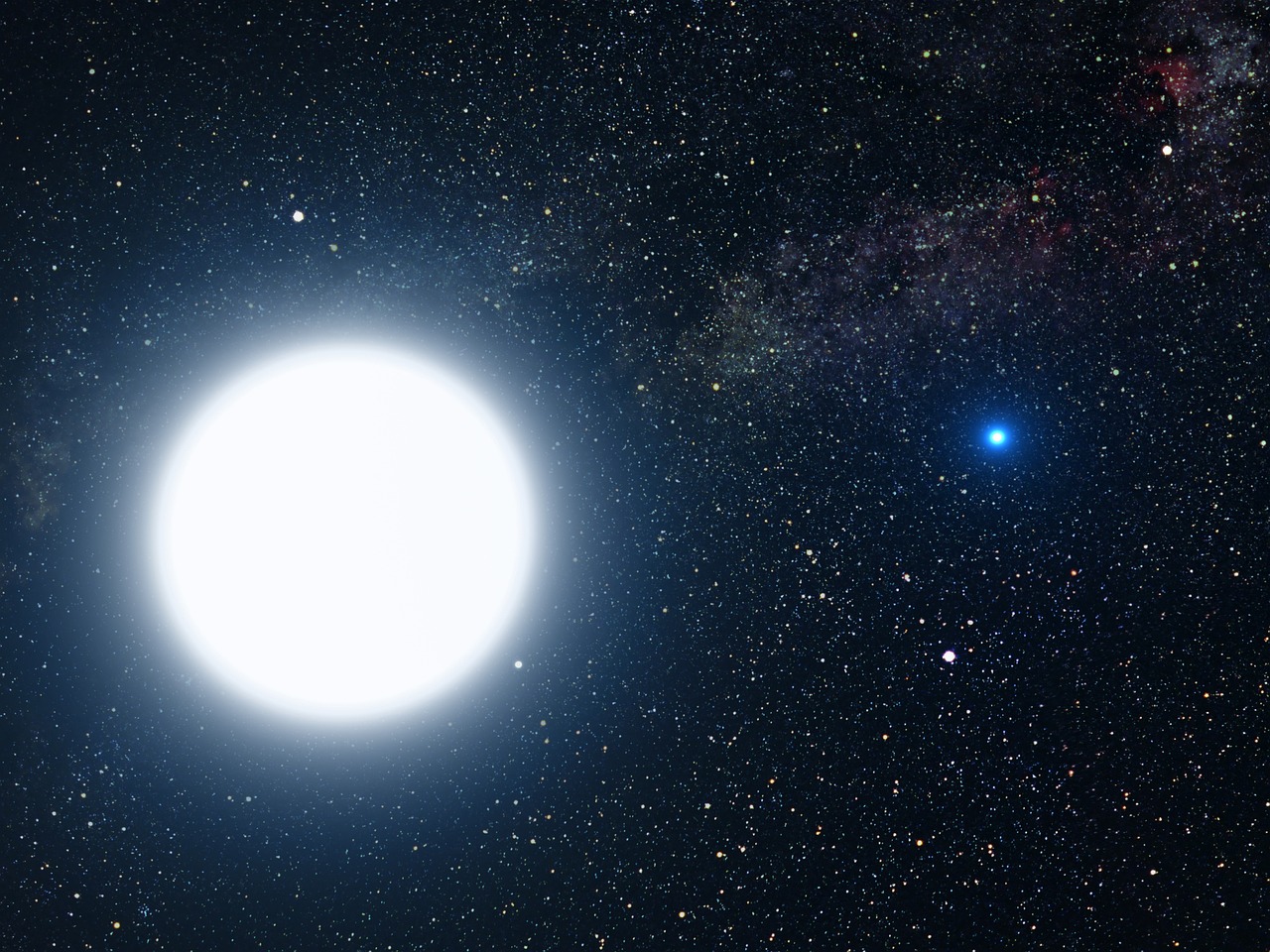
The brightest star in the night sky, Sirius, is actually a binary system. Sirius A is a main-sequence star. Its companion, Sirius B, is a white dwarf. Sirius B was the first white dwarf ever discovered. It has a mass about equal to the Sun but a radius comparable to Earth. Sirius B is not currently accreting material because the two stars are too far apart for mass transfer. However, it demonstrates the endpoint of stellar evolution that can lead to novae and supernovae in closer binaries.
Kepler's Laws and Measuring Stellar Masses
Binary star systems are the only direct way to measure the mass of a star. The method relies on Kepler's laws of planetary motion, modified by Newton's law of gravitation.
Kepler's Third Law

Kepler's third law states that the square of the orbital period of two bodies is proportional to the cube of the semi-major axis of their orbit. For a binary system:
P^2 = (4π^2 / G(M1 + M2)) * a^3
Here:
- P is the orbital period
- a is the semi-major axis (the average distance between the stars)
- G is the gravitational constant
- M1 and M2 are the masses of the two stars
By measuring the period and the separation of the stars, astronomers can calculate the sum of their masses. If the system is also visual or eclipsing, the individual masses can be determined.
Applying the Law
For a visual binary, astronomers track the positions of both stars over many years. They plot the elliptical orbit, measure the semi-major axis, and note the period. Using Kepler's third law, they obtain the total mass. If the system is also a spectroscopic binary, the Doppler shifts give the relative velocities, allowing the mass ratio to be calculated. Individual masses then follow.
For eclipsing binaries, the light curve and radial velocity curve combine to give exact masses and radii. The components of eclipsing binaries are among the most precisely known stellar masses in astronomy.
This method reveals that stars span a wide range of masses. The smallest red dwarfs have masses around 0.08 solar masses. The most massive known stars exceed 100 solar masses. Without binary star systems, these measurements would rely on indirect models with large uncertainties. For deeper context, explore our guide to Stars and Planets.
Example: Albireo
Albireo is a visual binary located approximately 430 light-years from Earth. The primary star is a K-type giant, yellowish in color. The secondary is a B-type main-sequence star, appearing blue. Their orbital period is roughly 75,000 years, far too long for a complete orbit to have been observed since telescopic discovery. Nevertheless, the system is a favorite among amateur astronomers because of the striking color contrast. Albireo illustrates how many binaries have extremely long periods, making them difficult to study dynamically.
1. What is a binary star system?
A binary star system consists of two stars that orbit a common center of mass due to their mutual gravitational attraction. They are bound together and usually form at the same time from a single molecular cloud.
2. How common are binary star systems?
More than half of all sun-like stars are in binary star systems. The fraction is higher for more massive stars. Studies show that about 56 percent of solar-type stars have at least one companion.
3. What is the difference between a nova and a supernova in a binary system?
A nova is a thermonuclear explosion on the surface of a white dwarf that does not destroy the star. A Type Ia supernova is a catastrophic explosion that completely destroys a white dwarf when it exceeds the Chandrasekhar limit.
4. How do astronomers measure the mass of stars in a binary system?
Astronomers use Kepler's third law, which relates the orbital period and separation to the total mass of the system. With additional data from spectroscopy or eclipses, they determine the individual masses.
5. What is Albireo and why is it important?
Albireo is a famous visual binary star in the constellation Cygnus. Its golden and blue components create a striking visual contrast. It is often used as a test object for telescope resolution and polar alignment.
Sources & References
- Raghavan, D., et al. (2010). "A Survey of Stellar Families: Multiplicity of Solar-Type Stars." The Astrophysical Journal Supplement Series, 190(1), 1-42. https://iopscience.iop.org/article/10.1088/0067-0049/190/1/1
- Sana, H., et al. (2012). "Binary Interaction Dominates the Evolution of Massive Stars." Science, 337(6093), 444-446. https://www.science.org/doi/10.1126/science.1223344
- NASA. "Binary Star Systems." NASA Exoplanet Exploration. https://exoplanets.nasa.gov/faq/8/what-is-a-binary-star-system/
- ESA/Hubble. "Binary Star Systems." European Space Agency. https://esahubble.org/wordbank/
- Carroll, B. W., & Ostlie, D. A. (2017). An Introduction to Modern Astrophysics. 2nd ed. Cambridge University Press.
Further reading: Binary star on Wikipedia