
Every second, trillions of neutrinos pass through your body unnoticed. They travel through rock, water, and air without slowing down. They originate from nuclear reactions inside stars, from exploding supernovae, and from radioactive decay on Earth. These particles, often called ghost particles, are among the most abundant in the universe. Yet for decades, physicists struggled to prove they existed. Understanding what are neutrinos requires examining their unique properties, the ingenious detectors that catch them, and the surprising discovery that they do have mass.
What Are Neutrinos? The Ghost Particles That Defy Ordinary Matter
Neutrinos belong to a family of particles called leptons, which also includes electrons and muons. They carry no electric charge and interact only through the weak nuclear force and gravity. Gravity is too weak to influence them at atomic scales. That leaves only the weak force, which operates over distances smaller than a proton. As a result, a neutrino can travel through a light-year of solid lead without interacting with a single atom. This property earned neutrinos the nickname ghost particles.
Three types, or flavors, of neutrinos exist. The electron neutrino pairs with the electron. The muon neutrino pairs with the muon. The tau neutrino pairs with the tau lepton. Each flavor has an associated antimatter counterpart, the antineutrino. Physicists detect all these varieties in experiments, but they behave identically for most purposes.
The weak force governs neutrinos exclusively. The strong force that binds atomic nuclei does not affect them. The electromagnetic force that interacts with charged particles ignores them entirely. This selective interaction explains why neutrinos are so difficult to catch. A beam of neutrinos can pass through a detector filled with thousands of tons of steel and water without leaving a trace. Detecting even a handful of interactions requires enormous facilities and years of observation. To truly grasp what are neutrinos, one must appreciate how their ghostly nature stems from this near-total avoidance of ordinary matter.
What Are Neutrinos and Why Do They Interact So Rarely
The weak force has a very short range, roughly 0.1 percent of the diameter of a proton. For a neutrino to interact, it must come within that tiny distance of a target particle. Given that atoms are mostly empty space, the chance of such a close approach is vanishingly small. A typical neutrino has a 1 in 10 billion chance of interacting while passing through the Earth. Most neutrinos that arrive from the Sun have already streamed straight through the planet without any interaction.
The probability of interaction depends on neutrino energy. Higher energy neutrinos have a larger cross section, meaning they interact more often. Low energy neutrinos, like those from the Sun, are especially elusive. The human body contains roughly 100 trillion trillion atoms. Even so, only about one solar neutrino per decade interacts with a single person’s atoms.
To compensate for this rarity, detectors must be both massive and sensitive. The Super-Kamiokande detector in Japan contains 50,000 tons of ultra-pure water. The IceCube Neutrino Observatory at the South Pole uses a cubic kilometer of Antarctic ice. These enormous volumes increase the chance that a neutrino will hit something. Even then, experiments detect only a few hundred events per year from natural sources.
How Do We Detect Neutrinos in Massive Underground Detectors?
Neutrino detectors must be placed deep underground to block out cosmic rays and other background radiation. Cosmic rays constantly bombard the surface, producing signals that would overwhelm neutrino interactions. A kilometer of rock between the detector and the surface filters out nearly all this noise.

The most common detection method involves observing Cherenkov radiation. When a neutrino collides with an atom, it produces a charged particle that travels faster than light does in the surrounding medium. This creates a cone of blue light, analogous to a sonic boom. Photodetectors lining the walls of the tank capture this light. By analyzing the timing and pattern, physicists determine the neutrino’s direction, energy, and flavor.
The Homestake experiment, built more than a mile underground in South Dakota, pioneered neutrino detection in the 1960s. It used 380,000 liters of dry cleaning fluid (tetrachloroethylene) rich in chlorine. Neutrinos converted chlorine atoms into radioactive argon, which chemists extracted and counted. The experiment famously detected only one-third of the predicted number of solar neutrinos, a discrepancy that led to major discoveries.
Modern detectors like Super-Kamiokande use thousands of photomultiplier tubes to detect individual bursts of Cherenkov light. IceCube uses strings of optical sensors frozen into the Antarctic ice sheet. The KM3NeT detector, currently under construction in the Mediterranean Sea, will use deep ocean water as its detection medium. Each approach builds on the same principle: create a transparent mass as large as possible and watch for flashes of light.
Solar Neutrinos and the Mystery of the Missing Neutrinos
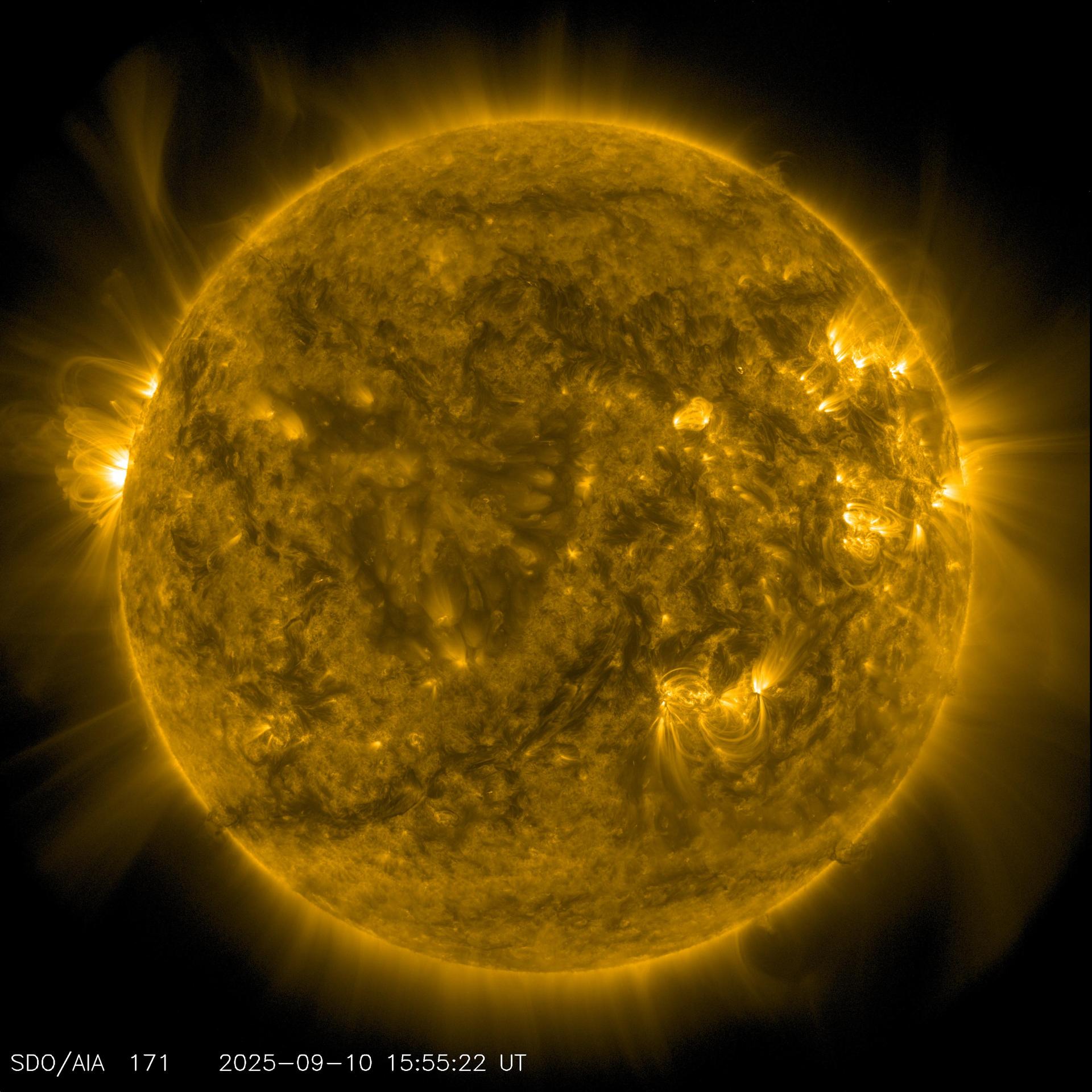
The Sun produces neutrinos in abundance through nuclear fusion. In the proton-proton chain that converts hydrogen to helium, neutrinos emerge directly from the core. Unlike light, which bounces within the Sun for thousands of years before escaping, neutrinos stream out almost instantly. This gives astronomers a direct view into the solar core.
The Homestake experiment detected fewer solar neutrinos than theoretical models predicted. This deficit became known as the solar neutrino problem. For three decades, physicists argued over the cause. Some thought the models of the Sun were wrong. Others suspected the neutrinos were changing form during their journey from the Sun to Earth.
To investigate, the Sudbury Neutrino Observatory (SNO) in Canada used heavy water instead of ordinary water. Heavy water contains an extra neutron in its hydrogen atoms. This allowed SNO to detect all three flavors of solar neutrinos simultaneously. The results showed that the total number of neutrinos matched predictions. The missing electron neutrinos had simply transformed into muon and tau neutrinos during their flight.
This transformation, called neutrino oscillation, required neutrinos to have mass. In the Standard Model of particle physics, neutrinos were originally assumed to be massless. The discovery proved the model was incomplete. It earned Takaaki Kajita and Arthur McDonald the 2015 Nobel Prize in Physics.
Neutrino Oscillation and the Surprise of Mass
Neutrino oscillation occurs because the three flavor states are not the same as the three mass states. Each flavor is a mixture of different mass states. As a neutrino travels, these mass components move at slightly different speeds due to their different masses. The mixture changes over distance, altering the observed flavor.
This phenomenon only works if neutrinos have nonzero mass and if the mass states are not identical. The mixing angles determine how strongly each flavor combines with each mass state. Three mixing angles have been measured experimentally. The largest angle, theta_12, governs solar neutrino oscillations. A smaller angle, theta_23, controls atmospheric neutrino oscillations involving muon neutrinos.

The fact that neutrinos oscillate means they must have mass. But their masses are extremely tiny. The heaviest neutrino has a mass at most a few millionths that of an electron. Physicists do not yet know the absolute masses or the ordering of the three mass states. The neutrino mass hierarchy, whether the two lighter ones or the two heavier ones are closer together, remains an open question. Several experiments, including JUNO and DUNE, aim to resolve this in the coming decade.
The discovery of neutrino mass was a complete surprise. In the Standard Model, neutrinos are the only fermions with no right-handed state. Without a right-handed partner, the Higgs mechanism cannot generate a mass term of the conventional type. This indicates that neutrino masses arise from a different mechanism, likely involving physics beyond the Standard Model. Many theorists believe this mechanism is connected to the origin of matter-antimatter asymmetry in the universe.
Supernova 1987A: A Neutrino Breakthrough
On February 23, 1987, a supernova exploded in the Large Magellanic Cloud, a satellite galaxy of the Milky Way. Designated SN 1987A, it was the closest supernova observed since 1604. Before the light from the explosion reached Earth, a burst of neutrinos arrived. Three underground detectors, including Kamiokande-II and IMB, recorded a total of 24 neutrino events over 13 seconds.
This detection confirmed theoretical predictions that 99 percent of a supernova’s energy is released as neutrinos. The neutrinos escape the collapsing stellar core long before the shock wave reaches the surface. They provide a direct signal of the explosion mechanism. The detected neutrinos had energies consistent with models of core-collapse supernovae. Explore our guide to Matter and the Physical World for more context.
The 1987A event also constrained neutrino properties. The fact that the neutrinos arrived over just 13 seconds after traveling 168,000 years set a tight limit on any difference in speed between neutrinos and light. This ruled out many proposed explanations for neutrino mass. Future supernova neutrino bursts, if detected by current massive detectors like Super-Kamiokande and IceCube, would provide even more detailed information.
What are neutrinos made of?
Neutrinos are elementary particles. They are not made of smaller constituents. They belong to the lepton family of particles in the Standard Model.
How do neutrinos get mass if they are not in the Higgs field?
Neutrinos likely get mass through a different mechanism. The most popular idea is the seesaw mechanism, which involves a hypothetical very heavy right-handed neutrino. This would explain why neutrinos are so light compared to other fermions.
Can neutrinos travel faster than light?
No. A 2011 experiment called OPERA initially reported neutrinos traveling faster than light. Further analysis revealed a loose fiber optic cable causing timing errors. Neutrinos adhere to the cosmic speed limit.
Are neutrinos dangerous to humans?
No. Neutrinos interact so rarely that they pose no health risk. Even during a supernova explosion, the neutrino flux would not harm a person. The particles pass through matter without depositing significant energy.
How many neutrinos pass through your body each second?
Approximately 100 billion solar neutrinos pass through every square centimeter of your body each second. Combined with atmospheric and reactor neutrinos, the total reaches about 1 trillion per second.
Sources & References
- Particle Data Group. “Neutrino Properties.” Lawrence Berkeley National Laboratory. https://pdg.lbl.gov/2023/reviews/rpp2023-rev-neutrino-mixing.pdf
- Super-Kamiokande Collaboration. “Solar Neutrino Results.” Kamioka Observatory, Institute for Cosmic Ray Research, University of Tokyo. https://www-sk.icrr.u-tokyo.ac.jp/sk/sk-solar.html
- IceCube Neutrino Observatory. “Detection of High-Energy Neutrinos.” University of Wisconsin-Madison. https://icecube.wisc.edu/science/neutrinos/
- NobelPrize.org. “The Nobel Prize in Physics 2015: Takaaki Kajita and Arthur B. McDonald.” https://www.nobelprize.org/prizes/physics/2015/summary/
- Hirata, K. et al. “Observation of a neutrino burst from the supernova 1987A.” Physical Review Letters, 1987. https://journals.aps.org/prl/abstract/10.1103/PhysRevLett.58.1490
Further reading: NASA: exploring the universe, and Neutrino on Wikipedia.