
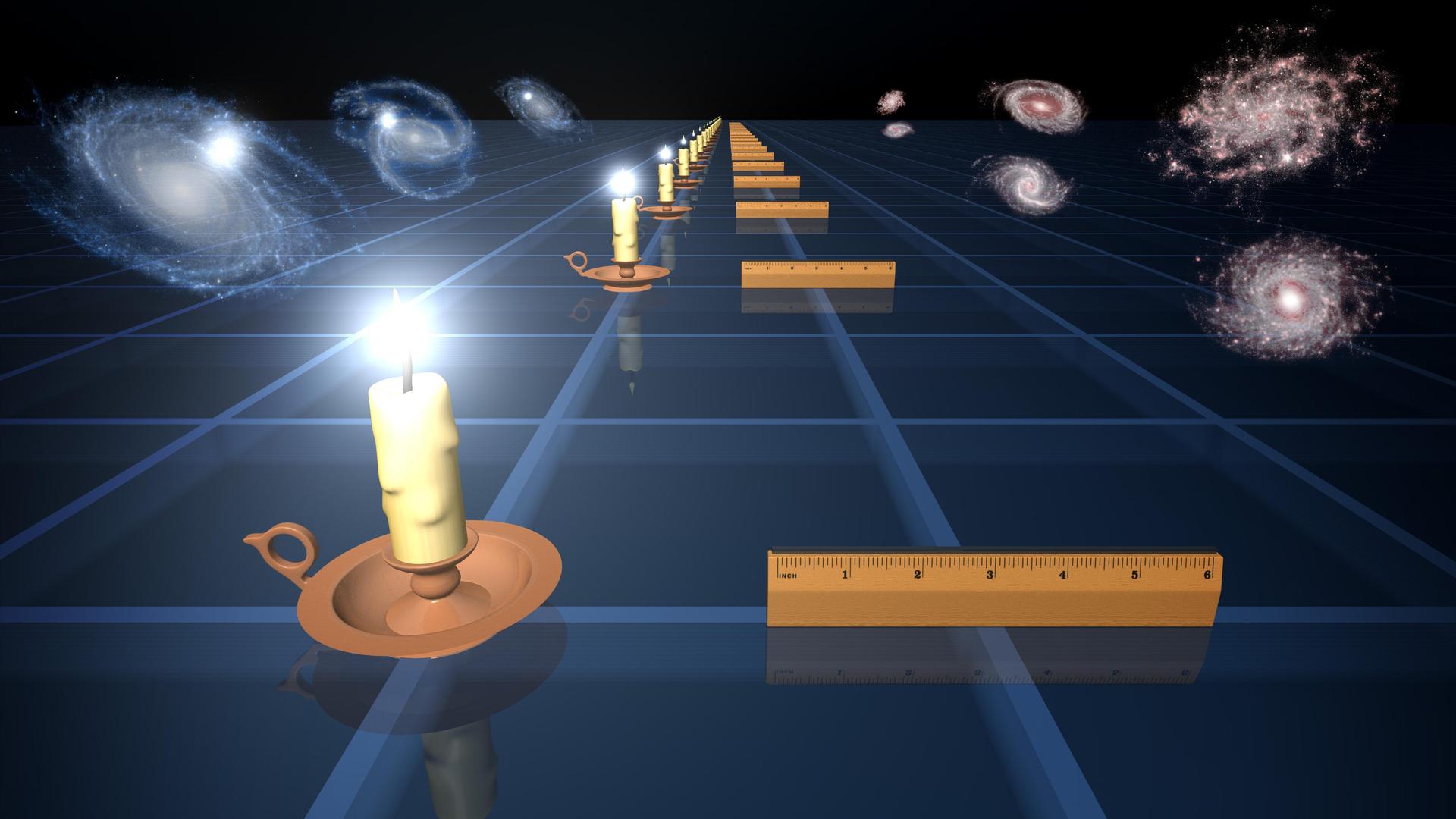
For over a century, astronomers have measured how fast the universe expands. The number that describes this expansion is called the Hubble constant (H0), named after Edwin Hubble. But two different methods of measuring H0 give different answers. This gap is called the Hubble tension. It is one of the most important unsolved problems in modern cosmology. To understand what is the Hubble tension, one must recognize that it represents a fundamental challenge to the standard model of cosmology.
Scientists do not know what causes the Hubble tension. Some think it is a measurement error. Others believe it points to new physics beyond the standard model of cosmology. This article explains what H0 is, how scientists measure it, why the two methods disagree, and what this disagreement might mean.
What is the Hubble Tension? A Precise Definition
The Hubble constant describes how fast the universe expands today. It tells astronomers the relationship between the distance to a galaxy and how quickly it moves away from Earth. In simple terms, the farther a galaxy is, the faster it recedes.
H0 is measured in units of kilometers per second per megaparsec (km/s/Mpc). A megaparsec is about 3.26 million light-years. If H0 is 70 km/s/Mpc, a galaxy 1 megaparsec away moves away at 70 km/s. A galaxy 10 megaparsecs away moves at 700 km/s.
The exact value of H0 has been debated for decades. But the current dispute is more serious than any previous one.
What Is the Hubble Tension? Core of the Crisis
The Hubble tension is the persistent and statistically significant mismatch between two high-precision measurements of the cosmic expansion rate. One method relies on the cosmic distance ladder using nearby objects, yielding approximately 73 km/s/Mpc. The other method uses the cosmic microwave background (CMB) from the early universe, yielding approximately 67 km/s/Mpc. The gap of about 5 km/s/Mpc represents a 5-sigma discrepancy, meaning the probability that it arises from random chance is less than one in a million. This tension is a crisis because it challenges the reliability of the standard cosmological model. To fully grasp what is the Hubble tension, one must appreciate that this 5-sigma discrepancy leaves virtually no room for statistical fluke.
Two Methods to Measure the Hubble Constant
Astronomers use two main approaches to measure H0. Each relies on different physics and different observations.
The Cosmic Distance Ladder
The first method uses a step by step process. Astronomers measure distances to nearby objects, then use those distances to calibrate measurements of farther objects. This is called the cosmic distance ladder.
The first step uses parallax. Astronomers measure the apparent shift of a star as Earth orbits the Sun. This gives a direct geometric distance to stars within a few thousand light-years.
The second step uses Cepheid variable stars. These stars pulsate at rates that depend on their intrinsic brightness. By comparing their apparent brightness to their known intrinsic brightness, astronomers calculate their distance. The Hubble Space Telescope has observed Cepheids in galaxies up to about 100 million light-years away.
The third step uses Type Ia supernovae. These exploding stars have a nearly uniform peak brightness. They serve as standard candles for distances across billions of light-years.
Combining these steps, teams like the SH0ES collaboration (led by Adam Riess) have measured H0 with high precision. Their most recent result is 73.0 ± 1.0 km/s/Mpc.
Method 2: The Cosmic Microwave Background
The second method uses the early universe. Scientists study the CMB, the faint glow left over from the Big Bang. The CMB contains tiny temperature variations that encode information about the universe's composition and expansion history.

The Planck satellite, operated by the European Space Agency, mapped the CMB with extraordinary detail. Using the standard model of cosmology (called Lambda-CDM, where Lambda represents dark energy and CDM stands for cold dark matter), scientists predict what H0 should be today. The Planck result is 67.4 ± 0.5 km/s/Mpc.
This value comes from indirect inference. It depends on the assumption that Lambda-CDM is correct. If the model is wrong, the inferred H0 could be wrong too.
What is the Hubble Tension? A 5 Sigma Growing Discrepancy
The two measurements disagree by about 5 km/s/Mpc. The difference is small in absolute terms. But it is enormous in statistical significance.
The tension between Planck (67.4) and the distance ladder (73.0) is about 5 sigma. In particle physics, 5 sigma is the threshold for a discovery. It means the probability that the disagreement is due to random chance is less than one in a million.
The gap has not shrunk over time. As measurements improved, the tension only grew more significant. This suggests the discrepancy is not a statistical fluke.
A Third Method: The Tip of the Red Giant Branch
A notable third method for measuring H0 uses the Tip of the Red Giant Branch (TRGB). This technique relies on the nearly uniform peak brightness of red giant stars just before they undergo helium ignition. The TRGB method offers an independent calibration of the cosmic distance ladder that does not depend on Cepheid variables. Recent TRGB measurements yield an H0 value of approximately 69.8 ± 1.9 km/s/Mpc, which falls between the Cepheid-based distance ladder and the Planck CMB result. This intermediate value adds complexity to the debate: it does not fully resolve the tension with Planck, nor does it agree entirely with the higher Cepheid-based measurements. The TRGB method provides an important cross-check and suggests that systematic effects in stellar distance indicators may play a role.
Possible Explanations
Scientists have proposed four main categories of explanations for the Hubble tension.
Measurement Error
The simplest explanation is that one or both methods contain systematic errors. Perhaps the cosmic distance ladder has an unrecognized bias. Maybe Cepheid stars behave differently in different galaxies. Or maybe the CMB analysis assumes a slightly wrong cosmology.
Many astronomers are working to test these possibilities. The James Webb Space Telescope can observe Cepheids at infrared wavelengths, where dust is less confusing. The Nancy Grace Roman Space Telescope will measure distances to hundreds of millions of galaxies. These new instruments may reveal a hidden bias.
But so far, every test has confirmed the existing measurements. Systematic errors are possible, but they would need to be very large and very well hidden.
New Physics in the Early Universe
The Planck measurement depends on the standard model of cosmology. If the early universe was slightly different, the inferred H0 would change. One popular idea is early dark energy.
In the standard model, dark energy only became important about 5 billion years ago. But early dark energy is a hypothetical form of energy that existed briefly in the first few hundred thousand years. It would accelerate expansion slightly, reducing the amount of time the universe had to cool. This would change the CMB predictions.
Early dark energy models can partially resolve the tension. But they often introduce new problems. They require fine tuning and are difficult to test.

New Physics in the Late Universe
Another possibility is that the universe's expansion rate changed recently in an unexpected way. Maybe dark energy behaves differently than the Lambda-CDM model assumes. Perhaps its density is not constant but varies with time.
If dark energy has become stronger recently, it would accelerate expansion more than predicted. This would raise the locally measured H0 while leaving the CMB prediction unchanged.
Some modified gravity theories also predict late time changes. But these models must survive other tests, such as the growth rate of cosmic structures and the gravitational lensing of distant galaxies.
Other Systematic Effects
Some scientists suggest that our local environment is special. The Milky Way sits in a region of lower density than average. This void could cause nearby galaxies to move faster than expected, artificially raising the measured H0.
This idea is called the "local void" or "Hubble bubble" hypothesis. But calculations show that the effect is too small to explain the full tension. The void would need to be extremely large and extremely empty.
Why This Matters for Cosmology
The Hubble constant is not just a number. It sets the size and age of the universe. It determines how much matter and dark energy exist. It affects predictions for galaxy formation and the history of cosmic expansion.
If the Hubble tension is real, then the standard model of cosmology is incomplete. Something is missing from our understanding of the universe. This missing piece could be a new particle, a new force, or a new property of space and time.
The tension also affects the interpretation of dark energy. If dark energy is not constant, then the fate of the universe is uncertain. It could lead to a Big Rip or a Big Crunch instead of eternal expansion.
Current Status and Future Directions
As of 2025, the Hubble tension remains unresolved. No single explanation has gained widespread acceptance. Most cosmologists believe the tension points to new physics, but the exact nature of that physics is unknown.
Several upcoming missions will help. The James Webb Space Telescope continues to observe Cepheids and other distance indicators. The Roman Space Telescope will measure H0 using multiple methods, including gravitational lensing of distant supernovae. The Euclid mission, led by the European Space Agency, will map dark energy distribution across cosmic time.
New data from CMB telescopes, including the Simons Observatory and the CMB-S4 experiment, will improve the early universe measurements and provide further constraints on the Lambda-CDM model. If they find a value even lower than Planck, the tension will grow. If they find a value closer to 70, the tension may ease. Explore our guide to The Universe for more context.
The resolution of the Hubble tension will likely take a decade or more. But its outcome will reshape our understanding of the universe.
What is the Hubble tension in simple terms?
The Hubble tension is the disagreement between two ways of measuring how fast the universe expands. One method measures nearby galaxies and gives a faster expansion rate. The other method uses the early universe and gives a slower rate. The difference is too large to be a coincidence.
Why is the Hubble constant measured in km/s/Mpc?
This unit relates speed to distance. It says that for every megaparsec of distance, a galaxy moves away at a certain speed. A megaparsec is about 3.26 million light years. The unit makes it easy to calculate distances from observed speeds.
Could both measurement methods be wrong?
Yes, but it is unlikely. Both methods have been tested and cross checked with different techniques. The systematic errors would need to be large and consistent across many observations. Most astronomers believe the discrepancy is real.
Does the Hubble constant change over time?
Yes, the expansion rate changes as the universe ages. The Hubble constant refers to today's expansion rate. In the past, the universe expanded faster. In the future, it will expand slower if dark energy remains constant.
When will the Hubble tension be resolved?
There is no fixed timeline. New telescopes and surveys should provide definitive data by the late 2020s or early 2030s. But the interpretation of that data may take additional years. A conclusive answer may come within a decade.
Sources & References
- Planck Collaboration, "Planck 2018 results. VI. Cosmological parameters," Astronomy & Astrophysics 641, A6 (2020). https://www.aanda.org/articles/aa/abs/2020/09/aa33910-18/aa33910-18.html
- Riess, A. G., et al., "A Comprehensive Measurement of the Local Value of the Hubble Constant with 1 km/s/Mpc Uncertainty from the Hubble Space Telescope and the SH0ES Team," The Astrophysical Journal Letters 934, L7 (2022). https://iopscience.iop.org/article/10.3847/2041-8213/ac5c5b
- European Space Agency, "Planck and the Hubble constant," ESA Science & Technology. https://www.esa.int/Science_Exploration/Space_Science/Planck/Planck_and_the_cosmological_constant
- Freedman, W. L., & Madore, B. F., "The Hubble Constant," Annual Review of Astronomy and Astrophysics 48, 673 (2010). https://www.annualreviews.org/doi/10.1146/annurev-astro-082708-101829
- Verde, L., Treu, T., & Riess, A. G., "Tensions between the Early and the Late Universe," Nature Astronomy 3, 891 (2019). https://www.nature.com/articles/s41550-019-0906-0
Further reading: NASA Hubble mission science, and Hubble tension on Wikipedia.