
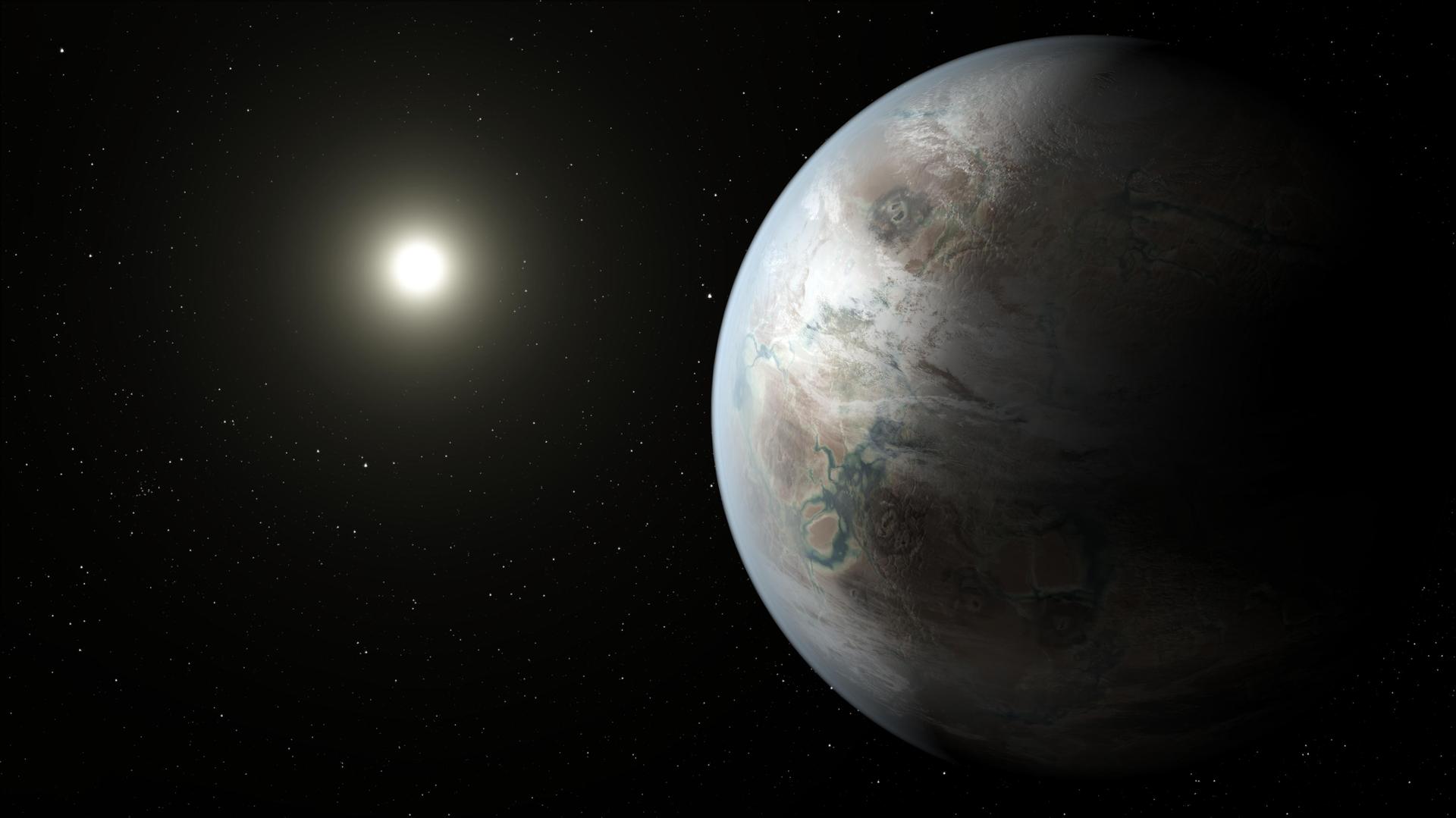
Kepler-442b is a habitable exoplanet 1,200 light-years away in the constellation Lyra. By one of the most rigorous mathematical measures of similarity to Earth, it is among the closest matches ever confirmed. Orbiting a calm, long-lived star in the habitable zone, it receives about 70 percent of the sunlight that warms our oceans. Its radius suggests it is likely rocky. Scientists assigned it an Earth Similarity Index score of 0.84, extraordinary given that Earth itself scores a perfect 1.0.
Despite this, the Kepler-442b habitable exoplanet remains largely obscure. This gap between its potential significance and its limited attention reveals how exoplanet science and its narratives develop.
Kepler-442b was found in 2015, catalogued in a landmark paper by Torres and colleagues in The Astrophysical Journal, and then quietly set aside as newer, closer, flashier worlds demanded attention. TRAPPIST-1 arrived. LHS 1140 b became the darling of atmospheric scientists. The JWST era transformed exoplanet science into something almost cinematic. And somewhere in that excitement, one of the genuinely best habitable-zone candidates ever identified slipped out of the conversation.
The planet has not gone anywhere. The physics have not changed. And the deeper you look at this system, the more it reveals what we are actually searching for when we scan the stars for company.

A Score That Demands Explanation
The Earth Similarity Index, or ESI, is an attempt to quantify how Earth-like a planet is across multiple parameters simultaneously. Radius, bulk density, surface temperature, and escape velocity are each compared to Earth’s values, normalized, and then combined via a geometric mean into a single number between 0 and 1. It does not measure whether life exists on a planet. It measures whether the basic physical conditions might be in the right ballpark.
Most confirmed exoplanets score well below 0.5. Planets sitting in the habitable zones of distant stars typically cluster between 0.6 and 0.7. An ESI above 0.8 is rare enough that the list of confirmed exoplanets achieving it is short enough to count on one hand.
Kepler-442b sits at 0.84, an exceptionally high value that places it among the most Earth-like planets ever confirmed.
To understand what drives that number, consider the planet’s vital statistics. Its radius is approximately 1.34 times Earth’s, comfortably below the critical 1.5 Earth-radius threshold that planetary scientists use as a rough dividing line between rocky worlds and sub-Neptune worlds drowning in hydrogen and helium. Below 1.5 Earth radii, the evidence strongly favors a solid surface, silicate rock, and perhaps an iron core. At 1.34, Kepler-442b sits firmly in that favorable zone.
Its orbital period is about 112 days. In that time, it completes a full lap around its host star while absorbing roughly 70 percent of the solar energy Earth receives. That is not a cold, dim existence; it is a comfortable energy budget. The planet sits well within the conservative habitable zone: not perched at the edge, not nudging the inner boundary, but comfortably mid-range.
The ESI score reflects all of this and packages it into that single, striking number. When the result was announced in 2015, there was a brief moment of genuine excitement. Then the world moved on.

The Star Nobody Talks About
One reason Kepler-442b deserves renewed attention has nothing to do with the planet itself. It has to do with its star, and with a growing scientific consensus about which type of star is actually best suited to nurturing life.
Kepler-442’s host is a K-type star, an orange dwarf. It is slightly smaller and cooler than our Sun but significantly more luminous and energetic than the M-type red dwarfs that dominate habitable-zone headlines. The host star is estimated to be around 2.9 billion years old (enough time for complex chemistry to potentially get started) while still having an enormous future ahead.
K-dwarf stars burn their hydrogen far more slowly than G-stars like our Sun. While the Sun will exhaust its main-sequence life in roughly 10 billion years total, a K-dwarf of Kepler-442’s type will likely remain stable for somewhere between 20 and 40 billion years. The universe itself is only about 13.8 billion years old. A biosphere that got started on Kepler-442b today would have a stable, nurturing star available to it for longer than the universe has currently existed.
K-dwarfs occupy a favorable middle ground. They are calmer than M-dwarfs during the critical early phases when planetary atmospheres are being established. They are more stable over billion-year timescales than G-stars. They are luminous enough that their habitable zones do not push planets into tidal locking. Astronomers have begun calling them the “Goldilocks” stellar class: not too hot, not too cold, not too violent, not too dim. The star at the center of the Kepler-442 system is exactly this kind of star.

What We Know, and What We Are Forced to Guess
We know the planet’s radius because Kepler watched it transit its star. That transit measurement is solid, well-confirmed, and tells us the planet is probably rocky. What we do not have is a direct mass measurement. Radial velocity confirmation was never achieved for Kepler-442b; at 1,200 light-years, the host star is simply too faint and too distant for current spectrographs to detect the minuscule velocity shifts that would reveal the planet’s gravitational tug.
Mass determines surface gravity. Surface gravity determines whether a planet can retain a substantial atmosphere against the slow evaporation driven by stellar radiation. Without knowing the planet’s mass, we cannot confidently assess whether it holds the kind of thick, protective atmosphere that life as we know it would require.
JWST has revolutionized our understanding of exoplanet atmospheres, but its capabilities are not unlimited. At 1,200 light-years, around a star cooler and dimmer than the Sun, Kepler-442 is simply too distant for JWST to extract a meaningful atmospheric spectrum. We will not learn whether Kepler-442b has oxygen, carbon dioxide, water vapor, or methane, not with any instrument currently in operation.

Why It Disappeared from the Headlines
Science journalism, like all journalism, is driven in part by narrative momentum. TRAPPIST-1 offered seven planets at once, orbiting a star a mere 40 light-years away. LHS 1140 b received JWST observations that hinted at a possible nitrogen-rich atmosphere. Both stories have next chapters.
Kepler-442b’s story has no obvious next chapter with current technology. It was found by the original Kepler mission, announced in 2015, and then eclipsed by K2 and later TESS, both of which prioritized finding habitable-zone planets around nearby, bright stars where follow-up characterization would be possible. Those mission objectives were scientifically sound. They just had the side effect of making Kepler-442b less practical for immediate study.
But “not a current priority” is not the same as “not important.”
The Planet That Asks a Larger Question
Step back from the specific numbers and consider what Kepler-442b represents as a category. It is a world roughly Earth-sized, orbiting a stable star of the type astronomers increasingly believe offers the best long-term conditions for complex life, sitting comfortably in the habitable zone, in a system that has had billions of years to develop whatever it will develop.
This is the fundamental tension in modern exoplanet science. Our detection methods favor large planets orbiting close to their stars. Our characterization methods favor planets orbiting nearby, bright stars. The actual best candidates for life may simply be too far away for the current era of astronomy to evaluate. Kepler-442b stands as a symbol of that gap: a very promising planet we may never truly know.
If K-dwarfs are indeed the optimal stellar class for complex life, and if planets like Kepler-442b are common around them, then the galaxy may be populated by a staggering number of worlds with similar promise. We found one at 1,200 light-years by looking at a tiny slice of sky. The rest of that sky remains unread.
Why the Kepler-442b Habitable Exoplanet Deserves a Second Look
Science progresses in unexpected directions. The telescope that will one day probe Kepler-442b’s atmosphere does not yet exist, but neither did JWST when Kepler-442b was discovered in 2015. NASA’s Habitable Worlds Observatory, currently in early planning stages, is explicitly designed to directly image Earth-sized planets around stars like Kepler-442’s host. It represents exactly the class of instrument that could eventually turn Kepler-442b from a transit statistic into a characterized world.
Kepler-442b is the kind of target that keeps those conversations alive. When scientists argue for the next generation of large space telescopes, when they push for direct-imaging missions, they do so in part because of planets like this one: worlds the data suggests are genuinely promising but remain frustratingly beyond reach.
There is something worth preserving in that frustration. Kepler-442b is a real world circling a real star, catching real starlight 1,200 light-years from here. It scored 0.84 on a scale built to describe a planet where life arose and eventually started scanning the cosmos for others like itself. That score is not a certainty. It is not even a promise. But in a universe that keeps its secrets behind walls of distance and time, it might be the closest thing we have to a destination worth reaching for.
What else is orbiting quietly around orange suns we have not yet catalogued, waiting for instruments we have not yet built? Kepler-442b does not answer that question. But at 0.84, in a system that will still be shining long after our own Sun has dimmed, it is a very good reason to keep asking.
Sources & Further Reading
- Torres, G., et al. (2015). “Validation of Twelve Small Kepler Transiting Planets in the Habitable Zone.” The Astrophysical Journal, 800(2), 99.
- Schulze-Makuch, D., et al. (2011). “A Two-Tiered Approach to Assessing the Habitability of Exoplanets.” Astrobiology, 11(10), 1041–1052.
- Cuntz, M., & Guinan, E. F. (2016). “About Exobiology: The Case for Dwarf K Stars.” The Astrophysical Journal, 827(1), 79.
- NASA Exoplanet Archive. Kepler-442 b (NASA Exoplanet Archive).
Explore more about the search for alien biosignatures and the habitable zone in our comprehensive guides.
Further reading: Kepler-442b on Wikipedia