
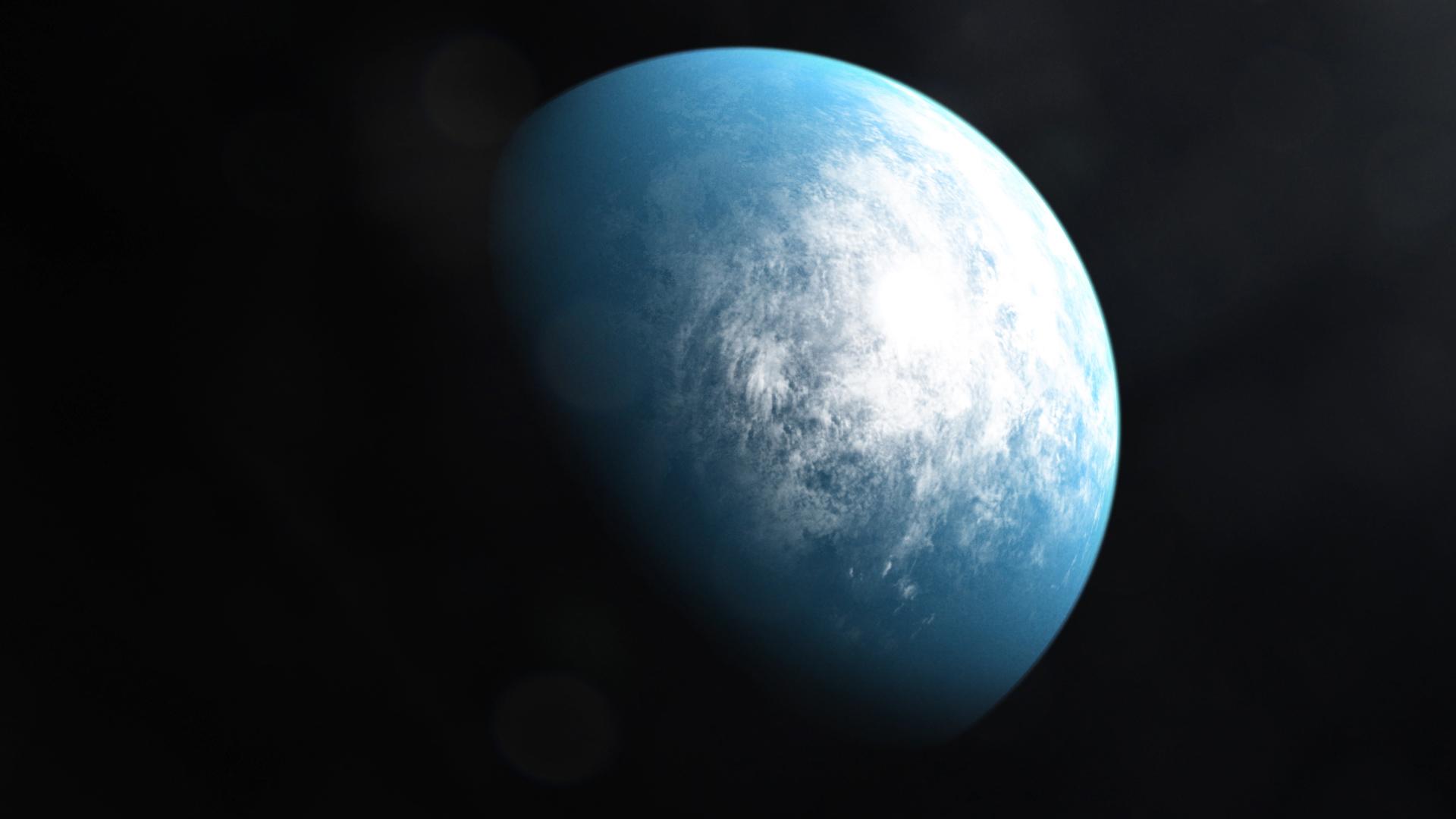

The TOI-700 e TESS discovery has revealed a remarkable planetary system. Imagine standing on a planet where the sun never moves. It hangs fixed on the horizon, or directly overhead, or just below the edge of the world, forever. Half your planet is scorched in perpetual noon; the other half is locked in unending night. At the terminator, the thin line between those two extremes, temperatures might be just right. While this dramatic scenario describes one possibility for tidally locked worlds, modern climate models suggest the reality could be more nuanced and potentially more welcoming. And now imagine that a few million miles away, another world orbits the same star under similar conditions: a sister planet, nearly your twin in size, sharing your sun’s habitable neighborhood.
This is not science fiction. This is TOI-700, a quiet red star 100 light-years away, where astronomers have confirmed something that has never been seen in quite this way: two Earth-sized planets orbiting simultaneously in the habitable zone of the same star. One sits in the “conservative” zone where liquid water is robustly predicted; the other occupies the “optimistic” zone, where habitability depends more critically on atmospheric conditions. Both are genuine candidates. Both are worth our attention.
A Star Worth Watching

TOI-700 sits in the southern constellation Dorado, roughly 100 light-years from Earth, close enough in cosmic terms to be a neighbor, far enough that its light takes a century to reach us. It is an M-dwarf star, one of the most common types of stars in the galaxy, burning cooler and dimmer than our Sun, with a reddish hue and a mass roughly 40 percent that of our own star.
M-dwarfs are the workhorses of the planet-hunting era. They are so prevalent (making up perhaps 70 percent of all stars in the Milky Way) that even if only a small fraction harbor habitable worlds, the number of potentially life-friendly planets in the galaxy would be staggering. But M-dwarfs come with complications. Many are volatile, prone to intense stellar flares that can strip atmospheres from nearby planets and bathe surfaces in ultraviolet and X-ray radiation. A planet that survives long enough to develop life around a flaring M-dwarf has run a gauntlet we can barely imagine.
This is where TOI-700 stands apart, even from other celebrated M-dwarf systems. Observations show it has low flare activity: a relatively calm star that is less likely to sandblast its planets with high-energy radiation. Compare this with TRAPPIST-1, the famous ultracool dwarf with three habitable-zone planets, which is considerably more active. TOI-700’s quietude gives its planets a fighting chance to hold onto their atmospheres, and potentially the conditions for liquid water, over geological timescales. In the planet-hunting game, a quiet host star is worth a great deal.
The First Discovery: TOI-700 d

NASA’s Transiting Exoplanet Survey Satellite (TESS) launched in 2018 on a mission to survey the nearest and brightest stars for orbiting planets. It works by staring at patches of sky and looking for the tiny dips in starlight that occur when a planet passes in front of its host star. In 2020, TESS delivered a landmark result from the TOI-700 system: the discovery of TOI-700 d, an Earth-sized planet orbiting in its star’s habitable zone.
TOI-700 d was a headline. At roughly 1.14 times Earth’s radius, it was one of the first Earth-sized planets discovered by TESS, sitting squarely in the “conservative” habitable zone, the range of orbital distances where liquid water would persist on a rocky planet’s surface across a broad range of atmospheric scenarios. Whether a planet has a thin atmosphere or a moderate one, conservative-zone worlds stay within plausible habitable temperatures. TOI-700 d orbits once every 37 days. For an M-dwarf, that’s a fairly tight orbit, but because the star is so cool and dim, that distance still puts the planet in the right temperature range.
The TOI-700 e TESS Discovery: A New Earth-Sized World
When astronomers analyzed an extended dataset from TESS observations of the TOI-700 system, they found something hiding in the data. In January 2023, Emily Gilbert and colleagues published the confirmation in The Astrophysical Journal Letters: a fourth planet in the TOI-700 system, designated TOI-700 e, orbiting between TOI-700 c and TOI-700 d.
TOI-700 e is, in some ways, more Earth-like than its famous sibling. Where TOI-700 d measures about 1.14 Earth radii, TOI-700 e comes in at approximately 0.95 Earth radii, slightly smaller than Earth, and one of the closest matches to our planet’s size among confirmed habitable-zone worlds. It orbits TOI-700 every 28 days, placing it just interior to TOI-700 d’s orbit.
The two planets occupy distinct but overlapping regions of habitability. TOI-700 d sits in the “conservative” habitable zone — the range where liquid water is expected to persist under nearly any reasonable atmospheric scenario. TOI-700 e occupies the “optimistic” zone: slightly closer to the star, where habitability is plausible but depends more critically on the planet having the right kind of atmosphere to moderate surface temperatures. TOI-700 d is the safer bet; TOI-700 e is the more intriguing gamble.
NASA scientists ran climate simulations across 20 different atmospheric scenarios for worlds in the TOI-700 system — ranging from a modern Earth-like atmosphere to a dense CO₂-dominated one similar to ancient Mars. In a significant fraction of those scenarios, both TOI-700 d and TOI-700 e could maintain surface temperatures compatible with liquid water. The question is not whether these worlds could be habitable — the models suggest they might be — but whether we can find out.
That answer may come from the James Webb Space Telescope. JWST is capable of detecting atmospheric signatures on nearby transiting exoplanets by analyzing how starlight filters through a planet’s atmosphere during transit. TOI-700’s low flare rate and predictable behavior makes it a better JWST target than more active M-dwarfs. If either planet has a substantial atmosphere, JWST observations accumulated over multiple transits could begin to reveal its composition. Carbon dioxide, water vapor, methane: any of these would be a landmark detection.
The Planetary Lineup: A Remarkable Architecture

Step back and look at the TOI-700 system as a whole; its architecture is striking. The innermost planet, TOI-700 b, orbits scorchingly close to the star, completing a lap every 9.98 days. It is rocky and hot, no plausible habitable environment there. The second planet, TOI-700 c, is a sub-Neptune, larger and likely gassy, orbiting every 16 days. Also, too hot, and it almost certainly lacks a solid surface in the way we’d recognize it.
The spacing is tight by solar system standards. From the surface of either planet, its neighbor would be a fixture of the sky: another world, visibly a world, a constant reminder that the universe had arranged two chances for life in the same small slice of space.

Every era of astronomy has its central obsession. For ours, it is this: are we alone? The TOI-700 system offers two simultaneous chances at an answer, not one planet to study but two, orbiting the same quiet star, in the same slim zone of possibility, close enough that we can contemplate pointing telescopes at them within our lifetimes.
Two Chances at an Answer
The TOI-700 system is not the most dramatic exoplanet story astronomy has produced. It lacks the sheer number of worlds packed into TRAPPIST-1, and its planets are too distant and too small to image directly with current technology. What it offers instead is rarer: a pair of Earth-sized planets, orbiting a quiet and well-behaved star, close enough to study in detail, positioned in the two habitable zones that planetary scientists actually argue about.
Most habitable-zone discoveries give us one candidate. TOI-700 gives us two simultaneously, with different atmospheric requirements for habitability — a natural controlled experiment written in orbital mechanics. If JWST detects an atmosphere on TOI-700 d and not on TOI-700 e, that tells us something about what the optimistic zone actually means. The system is, in this sense, built for science.
We are still in the early innings of exoplanet characterization. But 100 light-years is close. These planets are not abstractions — they are places, orbiting a star visible in the southern sky, completing their circuits around a red sun whether we watch or not. Somewhere out there, if conditions allowed, a world the size of Earth has been doing this for billions of years. We just found it.
Sources & Further Reading
- Gilbert, E. A., et al. (2023). “TOI-700 e: Discovery of the First Earth-Sized Planet in the Conservative Habitable Zone of a Nearby M Dwarf with TESS.” The Astrophysical Journal Letters, 944(1), L35.
- Gilbert, E. A., et al. (2020). “The First Habitable-Zone Earth-Sized Planet from TESS. I. Validation of the TOI-700 System.” The Astronomical Journal, 160(3), 116.
- Rodriguez, J. E., et al. (2020). “The First Habitable-Zone Earth-Sized Planet from TESS. II. Spitzer Confirms TOI-700 d.” The Astronomical Journal, 160(3), 117.
- NASA Exoplanet Exploration. TOI-700 d (Exoplanet Catalog). NASA Jet Propulsion Laboratory.
- NASA TESS Mission. Transiting Exoplanet Survey Satellite (TESS). MIT Kavli Institute.
Further reading: TOI-700 on Wikipedia